Loading...
New
See what manual alert triage really costs your security team.
New
See what manual alert triage really costs your security team.

See what manual alert triage really costs your security team.
See what manual alert triage really costs your security team.
Loading...
Automated incident response tools triage, investigate, contain, and document security incidents with limited human handoff. The strongest automated incident response platform in 2026 pairs AI incident response — reasoning agents that read novel alerts without a playbook — with deterministic execution, governed by a trust gradient (Read-only → Dry-run → Guided → Autopilot) the SOC promotes per action, not per platform.
TL;DR
New to the category? This page compares the tools and operating modes; for the definition, the closed loop, and what changed this year, start with the main guide to automated incident response.
There is exactly one question that decides whether an automated incident response program ships or dies inside an enterprise SOC: what happens the first time the automation is wrong, at 3am, on a compromised admin account? Every SOC leader searching this term in 2026 is really asking two things. First, what the phrase actually covers, when SOAR incident response, AI incident response, and SOC automation get used interchangeably. Second, how to turn on automation without surrendering the containment authority the SOC 2 auditor, general counsel, and CISO all insist stays human-owned.
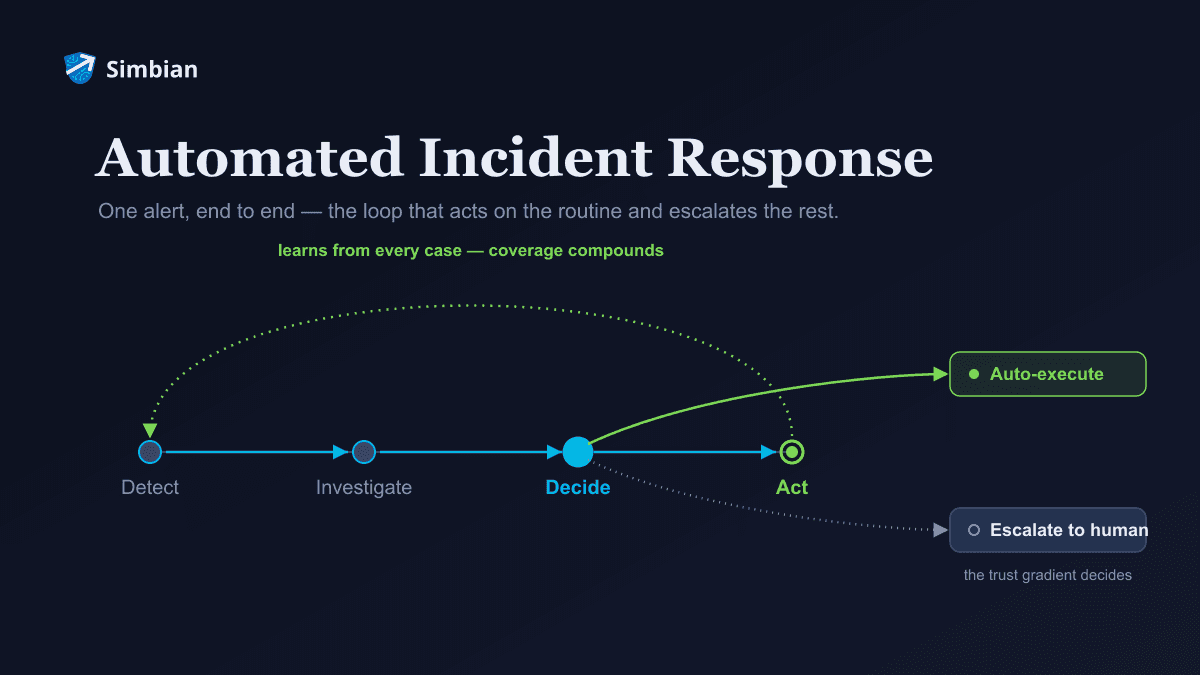
Incident response has five stages. Automated incident response is the practice of running as many of them as possible under software control, with humans steering the exceptions.
Incident response automation is not "one agent replaces the SOC." It is a set of stages, each of which the platform can own outright, propose to a human, or hand off. The design question is which stage runs at which autonomy level — and whether the platform lets a SOC change its mind as trust builds.
The 2026 market splits automated incident response into two architectures. They hit different ceilings.
A production-grade automated incident response platform blends both. Deterministic execution for the stable, high-confidence containment actions (revoking a token, isolating an endpoint, pushing a firewall rule) sits behind a reasoning layer that handles the alerts no playbook covers. Guardrails run on every action, not on a select few.
Reasoning up front, deterministic execution behind guardrails — that combination is what "governed automation, not blind automation" actually means in production.
Every SOC Manager we talk to raises the same objection: not "will the automation work?" but "what happens the first time it's wrong, at 3am, on a compromised admin account?"
That objection kills more incident response automation programs than any product limitation. The teams that shipped SOAR five years ago learned all-or-nothing automation is not politically survivable. The playbook that auto-disabled a rogue service account also once auto-disabled a payroll integration, and the CISO decided the failure mode was worse than the alert volume. Teams evaluating AI SOC vendors today are running the same math. They want automation and they want to keep containment authority.
The playbook that auto-disabled a service account once auto-disabled payroll — and the CISO decided the failure mode was worse than the alert volume.
A production-grade automated incident response platform answers the objection structurally, not rhetorically. It ships with named autonomy levels the SOC picks per action, per alert type, and per environment. It logs every proposed action, every executed action, and every override. And it lets the SOC dial autonomy up or down without ripping the deployment out.
Simbian ships automated incident response across the platform with four named operating modes. They are the trust gradient every SOC leader is trying to build in a spreadsheet — made explicit and enforced in the product.
The agent ingests alerts, runs enrichment, produces a full investigation narrative, proposes a verdict, and stops. No changes hit the environment. No tickets close. Read-only is where every deployment starts, and it's the honest answer to "how do I trust this?" The SOC watches the agent's reasoning against real alerts on real data for a defined window before any action fires. Read-only is also the durable mode for regulated environments where containment authority must stay human-owned for compliance reasons.
The agent proposes a specific action — revoke this token, isolate this host, block this IOC — and does not execute it. Every proposed action carries the underlying evidence, the risk assessment, and the guardrail check that would have gated it. Dry-run closes the trust gap on a specific action class. Watch the agent's proposals for two weeks across your phishing alerts. When the proposed containment matches what your L2 analyst would have done, promote that class to Guided.
The agent proposes actions and executes them only after an analyst approves in the queue. Approval is one click, and the case carries the full reasoning, so review takes seconds instead of the ten-minute investigation the analyst would have run from scratch. Guided is the working mode for the majority of enterprise SOCs during the first six months. It captures most of the speed benefit while keeping the human in the containment decision.
The agent executes pre-approved action classes autonomously, inside explicit guardrails, and writes the full audit trail on every case. Autopilot is not "the AI runs your SOC." It is "for this specific action, on this specific alert type, inside these specific guardrails, the agent has demonstrated enough accuracy against your data that you've decided to let it act." L3 analysts keep containment authority for anything outside the pre-approved envelope.
Progression from Read-only to Autopilot is not linear and not global. A mature deployment might run Autopilot on brute-force account containment, Guided on DLP violations, Dry-run on new EDR alert types, and Read-only on identity-provider actions that touch privileged accounts — all at once.
The benefits pitch for automated incident response has been oversold for a decade. The claims that survive scrutiny — the ones a CFO can defend to a board — pair every number with the mechanism that produces it.
MTTR falls to minutes because triage runs against every alert in parallel — not because the vendor put a chart in the deck.
The 2026 shortlist for automated incident response tools converges on four categories. The table below decides most buying questions.
Columns: SOAR (legacy playbook engines), Dropzone AI, Radiant Security, and Simbian AI SOC Agent. Cells verified against live vendor pages on 2026-07-01.
| Capability | Legacy SOAR (Splunk / Cortex / Torq / Swimlane) | Dropzone AI | Radiant Security | Simbian AI SOC Agent |
|---|---|---|---|---|
| Alert triage architecture | Playbook-driven, fixed | Autonomous agents, no playbooks | Reasoning triage, no playbooks | Reasoning with Context Lake™ |
| Handles novel alerts | No | Yes | Yes | Yes |
| Trust gradient | Manual per-playbook | Autonomous default + glass-box | 3 states: auto / escalation / manual | 4 modes: Read-only → Autopilot |
| Containment guardrails | Depends on engineer | Vendor-defined | Vendor-defined | Allowlist, verification, rollback, agent-vs-human separation |
| Cross-case memory | No | Environmental context only | Not documented | Context Lake™ across every investigation |
| Offensive validation on same platform | No | No | No | Yes (AI Pentest Agent, shared Context Lake) |
| Deployment | Weeks to months | Days | Days | Days SaaS / on-prem option |
| Playbook maintenance | High | Zero | Zero on covered alerts | Zero on covered classes |
Sources: radiantsecurity.ai and dropzone.ai live pages, checked 2026-07-01. Legacy SOAR row synthesizes Splunk SOAR, Cortex XSOAR, Torq, and Swimlane product documentation.
Radiant ships three states (full auto, escalation, manual). Dropzone defaults to autonomous execution with glass-box transparency. Neither ships an explicit, progressive trust gradient a SOC can promote specific alert classes through. That is fine for a phishing queue. It does not survive the CFO or the auditor when the SOC has to explain why an admin-account containment fired at 3am with no analyst in the loop.
Failed automation programs collapse in one of three ways: the team automates too much too fast, automates without a trust gradient, or automates the mechanical work while leaving the reasoning work on the analyst. A five-step sequence avoids all three.
Teams that get this right end up with a SOC running 24×7×365 at consistent depth, with humans focused on the eight percent of alerts that need judgment.
Simbian's AI SOC Agent is a reasoning-based automated incident response platform running on the same substrate as the AI Threat Hunt Agent, the AI Pentest Agent, and the AI NetSecOps Agent. All four share a Context Lake™ (persistent memory across investigations) and TrustedLLM™ (a deterministic reasoning layer that resists hallucination and prompt injection). The four operating modes above govern SOC triage, threat containment, firewall change assurance, and pentest execution alike.
The platform view shows how the four agents share findings: a vulnerability the Pentest Agent surfaces becomes severity-elevation context for the SOC Agent's next investigation, and a novel technique the Threat Hunt Agent flags becomes a new detection the SOC Agent can verify. Automated incident response inside the loop, not stapled to the outside.
For MSSP and MDR deployments, the same substrate runs multi-tenant with per-customer memory, per-tenant autonomy configuration, and 12× alert coverage against the same analyst headcount. In the broader SecOps market context, this is the architecture that replaces the SOAR maintenance tax without asking the SOC to trust an unproven black box.
On the shortlist stage of buying an automated incident response platform, the conversation should not be about features. It should be about three things.
Run the same test on the same data. Ask for a live pilot against a slice of your alert queue. Two weeks in Read-only is enough to see whether the reasoning holds up.
To see what Simbian's automated incident response platform looks like against your data, book a demo. The AI SOC Agent will triage a slice of your alert queue, show you the reasoning, propose the containment, and never touch your environment unless you promote the mode.
Q: What is automated incident response? Automated incident response uses software to triage, investigate, contain, and document security incidents with limited human handoff. In 2026 it spans SOAR incident response (deterministic playbooks for known alert shapes) and AI incident response (reasoning agents that handle novel alerts). Production-grade platforms combine both, behind guardrails on every action.
Q: What are the benefits of automated incident response? MTTR compression (under four minutes from detection to response, on average), alert coverage expansion (Bottomline went from ~30% to nearly 100%), 80% of investigation complete before the analyst opens the case, consistent quality across shifts, and lower cost per L3 alert. MTTR falls because the platform triages every alert in parallel — not because the vendor wrote a marketing chart.
Q: How do you automate incident response without giving up control? Adopt a trust gradient, not a switch. Simbian's AI SOC Agent ships four modes — Read-only, Dry-run, Guided, Autopilot — so the SOC promotes each alert class independently, with a one-click override on every proposed action. Containment authority stays with the human until an action class earns Autopilot on the SOC's terms.
Q: What is the difference between SOAR incident response and AI incident response? SOAR incident response runs pre-written playbooks against alerts that match a known shape and breaks on novel ones. AI incident response uses a reasoning agent that reads each alert, decides what to do, and acts inside guardrails without a playbook. The best AI platforms carry persistent memory across cases.
Q: How does Simbian compare to Radiant Security and Dropzone AI? All three sit in the AI incident response category. Radiant ships three operating states (full auto, escalation, manual). Dropzone defaults to autonomous investigation with glass-box transparency. Simbian ships a four-mode trust gradient, a persistent Context Lake™, and offensive validation via the AI Pentest Agent on the same substrate — with 25M+ alerts processed and 95% on the Cyber Defense Benchmark.
Q: What are the top automated incident response tools in 2026? The shortlist splits three ways. Legacy SOAR (Splunk SOAR, Cortex XSOAR, Torq, Swimlane) delivers deterministic playbook execution with a maintenance tax. AI-native platforms (Dropzone AI, Radiant Security, Prophet, Simbian) deliver reasoning triage without playbooks. XDR-embedded automation (CrowdStrike Charlotte, Cortex AgentiX) bundles automation with detection.
Q: How long does it take to deploy an automated incident response platform? SaaS deployments take days. On-prem takes days to weeks depending on identity and network integration scope. Simbian customers typically see ROI in the first week of a Read-only pilot. Time-to-value is a function of how fast the SOC promotes alert classes through the trust gradient — not how fast the platform installs.