Loading...

Loading...
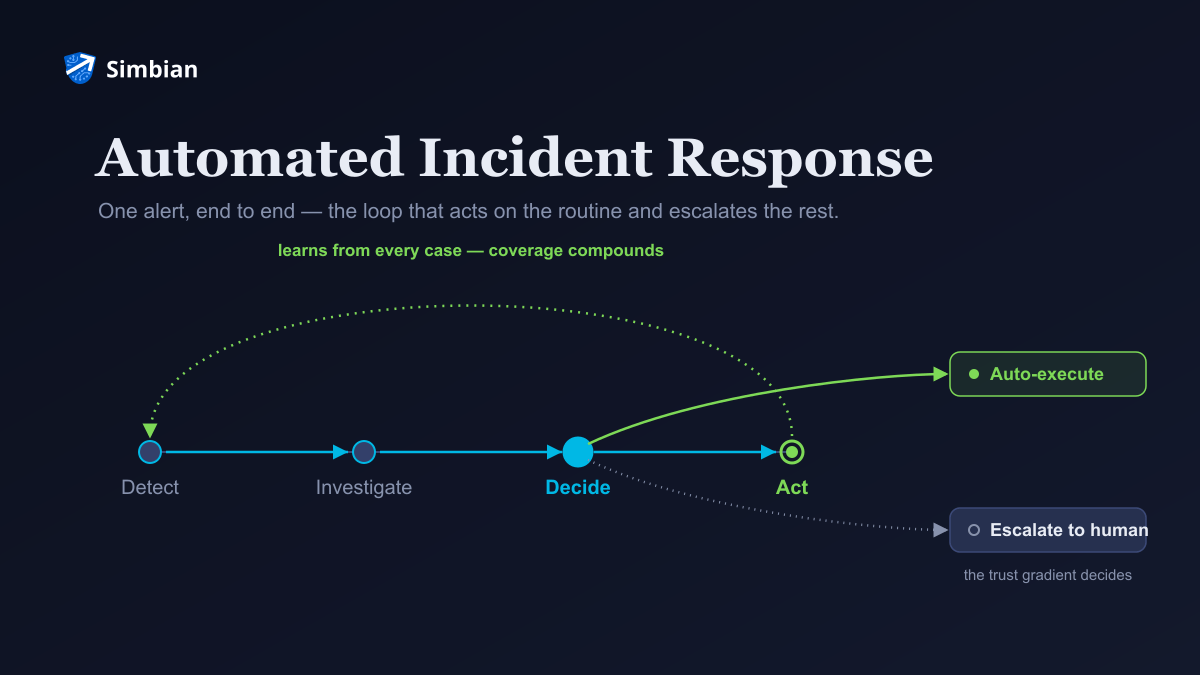
Automated incident response uses AI agents to detect, triage, investigate, and contain a security incident with limited human handoff. A reasoning agent works every alert end to end, resolves the routine ones inside guardrails, and escalates the rest with the investigation already built, which cuts mean time to respond from hours to minutes. In production deployments, autonomous agents resolve up to every alert without an analyst touching them.
For a decade, incident response automation meant one thing: a human wrote a flowchart, and software ran it faster. That model is being replaced. The version shipping now is an agent that reasons about an alert it has never seen, decides whether to act or escalate, and feeds what it learned back into the next investigation. The name stayed the same; the machine underneath did not.
Automated incident response is the use of AI agents and orchestration to detect, triage, investigate, contain, and learn from security incidents without a human at every step. The older term, incident response automation, described SOAR scripts calling APIs against alerts a human anticipated. The current model is a reasoning agent that runs investigations it has not seen before, chooses between auto-containing and paging a person, then writes the outcome back so the next case resolves faster.
The split in the work is the point. Mechanical steps — pulling logs, enriching indicators, mapping to MITRE ATT&CK, assembling an evidence chain, opening and closing tickets — run unsupervised. Judgment calls (containment authority, escalation, legal disclosure) stay with the team. The design question in 2026 is which stage runs at which level of autonomy, and who decides.
Automated incident response runs as a closed loop, not a one-shot transaction. Each stage feeds the next, and the last stage feeds the first:
The last step is the one the playbook era never delivered. Most SOAR deployments treat a case as a transaction that ends when the ticket closes, which is why coverage erodes the moment a rule goes stale or a log source goes quiet. Loop-based response is the core idea behind self-improving defense, and the reason coverage improves over time rather than drifting.
The difference between SOAR and AI-driven incident response is architectural, and it decides how far automation can go. SOAR runs playbooks a human wrote in advance. It handles the alert types you anticipated and stalls on the ones you did not. Every novel alert needs a new flowchart, every false positive needs a tune, and keeping the playbooks aligned with shifting vendor APIs becomes a standing engineering job. SOAR is real automation for your twenty most common incident types, plus a maintenance tax on everything else.
An AI incident response agent reads each alert dynamically and decides what to do, with or without a matching playbook. The serious implementations wrap the model in guardrails, deterministic execution for high-confidence actions, and persistent memory across cases. The weak ones drop a raw LLM in front of the alert queue and hope. A production-grade platform blends both: deterministic execution for the stable containment actions (revoke a token, isolate a host, push a firewall rule) behind a reasoning layer that handles the alerts no playbook covers, with guardrails checked on every action. For the deeper background, see what SOAR is and where it stalls.
Automate incident response when the action is well understood, reversible, and low blast radius, and keep a human in control for anything irreversible or cross-system. Teams running production deployments sort every action onto a four-band trust gradient — auto-execute, auto-execute with notify, approve-then-execute, and human-only. The harder question is less what the agent can do than what it should do without asking:
This gradient is the practical answer to "what happens the first time the automation is wrong, at 3 a.m., on a compromised admin account?" — the objection that kills more automation programs than any product limitation. Simbian ships the gradient as four named operating modes (Read-only, Dry-run, Guided, Autopilot) that a SOC promotes per alert class as trust builds. That progression deserves its own walkthrough: the four operating modes, explained.
A reasoning agent beats a playbook whenever context changes the meaning of an alert. A playbook matches patterns literally, so it floods the queue with expected-but-suspicious traffic; a reasoning agent applies one piece of business context and generalizes it across every future alert. Consider a pattern from a global mobile-device manufacturer with a China-based subsidiary. A playbook-driven tool drowned in China-bound network alerts — every connection matched a "suspicious destination" rule, so every connection generated a ticket, and the real signals were buried under thousands of expected ones.
A reasoning agent handled the same environment differently. Given one piece of context — this business is China-owned, so China-bound traffic and local keyboard software are normal here; look for other signals — it stopped flagging the expected traffic and kept investigating the anomalies that actually mattered. A playbook would have needed a new whitelist entry for every IP and every variant. The agent needed one sentence, generalized across every future alert that touched the pattern. That is the difference between automating the clicks and automating the reasoning.
Three shifts moved this from a "nice to have" to a budget line, and each corrects a claim the market got ahead of itself on:
The through-line under all three is a lesson the last year made hard to ignore: the model alone is not the differentiator. Wrap the same LLM in the right harness (shared memory, skills, a MITRE coordinate system) and defensive performance jumps. On Simbian's Cyber Defense Benchmark, the best frontier model on its own scored 46%; inside Simbian's harness, it reached 95%.
The 2026 shortlist for automated incident response tools falls into three groups. Legacy SOAR (Splunk SOAR, Cortex XSOAR, Torq, Swimlane) delivers deterministic playbook execution and carries the maintenance tax. AI-native platforms (Dropzone AI, Radiant Security, Prophet Security, Simbian) deliver reasoning-based triage without playbooks, and diverge on novelty handling, trust-gradient depth, and cross-case memory. XDR-embedded automation (CrowdStrike Charlotte, Cortex AgentiX) bundles response into the detection tool you already run.
Skip the feature grid. The evaluation that matters comes down to three demands: show me the reasoning on a real alert, show me the trust gradient I can promote per action class, and show me where the memory of past cases lives and how it changes the next verdict. For a full capability-by-capability comparison, the operating-modes guide runs the four leading approaches side by side, and the 15 use-case field guide shows where teams automate first.
Simbian's AI SOC Agent is a reasoning-based incident response platform on the same substrate as the AI Threat Hunt Agent, the AI Pentest Agent, and the AI NetSecOps Agent. All four share a Context Lake™ (persistent memory across every investigation) and TrustedLLM™, a reasoning layer hardened against hallucination and prompt injection. The numbers below come from production, and each has a mechanism behind it:
None of that is set-and-forget. Simbian is self-improving, not self-driving: the agent handles the mechanical work and gets better because the SOC keeps steering it, while L3 analysts keep containment authority and escalation calls. The platform view shows how a vulnerability the Pentest Agent finds becomes severity context for the SOC Agent's next investigation, so incident response runs inside the loop.
Q: What is automated incident response? Automated incident response uses AI agents and orchestration to detect, investigate, contain, and learn from security incidents at machine speed, with limited human handoff. A trust gradient decides which actions execute automatically and which escalate to a human.
Q: What is the difference between automated incident response and SOAR? SOAR executes playbooks a human authored in advance and breaks on alerts that do not match a known shape. AI-driven incident response uses a reasoning agent that investigates alerts it has never seen, reaches a verdict, and acts inside guardrails without a pre-written flowchart. Most SOAR playbooks still hand off to a human the moment an alert falls outside the rule set; a reasoning agent does not.
Q: Does automated incident response replace SOC analysts? No. It changes what analysts do. Tier-1 triage and playbook maintenance move to the agent, and analysts approve cross-system actions, tune the agent's skills, and handle the small share of incidents that escalate, with the timeline and evidence chain already assembled. The agent acts; humans steer.
Q: When should you not automate incident response? Anything irreversible or cross-system: public disclosure, regulatory notification, network-segment isolation across business units, anything legal touches. The four-band trust gradient — auto-execute, auto-execute with notify, approve-then-execute, human-only — is the practical way to sort each action.
Q: How much does automated incident response reduce MTTR? In production deployments, mean time to respond falls from hours to minutes — under four minutes from detection to response on average. Every alert is investigated in parallel instead of moving through a queue one at a time.
Q: Is automated incident response required by regulation? Not yet, but the direction is set. Under the EU AI Act, transparency obligations for AI systems apply from August 2026, and the heavier high-risk obligations were deferred to December 2027. Security operations is not blanket-classified as high-risk, but auditable reasoning traces are becoming an expectation regulators, auditors, and boards increasingly assume.
Q: What are the best automated incident response tools in 2026? The shortlist splits into legacy SOAR (Splunk SOAR, Cortex XSOAR, Torq, Swimlane), AI-native platforms (Dropzone AI, Radiant Security, Prophet, Simbian), and XDR-embedded automation (CrowdStrike Charlotte, Cortex AgentiX). Judge them on reasoning transparency, a promotable trust gradient, and persistent cross-case memory.
Incident response automation used to mean writing faster playbooks. The current model stops writing them and starts reasoning instead — acting on the routine incidents, escalating the rest with the evidence already assembled, and getting sharper with every case. To see a reasoning agent triage a slice of your own alert queue, show its reasoning, and propose containment without touching your environment until you promote the mode, book a demo.


