Loading...

Loading...
Self-Improving Defense is a class of security platform where offensive and defensive AI agents share one memory, score themselves against the same MITRE ATT&CK map, and close more gaps with every cycle. Coverage compounds instead of decays. In one real deployment, MITRE coverage moved from 33% to 83% in three cycles. Today, Simbian is the only platform built end-to-end around this loop.
Every category of AI for cybersecurity tooling shares the same hidden flaw: coverage decays. New techniques appear, old detection rules drift, analysts turn over, and the curve bends down. Self-Improving Defense inverts that. Defense compounds with every attack instead of falling further behind, because the offensive agents that find the gaps and the defensive agents that close them are wired into the same loop.
This is the bet behind Simbian's AI agents for security, and it is the AI SecOps platform category we are defining. The rest of this guide explains what self improving SecOps is, why it is the only durable answer to AI-speed attacks, how the loop works in practice, and what to demand from any vendor claiming to offer it.
Self-Improving Defense is autonomous security operations that get measurably better with use. A self-improving defense platform exhibits five properties, and anything missing any of them is not actually self-improving defense.
No playbook required for unseen alerts. Reasoning replaces rules. SOAR breaks without playbooks; a self-improving platform works without them and gets sharper alongside the ones you already have.
Every investigation generates learning signals. The agent self-corrects, a critique agent reviews, and once a pattern repeats it gets promoted to a skill that runs on every future investigation.
Customer A's agent is different from Customer B's, shaped by their data, their feedback, and their context. Not a generic model fine-tuned on someone else's logs.
Not just MTTR. The platform finds gaps, strengthens rules, and collects signals beyond what a SIEM provides — Slack messages, user outreach, tribal knowledge.
Offensive findings drive defensive coverage. Detection gaps drive new offensive tests. Shared knowledge flows from red to blue and back, every cycle.
Strip any one of those properties out and what is left is either a faster playbook (SOAR with an AI bolt-on) or a smarter copilot (an LLM that still needs a human in the loop to act). Neither compounds.
The core problem is not that security teams are bad at their jobs. The core problem is arithmetic.
A large enterprise SOC now sees roughly 14,000 incidents a day and runs on something like six analysts per shift. AI-powered attacks grew 89% year over year in 2026 and now compound at 72–89% annually, putting the SOC on a path to roughly 10× workload within four years. Attackers achieve lateral movement in about four minutes on the fastest incidents. The average breakout is 29 minutes. The average initial-access-to-exfiltration window is 48 minutes. You cannot close that gap by hiring.
The industry already tried two answers, and both stalled.
SIEMs scaled signal. They surfaced more events than any team could investigate. Roughly 40% of alerts at a typical enterprise are never looked at. The bottleneck moved from blindness to triage.
SOAR scaled action. Playbooks executed pre-defined responses, but every new threat needed a new playbook, every false positive needed a tweak, and the maintenance burden ate the savings. Industry estimates put SOAR's real-world automation rate around 25%. Copilots had the same problem in a friendlier interface: they accelerated the analyst but did not replace the analyst's decision. The bottleneck moved from action to reasoning.
AI that reasons about what is happening and what to do about it. Welcome to the Decisioning Era. It is the only wave where the math actually closes. Decisions are the bottleneck. Scaling decisions is what Self-Improving Defense does.
The loop is defined by four questions, and the questions sit on top of a shared MITRE ATT&CK heatmap so every agent's work lands on the same map. Each question is owned by a dedicated agent in Simbian's AI agents for security lineup.
| Agent | Question | What it does |
|---|---|---|
| AI Pentest Agent | What could happen? | Executes real techniques against your environment. Maps reachable attack paths. |
| AI Threat Hunt Agent | Did it already happen? | Searches historical logs for evidence of the same technique — the question nobody asks until after a breach. |
| AI SOC Agent | Did we detect it? | Verifies correct detection, correct verdict, no false-positive drowning. |
| Detection-engineering capability | Can we catch it next time? | Writes rules, validates them against the red team that found the gap, ships. |
MITRE ATT&CK is the coordinate system. Every technique has an ID. Every finding maps to an ID. One scoreboard, four perspectives, same map.
The scoreboard is a heatmap. Green tiles are techniques your SOC catches. Yellow tiles are techniques where an alert fires but triage is wrong. Red tiles are gaps. When a CISO asks whether the environment is covered against the supply-chain techniques behind a recent named breach, you do not guess. You point at the map. That is the conversation Self-Improving Defense is built to enable.
This is the part competitors copy worst. Running four agents is straightforward. Running four agents on a shared substrate, with one memory and one scoreboard, is not. The substrate has three layers.
Every Simbian agent inherits the same runtime, the same skills system, and the same integrations. When the AI NetSecOps Agent shipped, it took weeks rather than years because it reused the harness, and it answers the same four questions as every other agent. New surface, new agent, same loop.
One memory across every agent. A host that fires a SOC alert and then causes a firewall policy violation does not need a manual pipe between teams. NetSecOps sees the SOC alert because both agents read from the same Context Lake. Tribal knowledge, SOPs, analyst feedback, prior investigations, entity intelligence — all of it lives in one place and feeds every agent's reasoning. Generic AI gives generic answers. Context Lake-grounded reasoning gives answers shaped by your environment.
Every finding from every agent maps to the same scoreboard. Coverage is measurable, comparable across cycles, and durable across staff turnover.
Three layers, one circuit. Every other category in the market has picked a side of it.
Red-side vendors (Horizon3, Pentera, breach-and-attack-simulation tools) tell you what could happen. They do not tell you whether your SOC would catch someone exploiting it. The finding and the detection are two separate conversations, usually with two separate vendors.
Blue-side vendors (MDR services, SOC copilots, alert-triage tools) respond to what fires. They are responding to whatever detection rules were written last quarter, without knowing whether those rules cover the real attack paths.
The handoff between red and blue is where the gap lives. A vulnerability gets found, a ticket gets written, the backlog grows, and detection engineering looks at it in six weeks. In the meantime, you are exposed. Nobody runs both sides on the same substrate. Nobody measures the gap. That is the space Simbian is built for, and the structural reason no other vendor can deliver Self-Improving Defense today.
A claim that defense compounds has to be measurable. Here is what one cycle looks like in practice, drawn from real customer deployment data.
Pick a simplified five-stage kill chain: initial access through a compromised supply-chain package, credential access by harvesting keys from environment variables, lateral movement to an adjacent service, a C2 callback, and exfiltration. In Cycle 1, the SOC detects one of the five. The C2 callback fires an alert; the other four are invisible. AI Threat Hunt finds three of the five in historical logs. Detection engineering ships three new rules and tunes one. Coverage after Cycle 1: 33%.
In Cycle 2, the red team retests the original five plus three new variants. The SOC catches five of nine. Zero false positives. Four more rules ship. Coverage after Cycle 2: 56%.
In Cycle 3, the red team runs evasion variants designed to defeat the new rules. The rules hold. The SOC catches ten of twelve. Coverage after Cycle 3: 83%.
The map gets better every cycle. That is the loop working.
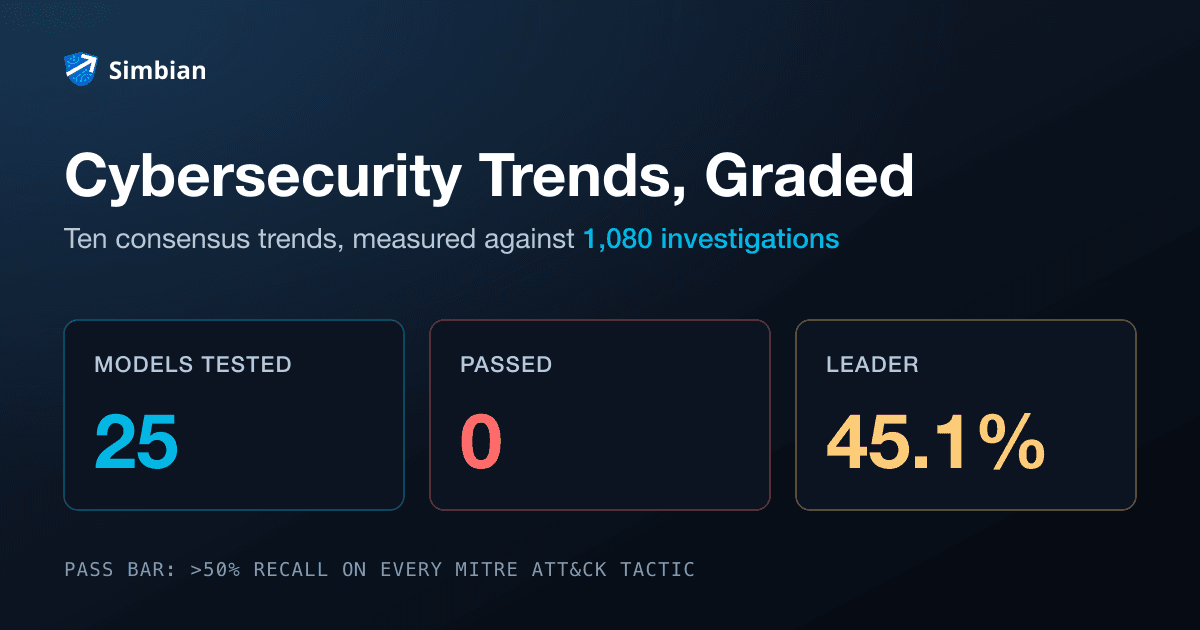
The second proof is third-party. In April 2026, an independent global MSSP partner ran the Cyber Defense Benchmark, a public benchmark measuring how well an AI system handles real SOC scenarios across 11 frontier LLMs. Pass threshold: 73%. Frontier LLMs alone averaged about 4%. The best frontier LLM alone scored 46%. The same LLMs wrapped in Simbian's harness — same model, same scenarios — scored 95%. +49 points from the substrate.
That is the harness-versus-model argument in one number. Frontier models are necessary; they are not sufficient. The substrate around them is what turns a 46% score into a 95% score, and the substrate is what makes the loop run.
If you are evaluating an "AI SOC" or "AI SecOps" vendor, the questions to ask have changed.
This is also why Self-Improving Defense is positioned as headcount-elevating, not headcount-replacing. The platform is self-improving, not self-driving. Agents do the mechanical work; humans stay human-in-control, keeping containment authority, escalation calls, and the strategic judgment that gives the agents direction. The SOC role evolves: tier-1 triage and playbook maintenance flow to agents, and analysts move up the stack to govern the fleet, build the skills, and review the corrections. The team that runs Self-Improving Defense in 2027 is not smaller than the one that ran the SOC in 2024. It is more senior, more leveraged, and pointed at the work that matters.
If your team is still asked to keep up with 14,000 incidents a day by hiring faster, the gap is not going to close. If your team is asked to build the loop — one substrate, one memory, one scoreboard — the curve starts to bend.
Q: What is Self-Improving Defense in one sentence? Self-Improving Defense is a class of autonomous SecOps platform where offensive and defensive AI agents share one substrate, score against the same MITRE ATT&CK map, and improve coverage with every cycle instead of decaying between point-in-time tests.
Q: How is Self-Improving Defense different from AI SOC, SOAR, or an AI copilot? SOAR scales pre-defined actions and breaks on novelty. Copilots accelerate analysts but still require a human in the loop to act. AI SOC point tools triage faster, but only on the defensive side. Self-Improving Defense spans offense and defense on one platform and measures itself against MITRE ATT&CK rather than against vendor-defined success criteria.
Q: Who is delivering Self-Improving Defense today? Simbian is the only platform built end-to-end around the loop. Other vendors run one side of it — pentesting, MDR, alert triage, detection engineering — but none of them share memory across agents and none of them score against a shared MITRE coordinate system. Running both sides on the same substrate is the defining architectural choice, and it is also the one competitors cannot retrofit.
Q: What is the Context Lake? Context Lake is Simbian's shared-memory layer. It captures tribal knowledge, SOPs, analyst feedback, entity intelligence, and prior investigations, and exposes them to every agent on the platform. It is the reason a SOC finding can shape a NetSecOps response without a manual handoff.
Q: How long does coverage take to compound? In production deployments, the first measurable jump usually shows up within the first cycle, and a 30+ point lift typically lands by the third cycle (the 33% to 83% arc cited above is from a real customer). Steady-state accuracy of 95% is reached during the operationalization phase, generally after a 60 to 90 day ramp.
Q: Does Self-Improving Defense replace my SOC team? No. The agents are self-improving, not self-driving. Containment authority and escalation calls stay with the team. What changes is what your analysts spend their hours on: tier-1 triage and playbook maintenance shift to the agents, and the team moves into governance, skill authoring, and oversight roles.
The market is converging on "AI SOC" as the label for the next era of security. That framing is too narrow. SOC is one department; SecOps is the loop. Detection is one wave; decisioning is the one that closes the math.
Self-Improving Defense is the category we are defining at Simbian, and the bet sits on the architecture. Anybody can ship an agent. Building four of them on a shared substrate, scoring them against the same map, and proving the coverage curve in production — that is the bar. If you want to see the loop run against your own environment, book a demo. If you would rather read the deeper CISO-level argument first, the CISO's 2026 SOC Game Plan walks through how to build the program around it.
Competitors can copy a side. Nobody can copy the circuit.