Loading...

Loading...
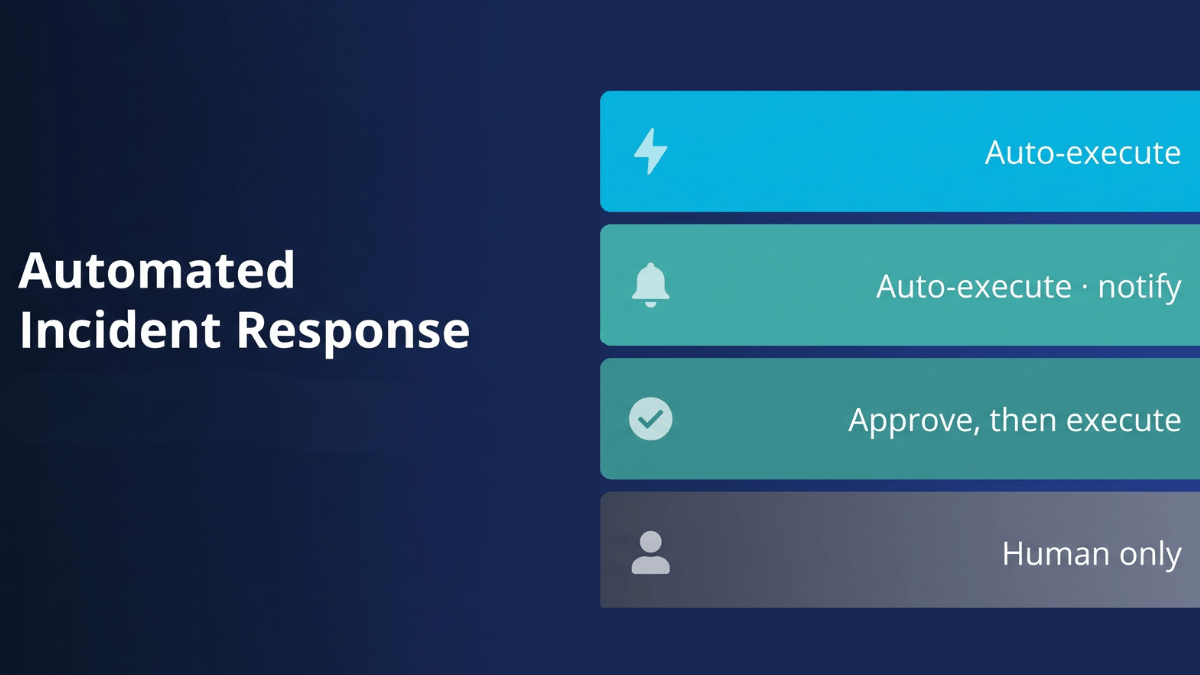
Security teams face a crushing wave of daily alerts. Even mature SOCs spend far too much time re-triaging known patterns instead of hunting advanced threats. The 15 automated incident response use cases below show where teams automate first — turning repeatable work into reliable, fast, and measurable workflows that cut MTTR, boost signal quality, strengthen compliance, and free analysts to focus on deep investigations. The goal isn't replacing people—it's amplifying them. New to the concept? Start with our guide to automated incident response, then use this page to see where it pays off.
The highest-impact automated incident response use cases span the full incident lifecycle — from threat-intel enrichment and multi-source evidence aggregation to containment, credential rotation, and post-incident hardening. Start with the repetitive, high-volume workflows (alert enrichment, investigation, false-positive triage): automating those first is where SOC teams cut MTTR and reclaim analyst hours fastest.
Automated Incident Response is the coordinated use of software (SOAR, SIEM, EDR/XDR, and AI SOC agent) to detect, triage, investigate, and act on security events with minimal human intervention as this grunt work becomes repetitive, leads to burnout and causes alert overload. Automated Incident Response with SOC AI technologies can silence the noisiest parts of SOC, autonomously. It connects three layers:
Inputs: telemetry from SIEM, EDR, NDR, cloud, identity, email security, DLP, and threat intel feeds.
Decisioning: rules, risk models, and machine learning that interpret context and set confidence.
Actions: orchestrated responses (isolation, block, revoke, rotate, quarantine, notify, ticket) plus feedback loops to learn from outcomes.
This isn't just "if-this-then-that." It's policy-aware, context-rich, and designed to evolve with your environment.
Scale: To investigate all alerts. SOC teams with limited staff no longer need to worry about the alerts they could not get to. Plus, when there are sudden spikes, you can ramp up your capacity equally fast.
Coverage: 24/7 responses that never burn out, with clear automation coverage targets by use case.
Quality: Enriched alerts and unified timelines raise fidelity and curb false positives.
Consistency: Every alert gets the same thorough, auditable steps—no more skipped checks at 3 a.m.
Speed: Slash MTTD/MTTR by automating the slowest hops—enrichment, evidence gathering, and routine containment.
Cost & Focus: Analysts shift from repetitive clicks to threat hunting, modeling, and architecture.
Normalize & Enrich: Parse alerts, attach asset criticality, user risk, and threat intel.
Decide: Score risk with business context (blast radius, data sensitivity, regulatory impact and organization specific processes).
Act: Trigger scoped actions with safeguards (change windows, approvals, tiered containment).
Learn: Capture outcomes, tune thresholds, and autonomously learn using real incident data.
The 15 use cases below are grouped into five tiers, from intelligence collection through learning and improvement. Most teams automate Tier 1 and Tier 2 first, then extend into orchestration and recovery once the metrics prove out.
Use Case 1: Dynamic Threat Intelligence Correlation: Automated Incident Response pipelines align IOCs with threat intel feeds, deduplicate, and score by recency and source reputation. Analysts see "campaign-level" context in seconds instead of tab-hopping for 20 minutes. This raises confidence, streamlines triage, and documents evidence for audit.
Use Case 2: Asset Context Mapping: When malware touches endpoint #0101, automation instantly maps business criticality, data access, ownership, and network relationships. Is it a dev VM or the CFO's laptop? Priority, SLA, and scope of action adjust automatically. This avoids over- or under-reacting and keeps business risk front and center.
Use Case 3: Historical Attack Pattern Recognition: AI agents compare current telemetry to historical incidents, surfacing recurring TTPs (e.g., initial access via OAuth grants). The system links past investigations and winning responses so analysts don't reinvent the wheel.
Use Case 4: Multi-Source Evidence Aggregation: Instead of querying SIEM, EDR, NDR, email, and cloud one by one, Automated Incident Response builds a unified timeline: process trees, DNS lookups, auth logs, and cloud API calls stitched into a narrative—result: fewer swivel-chair hours and faster, higher-quality decisions.
Use Case 5: Behavioral Anomaly Deep-Dive: Atypical behavior (off-hours admin logins, mass file access) triggers automated peer comparisons, baseline checks, and risk scoring. The agent returns a concise why-this-matters summary plus next-best actions for the analyst to approve.
Use Case 6: Lateral Movement Tracking: Automation maps likely pivot paths (identity, network, SaaS), highlights high-value targets, and recommends micro-segmentation or just-in-time access changes. Instead of reacting to damage, the SOC blocks potential spread.
Use Case 7: Intelligent Containment Decisions: Before isolating a host or disabling a service, the agent weighs blast radius, business impact, maintenance windows, and dependencies. Guardrails prevent production downtime due to a noisy false positive.
Use Case 8: Automated Evidence Preservation: Memory captures, disk images, PCAPs, and key logs are collected the moment severity crosses a threshold. Checksums and chain-of-custody metadata ensure legal defensibility and audit-ready trails.
Use Case 9: Communications Automation: Stakeholders (execs, IT ops, legal, privacy, customers when needed) receive templated updates based on incident stage and impact. Executive summaries and regulatory notifications are generated from the live investigation record, trimming delays and miscommunication.
Use Case 10: Surgical Threat Removal: Don't nuke from orbit. Automated Incident Response identifies the minimal effective action—remove a file, revoke a token, quarantine a message—so critical business services keep running while the threat is neutralized.
Use Case 11: Configuration Rollback Orchestration: If an attack exploits risky settings, the system proposes a rollback point, coordinates change approvals and executes across affected systems. Recovery happens in minutes, not hours, reducing downtime and toil.
Use Case 12: Credential Rotation Cascades: Compromised identities trigger intelligent rotation sequences for service accounts, API keys, and certificates. Dependencies update in order, avoiding the all-too-common authentication cascade failure.
Use Case 13: Attack Path Vulnerability Analysis: Post-incident, agents trace step-by-step attacker success and flag look-alike exposures across the estate. The output is a prioritized hardening plan mapped to MITRE ATT&CK.
Use Case 14: Response Effectiveness Measurement: Automation tracks lead time, accuracy, and business impact. Dashboards reveal bottlenecks (e.g., waiting for identity approvals) and recommend workflow tweaks backed by data.
Use Case 15: Playbook Evolution: Playbooks improve continuously as the system learns what works. Over time, Automated Incident Response becomes tailored to your environment's quirks, tools, and risk appetite.
With Automated Incident Response using AI SOC, Tier 1 analysts become investigation specialists while AI handles enrichment and timelines. Tier 2 analysts shift to threat hunting guided by patterns surfaced by agents. Senior staff focus on threat modeling, resilience, and defense architecture instead of endless triage. This partnership raises job satisfaction and security outcomes simultaneously.
The takeaway is clear: Automated Incident Response doesn't replace analysts—it elevates them. Start with enrichment and investigation acceleration, prove the value with hard metrics, then scale into orchestration and recovery with guardrails. The balance of human judgment and machine speed is where world-class SOCs win.
Q: What are the most common automated incident response use cases? The highest-volume starting points are alert enrichment (attaching threat intel, asset criticality, and user risk), multi-source evidence aggregation into a single timeline, and false-positive triage. These are repetitive and high-confidence, which is why SOC teams automate them first and see the fastest MTTR gains.
Q: Which incident response use cases should a SOC automate first? Start with Tier 1 (intelligence collection and enrichment) and Tier 2 (investigation acceleration). They carry the most repetitive analyst hours and the lowest blast radius, so automating them proves value quickly without risking production. Extend into containment, remediation, and recovery once the metrics hold.
Q: Does automating incident response reduce MTTR? Yes. Automating enrichment, evidence gathering, and routine containment removes the slowest manual hops, so mean time to detect and respond falls from hours toward minutes. The gain comes from investigating every alert in parallel with consistent depth, not from skipping steps.
Q: Do these automated incident response use cases replace analysts? No. They elevate analysts — Tier 1 staff become investigation specialists, Tier 2 shifts to threat hunting, and senior staff focus on threat modeling and defense architecture while the agent handles enrichment, timelines, and routine containment under human-defined guardrails.
Experience Intelligent Incident Response Today
Ready to shift from reactive to proactive? See how Simbian's AI Agents implement these 15 use cases—augmenting your team while preserving the human insight security depends on.