Loading...
New
See what manual alert triage really costs your security team.
New
See what manual alert triage really costs your security team.

See what manual alert triage really costs your security team.
See what manual alert triage really costs your security team.
Loading...
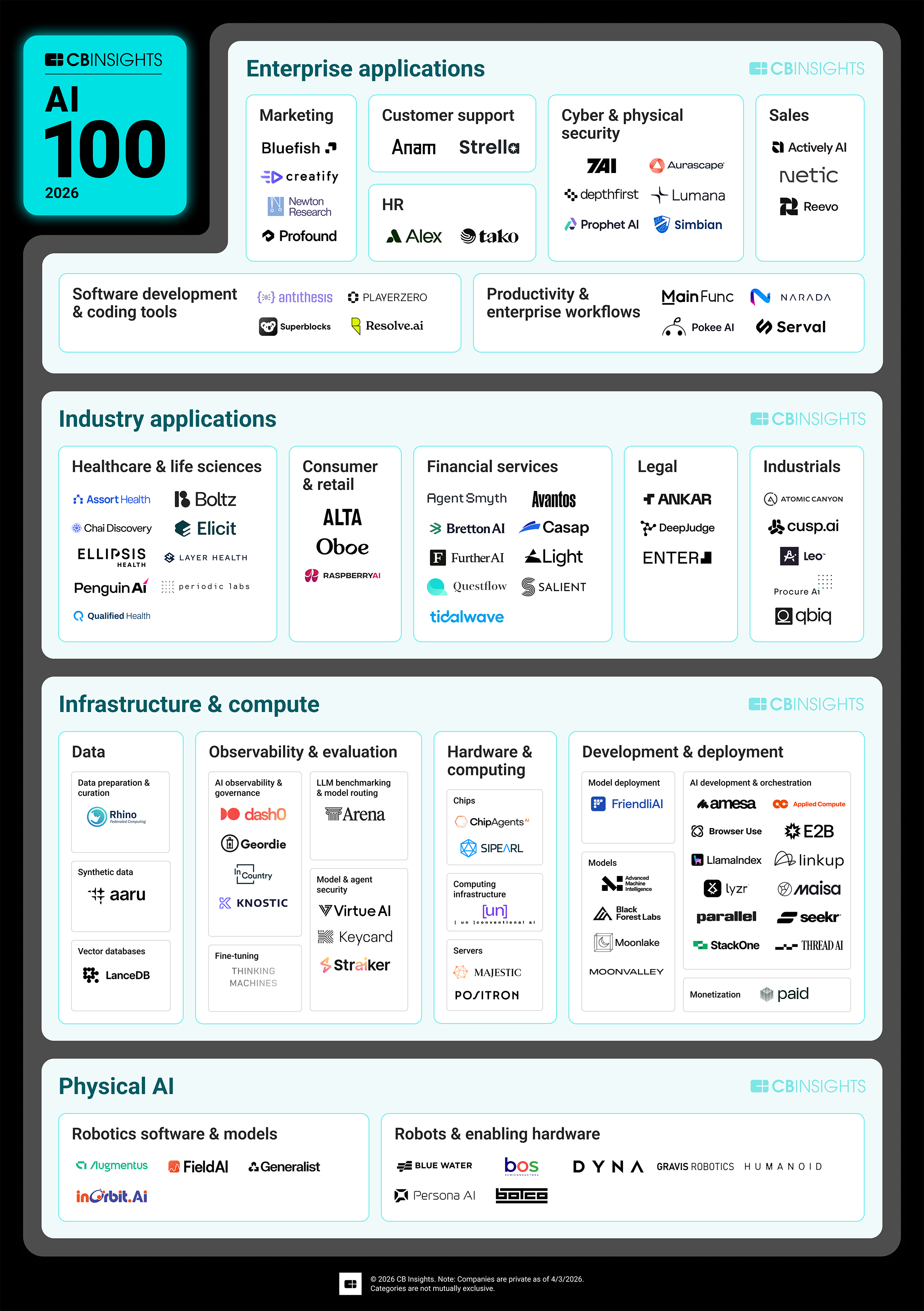
CB Insights named Simbian to its 2026 AI 100, the annual ranking of the 100 most promising private AI companies, now in its tenth year. The cohort was picked from more than 40,000 candidates spanning foundation models, robotics, healthcare, and enterprise software. It represents nine countries and $10.9 billion in equity funding. Six of the 100 are in cybersecurity. Simbian is one of them.
The AI 100 isn't a cybersecurity award. It's a cross-industry evaluation that weighs deal activity, industry partnerships, investor quality, hiring momentum, and commercial maturity, plus software-buyer interviews and analyst briefings. Companies earn a spot on production traction, not pitch potential.
That's what makes the security picks worth a second look. When a generalist AI program selects security companies alongside robotics, healthcare AI, and developer-infrastructure startups, it says something clear about where cybersecurity AI is heading: autonomous security operations isn't a niche experiment. It's a recognized AI category.
CB Insights AI Analyst Adya Pandey described what unifies the 2026 cohort: "The 2026 AI 100 identifies emerging, high-momentum startups worth watching in an increasingly crowded market. What unites them is proof of real traction outside a demo environment."
Proof of traction. Not proof of concept.
Simbian reached #1 in AI SOC ARR in 2025 and grew its customer base 15× in the same year. In production, every alert is triaged, investigated, and responded to autonomously. No playbooks. No human bottleneck. Deployed in days, with ROI in week one.
The results hold up under scrutiny. In production deployments, Simbian's AI SOC Agent investigates and responds to every alert, averaging under four minutes from detection to response, with 95% of those responses approved by the customer's own analysts.
Alert triage is only part of the story. Simbian is the only platform in security that unifies offensive and defensive AI agents for security on a single architecture. The AI SOC Agent handles investigation and response around the clock. The AI Threat Hunt Agent validates hypotheses proactively. The AI Pentest Agent finds vulnerabilities before attackers do. The GRC Agent automates security questionnaires and vendor risk. The NetSecOps Agent runs firewall operations and network policy autonomously. All five share one Context Lake™, the organization's living memory of tribal knowledge, SOPs, analyst feedback, and past investigations.
Every finding from one agent sharpens the others. Every investigation teaches the platform something new. Defenses don't just react to threats; they get stronger because of them. That's what self-improving defense means in production.
"Being one of six security companies on a generalist AI list of 100 tells you where the market is heading," said Ambuj Kumar, CEO of Simbian. "Autonomous SecOps isn't a niche experiment anymore. It's a recognized category. We built Simbian because the gap between AI-speed attacks and human-speed defense is structural, not incremental. You don't close a structural gap with a better playbook. You close it with AI that reasons, acts, and improves on its own."
The AI industry is shifting from copilots to agents, systems that reason and act on their own instead of waiting for a human prompt. In cybersecurity, that shift carries real urgency.
AI-powered attacks finish in seconds. They bypass static rules, cross tool boundaries, and outpace human triage. SOAR playbooks and human-in-the-loop workflows were built for a different threat model. The CISOs, SOC directors, and security architects adopting autonomous AI aren't chasing a trend. They're closing a structural gap between attack speed and defense speed that widens every quarter.
The CB Insights pick reflects that reality. The buyers driving demand for autonomous security operations aren't running pilots. They're running production.
A recognition list is a snapshot. The real measure is what the companies on it build next.
For Simbian, that means deepening cross-agent intelligence, expanding Context Lake's continuous learning, and bringing autonomous SecOps to more enterprises and managed security providers, backed by 80+ native integrations across every major SIEM, EDR, XDR, and cloud platform.
For security teams weighing where AI fits: the organizations moving now won't just detect threats faster. They'll operate differently, with AI agents that cover every alert, every shift, and every corner of the environment. And get smarter with each one.
See what autonomous SecOps and modern AI security operations look like in your environment — Book a Demo.