Loading...

Loading...
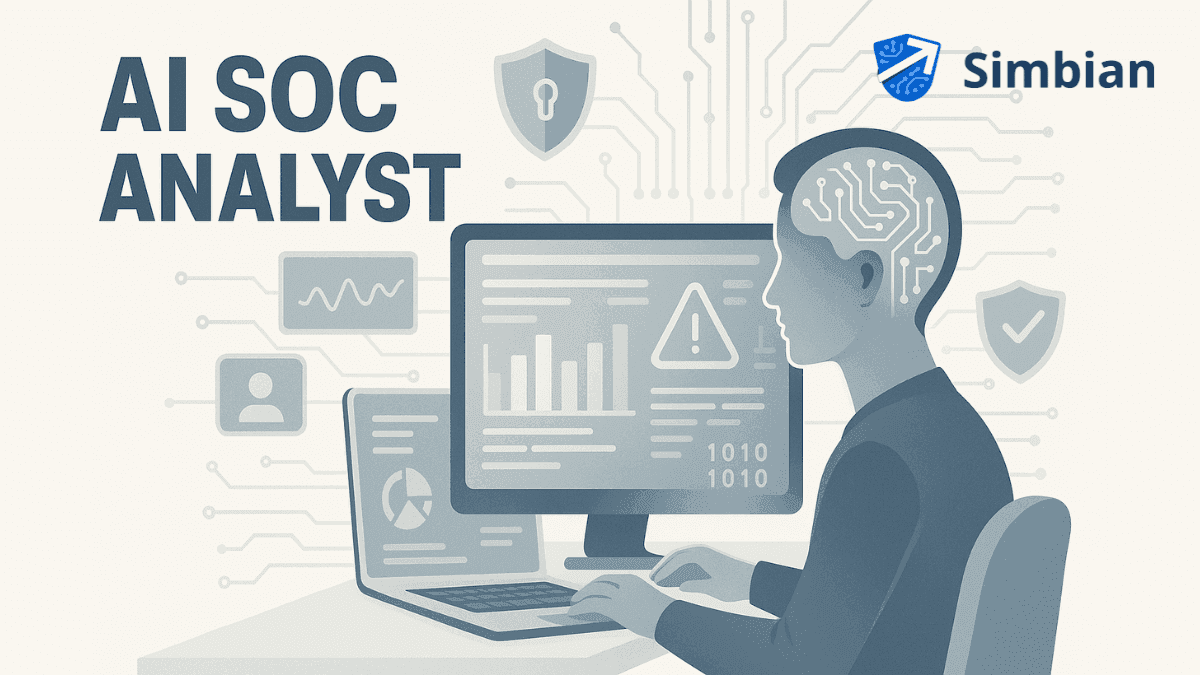
Security Operations Center (SOC) analysts field 500+ alerts a shift. Half are noise. One might be the first foothold of a ransomware attack. That gap between volume and signal is where an AI SOC Analyst earns its keep.
The AI SOC Analyst runs around the clock, triages the queue, cuts alert fatigue, and hands overloaded teams back the hours they used to spend on Tier-1 tickets.
An AI SOC Analyst is an autonomous system that replicates the investigative workflow of a human analyst using machine learning (ML), natural language processing (NLP), and large language models (LLMs). Traditional tools flag threats and stop there. An AI SOC Analyst reads context, correlates signal across SIEM, EDR, identity, and cloud telemetry, and makes triage calls the way a seasoned analyst would, at machine speed.
Core capabilities:
SOC teams waste 43% of their day chasing false positives. AI shrinks that number in three ways.
The point is not that AI is faster than a person on any single alert. The point is that the queue never stops growing, and human attention does. An AI SOC Analyst holds the line at 100% coverage, then hands the work that actually needs a brain to a human.
78% of SOC leaders say AI augments their people, not replaces them. That maps to what deployment teams see on the ground.
The distinction matters. Simbian's AI SOC Agent runs the loop; humans keep containment authority and escalation calls. Headstart, not replacement.
If you cannot measure it, you cannot defend the budget line item. The teams that get the most out of an AI SOC Analyst treat rollout as a quarterly review cycle, not a set-it-and-forget-it install.
Gartner projects that 75% of SOCs will run AI analysts by 2026. The Autonomous SOC is not a replacement play. It is a role evolution. Tier-1 grunt work becomes machine work, and human analysts move up into threat hunting, detection engineering, and adversary emulation.
AI SOC Analysts are already in production, cutting cost and burnout while sharpening response speed. For teams drowning in alerts, the question is not human or machine. It is what your team gets to focus on once the machine handles the queue.
Simbian's AI Agents are built on TrustedLLM™ and a Context Lake™ that unifies telemetry with planning modules, memory graphs, toolchains, and action policies. They do not just answer queries. They ingest signals, reason across context, decide in real time, and take response actions inside the runbook boundary you set.
That combination is why an AI SOC Analyst is different from a rules engine wearing an AI badge. Rules engines match patterns. Reasoning engines investigate.
Q: What is the difference between an AI SOC Analyst and a SOAR? A SOAR runs playbooks written by humans. An AI SOC Analyst reasons about each alert, chooses which steps apply, and improves against its own decisions. Industry rule of thumb puts SOAR automation at roughly 25% of the queue. An AI SOC Analyst covers the full queue.
Q: Will an AI SOC Analyst replace my Tier-1 team? No. It handles the volume; humans keep containment authority, tuning, and adversary work. Simbian's design principle is self-improving, not self-driving. Your team gets to stop being the bottleneck and become the multiplier.
Q: How fast can an Autonomous SOC be deployed? Simbian's AI SOC Agent integrates with existing SIEM, EDR, and identity stacks in weeks, not quarters..
Q: What does an AI SOC Analyst do that a copilot cannot? A copilot suggests. An AI SOC Analyst investigates, decides, and acts inside the guardrails you set, then shows its work. That is the line between assistance and autonomy.