Loading...
New
See what manual alert triage really costs your security team.
New
See what manual alert triage really costs your security team.

See what manual alert triage really costs your security team.
See what manual alert triage really costs your security team.
Loading...
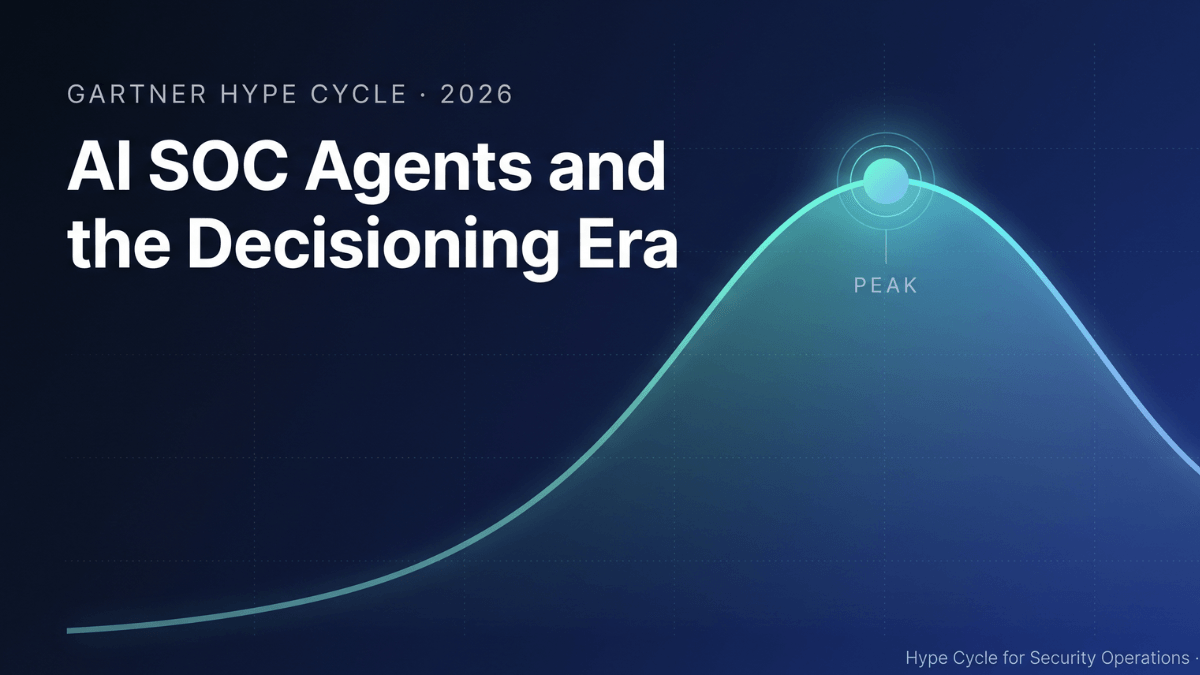
AI SOC Agents jumped from Innovation Trigger to the Peak of Inflated Expectations in Gartner's 2026 Hype Cycle for Security Operations — a full phase in twelve months. The same report warns four times about AI washing and tells buyers to demand independent benchmarks before paying a premium. Three structural shifts are pulling the whole industry toward decision-grade automation, and Simbian is one of ten vendors Gartner named in the profile.
If you're being asked to fund, evaluate, or kill an AI SOC project this year, the Gartner Hype Cycle for Security Operations, 2026, published 5 June 2026 by Darren Livingstone and Jonathan Nunez, is the analyst document you will be measured against. Two facts about the report deserve the most attention. AI SOC Agents climbed one full phase in a single year — the fastest move on the chart. And in the same document, Gartner repeats the phrase "AI washing" four times. The category is now real enough to attract serious budget and unproven enough to warrant a serious procurement bar. This post pulls the report apart with that tension in mind.
The analysts don't bury the lede. Gartner calls 2026 an "industry aggressively correcting course" with "massive structural corrections" across three core areas — each big enough to redraw a buyer's roadmap.
The connective tissue Gartner doesn't quite name: every one of these shifts is downstream of the same bottleneck.
SIEM scaled signals — the early 2010s. SOAR scaled actions — the late 2010s. Both ran into the same wall: the bottleneck moved downstream, to what to do with the signal once it fires. That is decision-making, and it is where every 2026 shift converges.
This is the Decisioning Era — and the math behind it is brutal. Industry breach-cost reporting puts mean initial-access-to-exfiltration at 48 minutes. The 2026 threat index puts adversary breakout at 29 minutes, with the fastest observed case at 27 seconds. The typical enterprise sees 14,000 incidents a day. The typical SOC has six analysts on shift. Hiring does not close that gap. AI SOC Agents — the category Gartner just promoted to the Peak — are the operating units built to.
In 2025, AI SOC Agents debuted in the Innovation Trigger phase. One year later, Gartner placed them at the Peak of Inflated Expectations. Eric Ahlm, the analyst on the profile, pins market penetration at 1% to 5% of the target audience and maturity at Embryonic. Both numbers are unchanged from last year. The climb reflects attention, not maturity.
Gartner's definition is worth reading verbatim. AI SOC agent solutions use AI to "augment investigation through natural language query, false-positive reduction, alert enrichment, attack path contextualization, reporting summarization and next-step advisory."
The Peak is a position with consequences. Product usage rises sharply. So does the gap between what marketing teams promise and what production deployments deliver. Gartner names that gap explicitly — repeating its warning about "GenAI washing," "AI washing," and "agent washing" four times across the report's analysis. Read another way: the analysts expect the category to slide into the Trough next year unless buyers force a measurable bar before signing contracts.
The clearest way to read the 2026 cycle is alongside 2025. Three of the categories most relevant to a SOC leader's roadmap moved in different directions.
| Category | 2025 phase | 2026 phase | Movement |
|---|---|---|---|
| AI SOC Agents | Innovation Trigger | Peak of Inflated Expectations | ▲ Up one full phase |
| Cybersecurity AI Assistants | Innovation Trigger / Peak | Sliding into the Trough | ▼ Cooling, 20–50% penetration |
| Penetration Testing as a Service (PTaaS) | Peak | Sliding into the Trough | ▼ Maturing through disillusionment |
| Integrated SOC Systems | Innovation Trigger | At the Peak (mainstream-track) | ▲ Up; replacement narrative against SIEM |
| Unified Cyber Risk Intelligence | New | New profile, On the Rise | New entrant |
The split between AI SOC Agents and AI Assistants is the single most important read. Gartner is now formally distinguishing the two — agents that act autonomously across the investigation lifecycle versus assistants that accelerate an analyst's keystrokes. Most of what gets sold as "agentic" in 2026 vendor decks is, by Gartner's definition, an assistant.
| Dimension | Cybersecurity AI Assistant | AI SOC Agent |
|---|---|---|
| Hype Cycle phase (2026) | Sliding into the Trough | At the Peak of Inflated Expectations |
| Market penetration | 20% to 50% | 1% to 5% |
| Maturity | Adolescent | Embryonic |
| Mode of operation | Augments human keystrokes; requires analyst-in-the-loop per task | Acts autonomously across triage, investigation, and response |
| Where it lives | Companion feature embedded in an existing product | Vendor-agnostic; reasons across the existing stack |
| What it produces | Summaries, suggestions, drafts the analyst confirms | Verdicts, evidence packages, escalations |
| Failure mode if mis-sold | Marketed as "agentic"; still requires the human bottleneck | Marketed as "autonomous"; brittle without a real harness |
The takeaway most vendor pitch decks won't put on a slide: if a "SOC agent" only works when a human is at the keyboard, Gartner now has a different name for it. Use the table in evaluation.
Decisioning Era is not a marketing frame; it is an architectural claim. The platform that wins the era runs the full loop of decisions, not just the alert-triage segment.
A self-improving SOC asks four questions in order, on the same MITRE ATT&CK coordinate system:
A worked example makes the loop concrete. Take a five-stage kill chain: initial access through a compromised supply chain package, credential harvesting from environment variables, lateral movement to an adjacent service, a C2 callback, then exfiltration. Most SOCs detect one of those five stages — the C2 callback fires an alert; the other four are invisible. A self-improving loop tests each stage in pentest, looks for it in threat-hunt logs, verifies SOC detection, and ships a new rule per gap. The same five stages, three cycles later, are five out of five. That is the architectural answer to Gartner's observation that "no technology on the Hype Cycle can independently close remediation chokepoints." A loop can.
The proof that a real loop is running — and not an alert-triage agent dressed up — is whether coverage compounds across cycles. From a real customer deployment, on the same MITRE map:
That curve is the working definition of "self-improving, not self-driving." Humans keep containment authority and the escalation calls. The agent does the mechanical work. The map gets better every cycle. A single headline response-time number, in contrast, is a snapshot from a tuned production deployment — not a day-one number, and not a measure of whether the loop closes.
Gartner's user recommendations boil down to three sentences: baseline your operations, pilot rigorously, demand transparency. The five questions below operationalize that advice. Each pairs with the anti-pattern it exposes.
The point is not to disqualify every vendor on every question. The point is to make those questions the bar a contract crosses — which is what the report itself tells buyers to do.
Gartner names ten Sample Vendors in the AI SOC Agents profile, alphabetical. Simbian is one of them. Sample Vendor inclusion is not an endorsement — Gartner is explicit that its research publications do not advise selecting only the vendors with the highest ratings, and Gartner does not endorse any vendor depicted in its research.
The diligence question is which of the ten can answer the five questions above with measurable, reproducible evidence — and which build a loop that runs both sides of the fence. Most named vendors are blue-side only: alert triage, investigation, response. Simbian is built around the offense-to-defense loop on a single Context Lake™. The AI Pentest Agent executes techniques. The AI SOC Agent and AI Threat Hunt Agent verify whether the defense catches them. Detection rules close the loop. Coverage compounds across cycles because every agent reads from and writes to the same memory.
That architecture is the reason the Self-Improving Defense explainer names the loop, not the agents, as the moat. Competitors can copy a side. The circuit takes longer.
Three concrete next steps for SOC and security leaders:
If you want the side-by-side that the five questions are designed for, the AI SOC Buyer's Scorecard lays out the criteria — autonomy depth, audit trail, integration breadth, measurable coverage compounding, and the offense-to-defense loop — that separate the agents likely to survive the slide into the Trough from the ones that won't.
Q: What is the Gartner Hype Cycle for Security Operations 2026? It is Gartner's annual analyst report mapping the maturity and adoption trajectory of security operations technologies and services, published 5 June 2026 by analysts Darren Livingstone and Jonathan Nunez. The 2026 edition names three structural shifts: TDIR architectures being challenged, vulnerability management evolving into CTEM, and threat intelligence undergoing a transformation. The full document is available at gartner.com/en/documents/7962373.
Q: Where do AI SOC Agents sit on the 2026 Hype Cycle? AI SOC Agents sit at the Peak of Inflated Expectations in the 2026 Hype Cycle for Security Operations, up one full phase from Innovation Trigger where the category debuted in 2025. Market penetration is 1% to 5% of the target audience, maturity is Embryonic, and Gartner projects 2 to 5 years to mainstream adoption with a Moderate benefit rating.
Q: Who are the AI SOC Agents Sample Vendors named by Gartner in 2026? Gartner names ten Sample Vendors in the AI SOC Agents profile, alphabetical: 7AI, Arcanna.ai, Conifers.ai, Crogl, Dropzone AI, Exaforce, Intezer, Qevlar AI, Prophet Security, and Simbian. Sample Vendor inclusion is not an endorsement — Gartner does not recommend selecting only the vendors with the highest ratings.
Q: What does Gartner mean by AI washing and how do buyers avoid it? Gartner uses "AI washing," "GenAI washing," and "agent washing" to describe vendor claims that attach AI labels to features without true agent capability. The 2026 Hype Cycle repeats this warning four times. The recommended defense is to rigorously pilot emerging capabilities, baseline current operations before evaluating tools, demand transparency into how the system works, and verify claims against measurable benchmarks rather than vendor-published numbers.
Q: What is the difference between an AI SOC Agent and an AI SOC copilot or assistant? Gartner now separates AI SOC Agents from Cybersecurity AI Assistants as distinct innovation profiles. Agents operate autonomously across investigation, triage, and response. Assistants accelerate human analyst work but require an analyst in the loop for each task. In the 2026 cycle, AI Assistants are sliding into the Trough of Disillusionment with 20% to 50% market penetration; AI SOC Agents are at the Peak of Inflated Expectations with 1% to 5%.
Q: Will AI SOC Agents replace SOC analysts? No. The category Gartner profiles is built around augmentation, not replacement — self-improving, not self-driving. Agents handle the mechanical work (alert investigation, false-positive reduction, evidence enrichment, response recommendation) while analysts keep containment authority, escalation calls, and strategic decisions. The role shifts up the stack, not out the door.
Q: How should you evaluate AI SOC agent vendors against the 2026 Hype Cycle profile? Start with the five questions in this post: independent benchmarks, multi-cycle coverage compounding, reproducible audit trails, environment-fit without engineering tickets, and whether the agent runs the full loop or one segment. Pilot rigorously, baseline against your current operations, and demand transparency — the same advice Gartner's user recommendations carry verbatim.


