Loading...

Loading...
Automated security remediation is the software-driven execution of the corrective action that closes a security gap: isolating a host, revoking credentials, patching a vulnerability, blocking an IP, quarantining a file, or rolling back a risky change. It runs on a detection signal, with or without human approval. It is the action itself, not the workflow around it, and not the same thing as incident response or SOAR.
Ask a SOC manager why they still approve every containment action by hand, and you will usually hear about the one time a playbook didn't ask. A rule fired on a false positive, quarantined a domain controller, and knocked out authentication for half the building before anyone reached the stop button. That memory is the real reason automated security remediation still makes experienced teams flinch. The tooling did what it was configured to do. The judgment behind the trigger is what was missing.
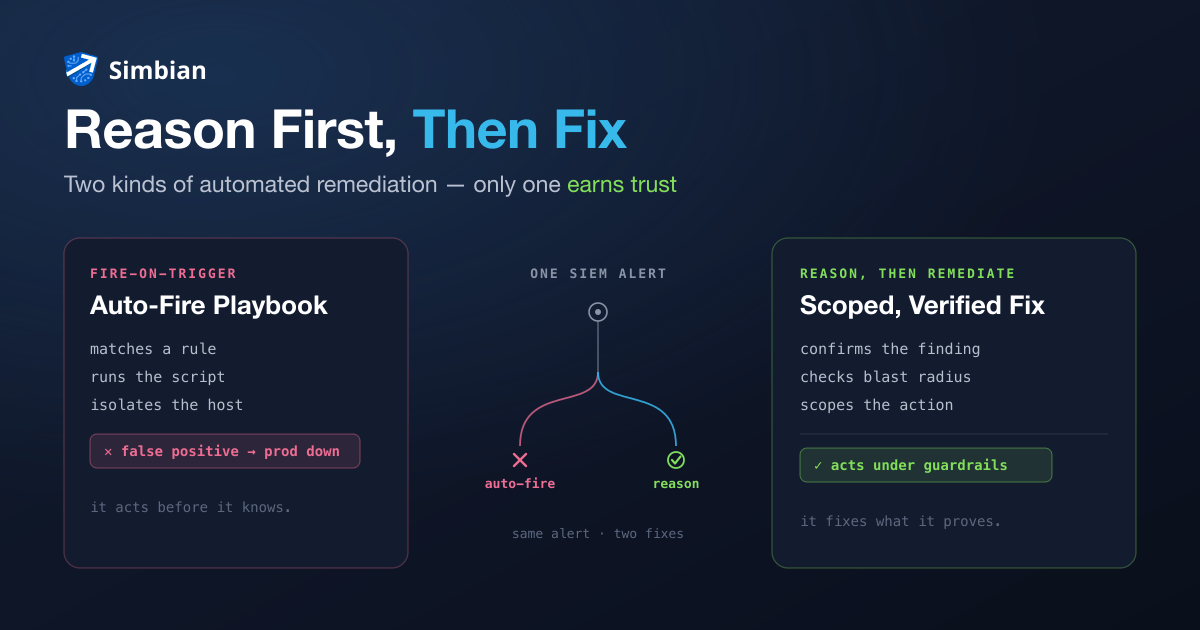
The flinch is earned, but it lands on the wrong target. The label "automated remediation" now hides two very different things, and only one of them has earned the distrust.
Automated security remediation is the corrective action a system takes to close a security gap without a human running each step by hand. That action is concrete: isolate a compromised host, revoke a stolen session, block a malicious IP, quarantine a phishing email, patch a vulnerable package, or roll back a bad configuration change. Something detects a problem, and something else does the fixing.
The confusion starts with the word automated. For one camp it describes a pre-wired action that fires the instant a signal crosses a threshold. For another it describes an agent that investigates the case first, decides what the right fix actually is, and then acts. Same phrase, very different amount of judgment in the room. Most of the distrust in the category traces back to people who were sold the first thing and assumed it behaved like the second.
No. SOAR (security orchestration, automation, and response) is the wiring that connects your tools and runs a sequence of steps. Remediation is the one step at the end that actually changes the state of a system. You can automate remediation without SOAR, and you can run a SOAR playbook that enriches, correlates, and closes a ticket without ever firing a remediation action at all.
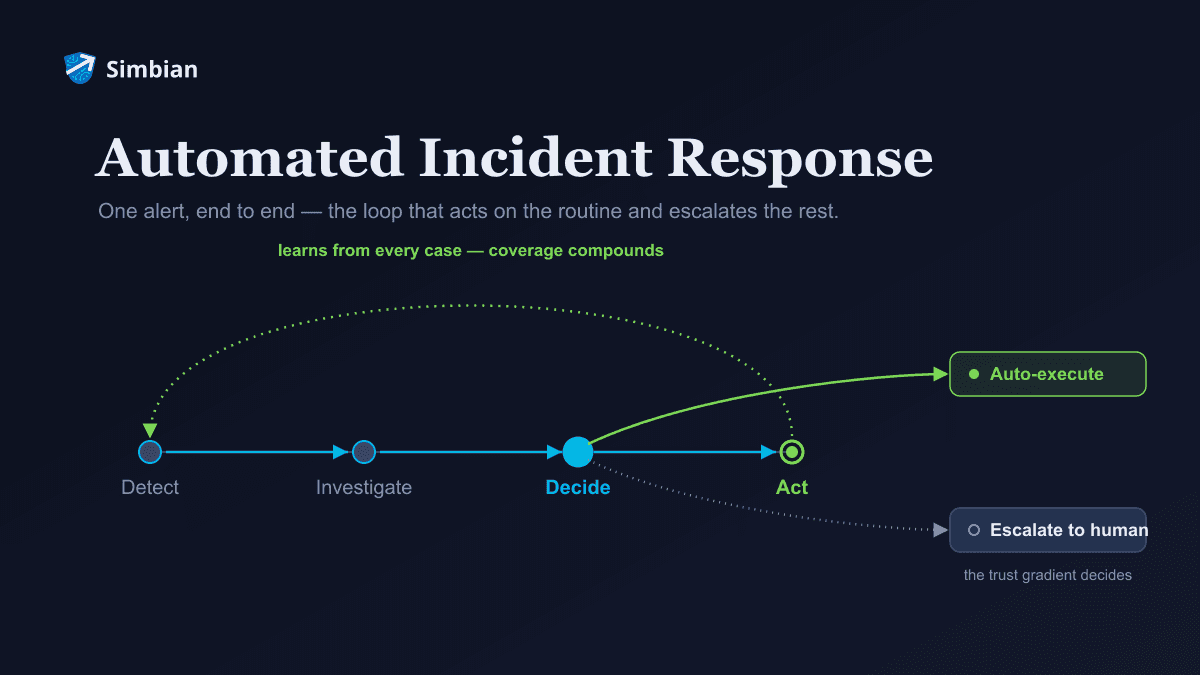
It helps to separate three words that get used interchangeably and shouldn't be. Mitigation reduces the impact of a problem you haven't fixed yet, such as rate-limiting traffic while an attack is underway. Remediation removes the problem itself. And automated incident response is the whole process wrapped around both, from the first alert to the closed case. Remediation is one move inside that process, not the process. Keeping the three straight is the difference between a program you can reason about and a pile of overlapping playbooks nobody fully trusts.
SOC teams distrust automated remediation for one specific reason: the failures they remember weren't caused by bad tooling. They were caused by a fixed action firing on a signal that turned out to be wrong.
A traditional playbook carries no case-specific judgment: it matches a condition and executes. When that condition is a brittle detection, a mislabeled asset, or a benign event that looks malicious out of context, the playbook does exactly what it was told, and the blast radius of a wrong containment action on a production system is enormous, landing in seconds. So teams do the rational thing. They turn the automation down to recommend-only, keep a human on every trigger, and accept that most of their remediation stays manual.
The missing piece was never courage. It was a defensible rule for when each action is safe to fire, plus evidence that the system reached the right verdict before it acted. Without those two things, full automation is a gamble. With them, it stops being one.
Automated remediation becomes trustworthy when the system reasons through each case before it acts, instead of firing a pre-written action the moment a signal trips. That is the real line between the two, and it is where reasoning-based AI remediation changes the math.
Simbian's AI SOC Agent works a case the way a strong L2 analyst would. It pulls the alert, queries the tools that hold relevant context, follows what it finds, and reaches a verdict with a written rationale before it proposes an action. Its context is general rather than a per-IP whitelist: a single instruction like "this subsidiary is China-owned, so traffic to China is expected here, look for other signals" reshapes how it investigates every related alert, instead of forcing you to enumerate each address by hand. A static rule engine picks one direction and commits. A reasoning agent keeps digging when a novel signal doesn't fit the benign pattern.
That difference shows up in the artifact the analyst actually reads. Every investigation ends in a case report laying out what was checked, what the enrichment returned, the verdict, and, importantly, what stayed unresolved. In one production run, a shallow pass would have called an alert a true positive on domain reputation alone. The deeper investigation recognized that the flagged IP was an internal DNS resolver fanning out queries for many downstream clients, refused the false-confident verdict, and pushed attribution back to the real source. A system that tells you when it isn't sure is a system you can eventually trust to act. In production deployments, Simbian's AI SOC Agent autonomously triages, investigates, and responds to every alert in under four minutes from detection on average, and analysts approve 95% of the responses it proposes. Whether it also executes the fix is a separate, tunable call, which the next sections cover. What earns trust either way is that every verdict shows its work.
No. Cloud auto-remediation fixes a misconfiguration to restore posture; SOC remediation resolves an active incident. They solve different problems, and treating them as one is why buyers end up comparing tools that don't really compete.
Cloud security posture management (CSPM) tools from vendors like Wiz and Orca watch your cloud accounts for drift: a public S3 bucket, an over-permissive security group, an unencrypted volume. When one appears, an automation rule can close it in seconds, often by adjusting the setting directly or opening a Terraform pull request. That is genuinely useful, and for well-scoped, low-risk misconfigurations it is a fine fit for full automation. But it fixes a state, not an event. No attacker is in the loop, there is no verdict to reach, and intent never has to be judged.
SOC incident remediation starts from an alert that might be a breach. The job is to decide whether something bad is actually happening, to whom, and how far it has spread, then act. Vulnerability remediation sits in between: patching the flaw an attacker could use, usually on the timeline the business can tolerate rather than the instant it is found. Automated vulnerability remediation is its own discipline, driven by CVE severity and patch windows, and scanners like SentinelOne and Tenable live there. When you evaluate automated remediation, know which of the three you are buying. A CSPM auto-fix rule, an automated vulnerability remediation workflow, and a reasoning SOC agent all wear the label "automated remediation," and they are not interchangeable.
Remediation should require human approval whenever the blast radius of a wrong action outweighs the system's confidence in its verdict. The mistake most teams make is treating that as a single switch for the whole platform, flipped on or off. Autonomy is better managed as a ladder you climb one action-type at a time.
A practical progression looks like this:
The gate sits in different places for different actions. It moves per action-type, per asset criticality, and per the confidence the agent reached on that specific case. Containment that touches critical systems stays behind a human by default, because that is exactly where a false positive costs the most.
This is what "self-improving, not self-driving" means in practice. The agent does the mechanical work and earns more autonomy as its track record holds, while your team keeps containment authority and the escalation calls. Simbian's autonomous response is built to run at whatever rung you have reached, not at a rung a vendor picked for you.
Yes. The highest-value remediation goes past the containment action to fix the root cause, so the same alert doesn't return tomorrow and the next investigation starts smarter than the last.
Most remediation closes the ticket and moves on. The alert comes back next week because the broken thing underneath was never touched: a detection rule that quietly stopped firing, a log source that went silent, a connector that broke after a vendor update. Coverage decays that way constantly, and a SOC that only chases the resulting alert storm is on a treadmill. Remediating the decay itself, by retuning the rule, restoring the feed, or relearning the integration, is what stops the storm at its source. Every resolved case then feeds the next, so detections, context, and verdicts compound instead of resetting to zero.
The economics of getting there are no longer theoretical. IBM's 2025 Cost of a Data Breach report found that organizations using security AI and automation extensively cut their breach lifecycle by 80 days and lowered average breach cost by USD 1.9 million versus those that didn't, part of why global average breach costs fell for the first time in five years. When breakout time is measured in minutes, and CrowdStrike clocked the 2025 average eCrime breakout at 29 minutes with the fastest at 27 seconds, the loop has to close at machine speed or it doesn't close in time at all. That is the case for self-improving defense: remediation that learns is the only kind that keeps pace.
Q: What is automated security remediation in simple terms? It is software taking the corrective action that closes a security gap, such as isolating a host, revoking access, patching, blocking, or rolling back a change, triggered by a detection signal instead of a person doing each step by hand. Whether it acts on its own or waits for approval depends on how risky the action is.
Q: What is remediation in cybersecurity? In cybersecurity, remediation is the corrective action that removes a security problem at its source, such as patching a vulnerable package, revoking a stolen session, or isolating a compromised host. It differs from mitigation, which only reduces the impact of a problem that is still present.
Q: Is automated remediation the same as SOAR? No. SOAR is the orchestration layer that connects tools and runs multi-step workflows. Remediation is the single corrective action at the end that changes a system's state. You can automate remediation without SOAR, and a SOAR playbook can run without ever firing a remediation action.
Q: What is the difference between remediation, mitigation, and incident response? Mitigation reduces the impact of a problem you haven't fixed yet. Remediation removes the problem itself. Incident response is the end-to-end process around both, from first alert to closed case, and remediation is a single action within it.
Q: How is automated vulnerability remediation different from incident remediation? Automated vulnerability remediation patches known flaws on a schedule set by severity and business risk. Incident remediation responds to a live alert that may be an active attack, deciding what happened and containing it in the moment. Both close security gaps; one is planned maintenance, the other is emergency response.
Q: Can automated remediation act on a false positive? A rule-based system can, because it fires on a signal without judging the case. A reasoning-based agent lowers that risk by investigating first, reaching a documented verdict, and proposing only a scoped action, while keeping high-blast actions gated behind human approval until its track record earns more autonomy.
Q: What happens to SOC analysts when remediation is automated? Their role shifts. Automation absorbs the mechanical work, the repetitive triage and routine containment steps, and moves analysts toward oversight, tuning, and the judgment calls that need a human. Teams keep containment authority, and the automation earns trust one action-type at a time.
The teams getting real value from automated security remediation didn't flip a switch and hope. They started in read-only, graded the verdicts, and climbed the ladder one action-type at a time as the evidence stacked up. If you are evaluating where an AI SOC Agent fits that progression, the AI SOC Buyer's Scorecard breaks down the capabilities that separate reasoning from rule-matching. And if you would rather watch reason-then-remediate work on a live case, book a demo and bring your noisiest alert.