Loading...
New
See what manual alert triage really costs your security team.
New
See what manual alert triage really costs your security team.

See what manual alert triage really costs your security team.
See what manual alert triage really costs your security team.
Loading...
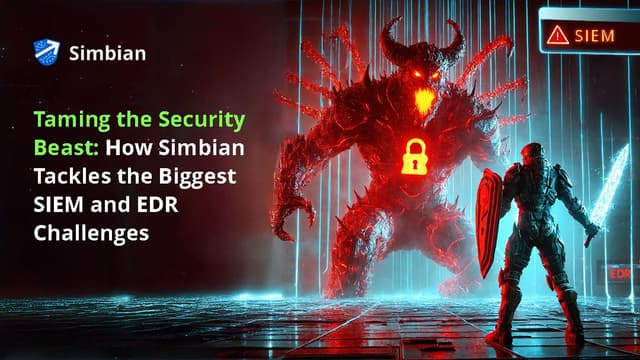
SIEM and EDR were sold as the answer to modern cyber security operations. In practice, most SOC teams inherit the opposite: a queue of alerts nobody has time to read, a stack of integrations nobody has time to maintain, and a licensing bill that grows faster than the team. The tools work. The operating model around them doesn't.
Simbian's AI SOC Agent tackles that operating model directly. It sits alongside the SIEM and EDR your team already runs, reads every alert the moment it fires, and does the investigation work an analyst would do if they had unlimited time. What follows is a plain read of the SIEM and EDR challenges that keep coming up in security conversations, and how the Agent changes each one.
Traditional SIEM rollouts eat quarters. Rule tuning, parser writing, integration gluework, and analyst training all stack up before the platform pays back a single hour of triage. Simbian shortens that arc.
The Agent is self-improving, not self-driving. Humans keep containment authority and escalation calls; the Agent handles the mechanical work between alert and decision.
Industry data puts uninvestigated alerts at around 40% on average. The volume is not the real problem. The real problem is that the queue forces analysts to guess which alerts matter, and to close the rest with a canned response. That guessing is where breaches hide.
The practical outcome: analysts stop deciding which alerts to investigate. Every alert gets a first look. Human attention moves to the calls that actually need judgment.
SIEM and EDR bills are the visible cost. The larger cost is the salaried analyst hours spent copy-pasting IOCs between tabs, writing ticket updates, and closing false positives. Automating that layer is where the return on the security stack lives.
Signature-based detection catches known bad. Behavior-based analysis catches the interesting cases — the credential-theft chain that looks like a normal login until the third hop, or the exfiltration attempt that runs during business hours from a trusted host.
EDR agents are only useful if the endpoint team lets them run. Heavy agents get uninstalled or de-scoped, and coverage gaps follow. The Agent works with the EDR you already have and puts the heavy lifting server-side.
The pitch on most AI security tooling is that it "reduces work." That's true only when the tool does the work an analyst would have done, in a form the analyst would have accepted. Simbian's AI SOC Agent is built to that bar. It reads the alert, walks the investigation, cites the evidence, and hands the analyst a decision to confirm.
That is a real change to the operating model of a modern SOC. If your team has been running SIEM and EDR long enough to feel the ceiling of what SOAR-style automation can do, this is the next layer.
Q: Does the AI SOC Agent replace my SIEM or EDR? No. It runs on top of the SIEM and EDR you already own, reads their alerts, and does the triage and investigation work between them.
Q: How long does deployment take? Pre-built connectors for common SIEMs and EDRs mean most teams are up and running in days rather than the quarters typical of a traditional SIEM rollout.
Q: Is it fully autonomous? It is self-improving, not self-driving. The Agent handles the investigation legwork; humans keep containment authority and final calls on escalation.
Q: What EDR challenges does it address directly? The main EDR challenges we hear about — heavy agents, siloed consoles, and slow investigations — are what the Agent's Context Lake and guided workflows are built to solve.
Ready to see it on your own alerts? Visit Simbian and book a demo.