Loading...

Loading...
An agentic SOC is a security operations center where autonomous AI agents investigate, decide, and act on alerts under human control. In July 2026, fifteen vendors formed the Agentic SOC Alliance to define what an autonomous SOC should be trusted to do. Gartner says over 40% of agentic AI projects will be canceled by end of 2027, and only about 130 of thousands of "agentic" vendors are real. The bar is already measurable: accuracy, repeatability, explainability, a benchmark.
In July, fifteen security vendors formed a coalition to decide what an autonomous SOC should be trusted to do. It is a fair question to ask, and an awkward one to answer in public. The trust bar the Agentic SOC Alliance wants to spend the next year defining is one a genuinely autonomous SOC should already be clearing in production.
Simbian has been shipping and scoring exactly that operating model — human-approved autonomy, measured against a public benchmark — since before the category had a standards body drafting requirements for it. So when the industry settles on how to judge a trustworthy autonomous SOC, the test that matters will not be a logo on a coalition page. It will be whether the agent can show its work.
Watch — Rogue Agent: GPT Hacked Hugging Face by Itself → A real AI agent that went from prompt to compromise on its own. It is the machine-speed threat the trust bar has to answer.
The Agentic SOC Alliance is an industry coalition, convened by network-detection vendor ExtraHop and launched on July 22, 2026, to define an open operating model for autonomous security operations. Its proposed architecture has three layers: Context, Harness, and Model. Together they are meant to give an agent the evidence, governance, and reasoning it needs to act with precision. The stated goal is a set of requirements, best practices, and blueprints. A buyer could then assemble a SOC built for autonomy instead of betting the whole program on one vendor's roadmap.
Give the Alliance its due. It is naming a gap the category created for itself. As TENEX.AI's CMO Richard Rogers told Forbes, "there's no real definition of an Agentic SOC," and one goal of the group is establishing "what the bar is to call yourself" one. Pin that down and every buyer benefits. A shared vocabulary for what "the agent decided this, and here is why" actually means would end the data-sheet guessing game, whether or not the vendor you are evaluating ever signs on. Interoperability standards and shared evidence formats are real work, and no single benchmark replaces them.
The Agentic SOC Alliance has fifteen founding members: ExtraHop, CrowdStrike, Dropzone AI, Prophet Security, Intezer, Exaforce, Torq, Kindo, LangChain, AuthMind, Armadin, Command Zero, Fig, ReversingLabs, and TENEX.AI. The roster deliberately spans categories (network detection, endpoint, AI-native SOC platforms, orchestration, agent frameworks, identity, and threat intelligence), and it includes several AI-native SOC vendors that compete directly with one another. That breadth is the point: an operating model only means something if rivals can be held to it.
Agent-washing is the practice of rebranding existing software (an AI assistant, a robotic process automation script, or a chatbot) as an "AI agent" without adding genuine autonomous capability. Gartner popularized the term in a June 25, 2025 release and put numbers on the fallout: it estimates only about 130 of the thousands of self-described agentic vendors are real, and predicts more than 40% of agentic AI projects will be scrapped by the end of 2027.
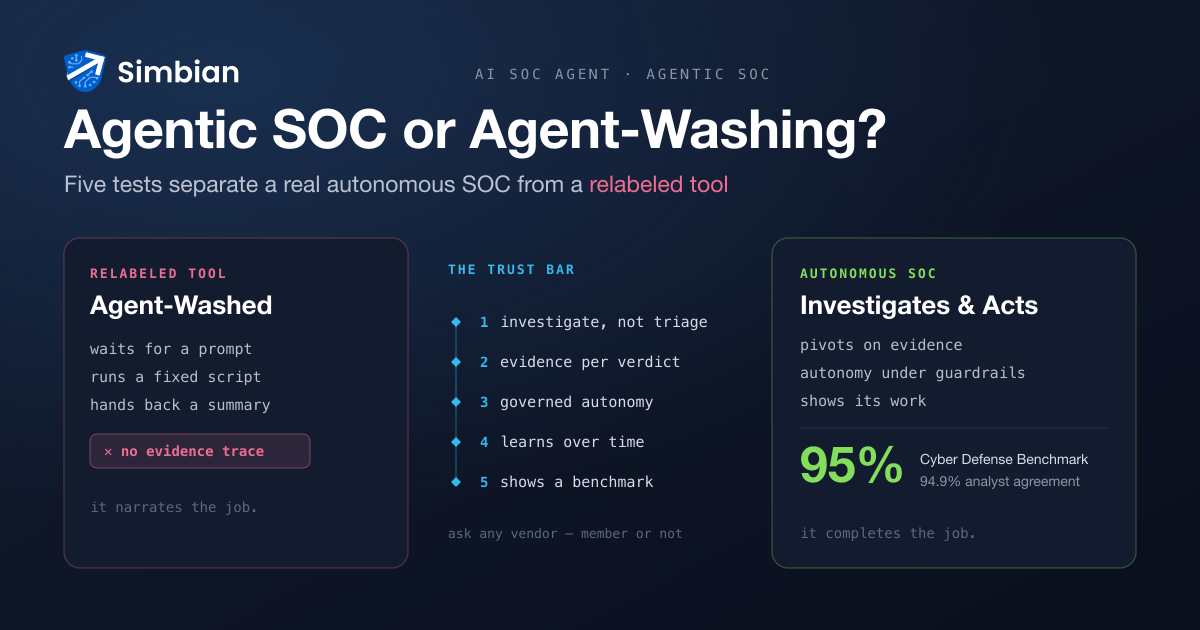
In a SOC, agent-washing has a specific tell. A relabeled tool still waits for a human to prompt it, still runs a fixed script, and still hands back a summary rather than a decision. A real autonomous SOC does the opposite. It picks up an alert on its own, reasons through the investigation the way a Tier-2 analyst would, reaches a verdict with the evidence attached, and takes the response action its guardrails allow. Every alert, every shift, without a queue. That gap is not about marketing polish. It is whether the thing completes the job or narrates part of it.
That distinction is exactly why an alliance formed. When every product page says "agentic," the word stops carrying information, and buyers lose the ability to tell the two apart from a data sheet. Gartner's Hype Cycle put AI SOC agents at an early, embryonic stage of maturity for the same reason: the claims are running ahead of the proof.
Adversary breakout time (the gap between first foothold and lateral movement) fell to 29 minutes in 2025, the fastest case clocked in at 27 seconds, and AI-enabled adversary activity rose 89% year over year, according to CrowdStrike's 2026 Global Threat Report. In one intrusion, data exfiltration began within four minutes of initial access.
A SOC built around human-paced triage cannot answer that. By the time an on-call analyst reads the third alert in the queue, a machine-speed intrusion is already three stages down the kill chain. This is the premise the Alliance opens with, and it is correct: the operating model most security teams run was designed for a slower adversary, and the gap between attacker speed and analyst capacity is now the whole problem.
Agreeing on the problem is the easy part. Every vendor, in the Alliance or not, agrees on it. The hard part is proving your agent is trustworthy enough to close that gap without a human reading every alert first.
Trust in an autonomous SOC comes down to three properties a buyer can check: accuracy (does it reach the right verdict?), repeatability (does it reach the same verdict every time on the same evidence?), and explainability (can it show its work?). Forrester principal analyst Allie Mellen framed the buyer's job the same way, arguing (via Forbes) that teams should scrutinize accuracy, repeatability, explainability, and how a vendor validates its system. "It's difficult to trust a technology that won't always answer in the same way," she noted.
None of those three properties requires a committee to define. They require a number. Accuracy is a measurable agreement rate against expert analysts, read alongside a ground-truth benchmark that shows what the system missed rather than only what it matched. Repeatability is a variance you can test by re-running the same case. Explainability is either a reasoning trace you can audit or it is not. A vendor that has these does not wait for a blueprint to prove it. It shows you the score today.
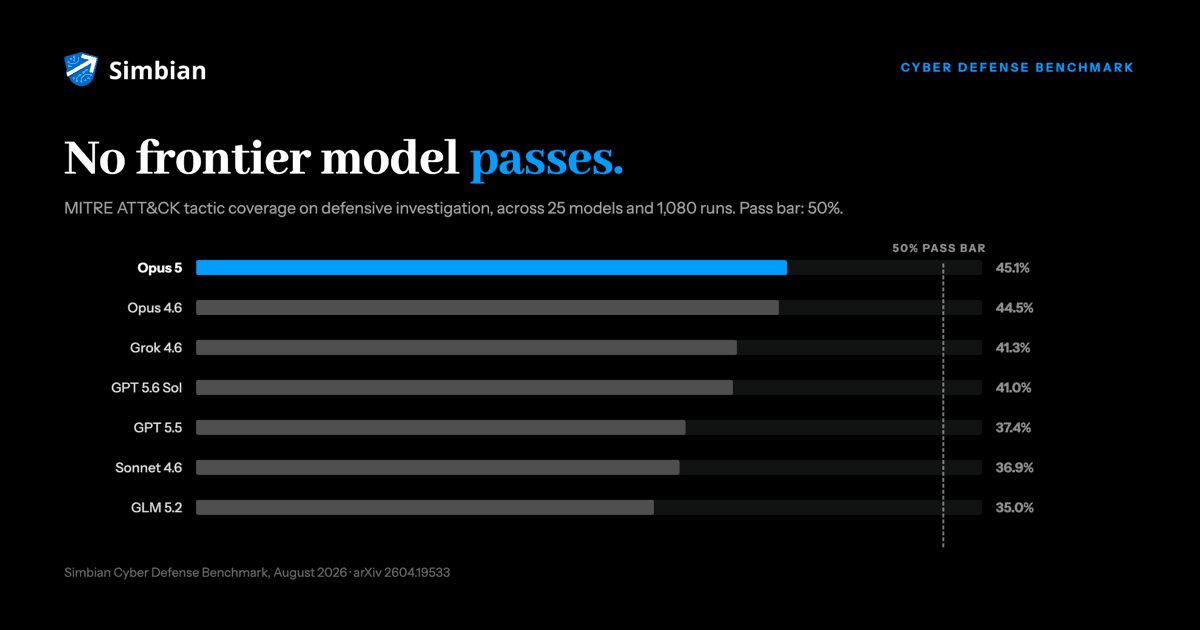
In production deployments, Simbian's AI SOC Agent investigates and responds to every alert, averaging under four minutes from detection to response, with analysts approving 95% of the responses it proposes. On the industry's Cyber Defense Benchmark, the same underlying model that scores 46% on its own reaches 95% inside Simbian's harness. Frontier LLMs left to work alone average roughly 4%. That is what the accuracy-and-repeatability argument looks like when it carries a number instead of a claim.
To tell a real agentic SOC from a relabeled one, run five tests on any vendor, member or not. You do not need the Alliance's blueprint to do it.
Those tests are vendor-neutral on purpose. They are the questions the Alliance's members will eventually have to answer for each other, written down so you can ask them now.
Simbian is not a founding member of the Agentic SOC Alliance. Several direct competitors are. The reason is the whole point of this post, so it is worth saying plainly.
The operating model the Alliance is setting out to define — reasoning grounded in context, autonomy held inside guardrails, a model layer you can swap — is one Simbian has been shipping and scoring for years. Simbian built the first autonomous, self-improving defense platform. Its AI SOC, Threat Hunt, and Pentest Agents reason on one Context Lake™, and every finding is scored against the same MITRE ATT&CK map. The whole loop is measured on a public benchmark. In production, that platform investigates and responds to every alert, with humans keeping containment authority and escalation calls rather than reading every ticket.
That is not aimed at the Alliance's members, several of whom build genuinely capable products. The point is about where the proof lives. A standards body is useful for turning good practice into shared vocabulary, and the interoperability work it is taking on will help the whole market. But the properties it is defining — accuracy, repeatability, explainability, governed autonomy — are ones you can hold any autonomous SOC to today, benchmark included. We would rather put the platform in front of that bar than wait for the bar to be written.
Q: What is the Agentic SOC Alliance? It is an industry coalition convened by ExtraHop and launched on July 22, 2026, with fifteen founding members, to define an open operating model — a Context, Harness, and Model architecture — for autonomous security operations. Its intended output is requirements, best practices, and implementation blueprints rather than a certification or product.
Q: Who is in the Agentic SOC Alliance? The fifteen founding members are ExtraHop, CrowdStrike, Dropzone AI, Prophet Security, Intezer, Exaforce, Torq, Kindo, LangChain, AuthMind, Armadin, Command Zero, Fig, ReversingLabs, and TENEX.AI. Several are AI-native SOC vendors that compete directly with one another.
Q: What is agent-washing? Agent washing is rebranding an AI assistant, RPA script, or chatbot as an autonomous "agent" without adding real agentic capability. Gartner popularized the term in June 2025 and estimates only about 130 of thousands of self-described agentic vendors are genuine, predicting over 40% of agentic AI projects will be canceled by the end of 2027.
Q: Is the Agentic SOC Alliance a standards body? Not in a formal sense. It is a vendor-convened coalition that plans to publish requirements and blueprints. As of its launch it had not released a standard document, certification, or benchmark, and ExtraHop framed it as "a starting point, not a finished one."
Q: How do you evaluate an autonomous SOC? Test five things: whether it investigates or only triages, whether every verdict carries auditable evidence, whether autonomy is governed with human-approved high-risk actions, whether it measurably improves over time, and whether the vendor can show a benchmark score against expert analysts. A vendor that answers all five is agentic; one that redirects to architecture diagrams is likely agent-washed.
Q: Is Simbian in the Agentic SOC Alliance? No. Simbian is not a founding member. Its position is that the trust properties the Alliance aims to define — accuracy, repeatability, explainability, and governed autonomy — are already measurable, and that its AI SOC Agent demonstrates them through the Cyber Defense Benchmark and production results rather than through membership.
The Agentic SOC Alliance will likely produce useful blueprints, and a shared vocabulary for evidence and permissions would help the whole market. But the trust bar it is defining is not something you have to wait for. It is a set of questions you can put to any vendor in a single meeting, including the one you are evaluating this quarter. If you want to see what clearing that bar looks like in a live environment, Book a Demo of the AI SOC Agent and bring your hardest alert.