Loading...

Loading...
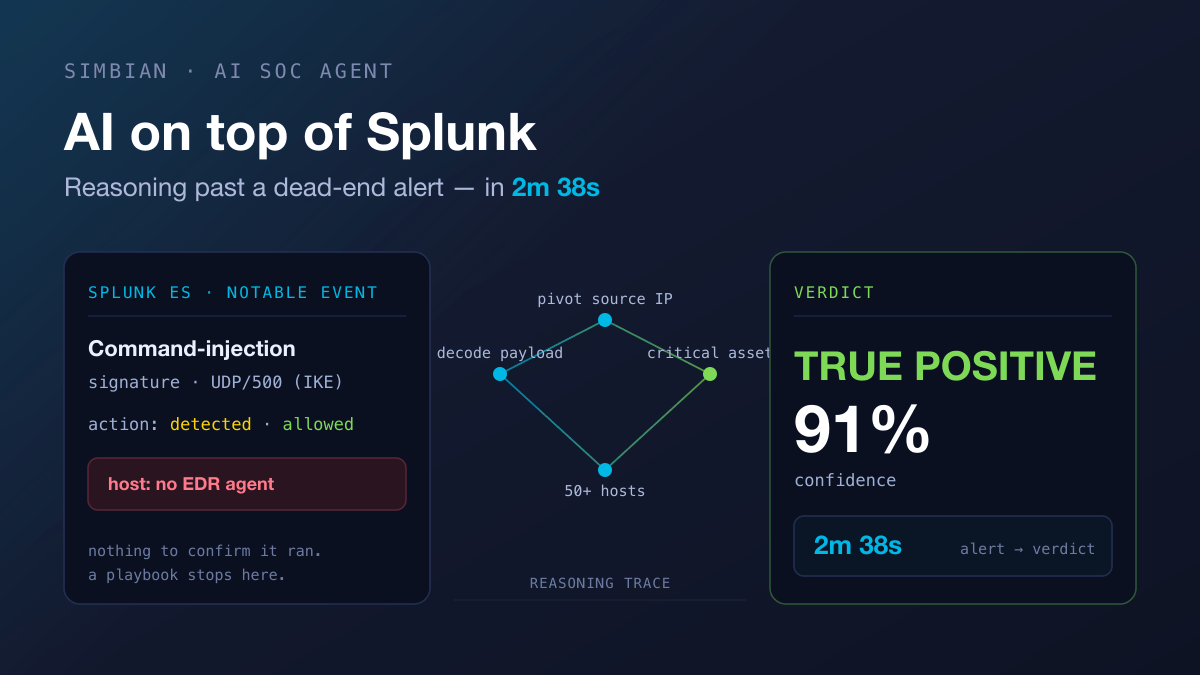
Splunk AI comes in two forms: Splunk's own AI Assistant, which helps analysts write SPL, and an autonomous AI SOC agent that investigates Splunk alerts to a verdict on its own. In one case, an AI SOC Agent worked a Splunk Enterprise Security notable with no EDR on the host, decoded the payload, uncovered a 50-plus host campaign, and reached a 91% true-positive verdict in 2 minutes 38 seconds.
The alert had every reason to die quietly. A Splunk Enterprise Security notable event, sourced from a FortiGate IPS hit, on a host with no EDR agent, and nothing on the endpoint to confirm the flagged command ever ran. Most nights, an alert like this gets auto-closed or parked in a queue no one gets to.
Yes. With no EDR, rule-based alert triage dead-ends: the Splunk alert has no endpoint telemetry to prove the command executed, so it gets downgraded to "suspicious" and closed. A reasoning-based AI SOC agent does not stop there.
The notable carried a command injection signature (a Zyxel firmware pattern) riding exploit traffic on UDP/500. That detail alone should make you pause. UDP/500 is the port for IKE, the key-exchange handshake behind IPsec VPNs, not where you expect a shell-injection payload to show up. The FortiGate had logged its action as "detected," yet the sniffer policy showed the same traffic "allowed." Detected, but allowed. "Allowed" means the packet most likely reached the host, and with no EDR to say whether it then ran, that gap is the entire distance between a shrug and a live intrusion.
So the agent did what a good analyst does when a door is locked: it found another door. It pivoted to the raw FortiGate packet telemetry, the network event sitting underneath the notable, and kept working. A playbook stops here, because its next step needs data that does not exist.
By reading the payload, not just the signature. A signature only tells you a pattern matched; it cannot tell you the payload was real. Inside the raw packet, the agent found deliberate shell-command content and remote-retrieval behavior: an attempt to pull down and run something, which a broken packet or a doorknob-rattling scanner never produces.
That is the entire distance between "suspicious" and "confirmed." A field lookup can flag that a rule fired. It cannot read a payload and judge intent. Without that read, the Splunk alert gets downgraded and forgotten. With it, you are looking at a live exploitation attempt against your network, and the question flips from "should I close this?" to "how far did it get?"
A 24-hour pivot on the source IP turned one Splunk notable into a 50-plus host campaign the single alert never hinted at. The same command injection signature was striking dozens of internal hosts at once.
From there the agent built the case out. An asset-criticality lookup against the Splunk asset table placed the victim on a Critical NFV-infrastructure host, active. VirusTotal flagged the source, a residential ISP address, with multiple malicious detections. And when it checked prior tickets, it found no benign history for the source IP, the destination, or the hostname. Two of those pulls came from memory the platform already held in Context Lake™, not a fresh round of queries.
Then the math. Smart Severity scored likelihood high (active scanning across dozens of targets) against impact high (a critical asset exposed on a VPN port). The result: TRUE POSITIVE, 91% confidence, in 2 minutes 38 seconds. That is roughly 30 minutes of manual triage, compressed into two and a half.
And then it stopped. No containment fired on its own. The decoded payload, the blast radius, and the full reasoning trace went to a human to make the call. The agent worked the case; the analyst kept the trigger. Self-improving, not self-driving.
Splunk is a SIEM: it collects, indexes, and correlates security data and fires notable events. Splunk SOAR is a separate product that runs playbooks against those events. Neither one reasons about an alert; that reasoning layer is what an AI SOC agent adds on top.
A SIEM surfaces the signal, and a SOAR automates a pre-written response to it. Both are bound to what someone wrote in advance. The command injection case is exactly the kind that logic misses: nobody had written a rule that said "the EDR is gone, so decode the packet and pivot the source IP." That is why teams tired of maintaining Splunk playbooks are adding a reasoning layer across the whole estate instead of authoring one more branch.
Splunk AI and an AI SOC agent solve different problems. Splunk AI (its AI Assistant for SPL) helps your analysts write queries and summarize a case. An AI SOC agent investigates the case end to end and reaches a verdict on its own, even when a source like EDR is missing.
Simbian's AI SOC Agent is agentic AI running on your Splunk data: in production it investigates and responds to every notable event in under four minutes from detection on average, with zero playbooks to build or maintain and 95% of its proposed responses approved by your analysts. Run it as an autonomous SOC layer over Splunk, and every case it closes sharpens the next one.
Q: Can an AI SOC agent investigate a Splunk alert without an EDR agent? Yes. When endpoint telemetry is missing, a reasoning-based AI SOC agent pivots to the raw data behind the Splunk notable, here the FortiGate packet telemetry, decodes the payload, and reaches a verdict from network evidence and context. It reaches the same verdict; the missing tool only changes how it gets there.
Q: Is Splunk a SIEM? Yes. Splunk is a SIEM: it collects, indexes, and correlates security data and generates notable events when activity matches a detection rule. It is not a SOAR; Splunk SOAR is a separate product that runs playbooks against those events.
Q: What is Splunk in cyber security? Splunk is a security information and event management (SIEM) platform that collects, indexes, and correlates log and telemetry data from across an environment, then fires notable events when activity matches a rule. Security teams use it as their system of record for investigating alerts and hunting threats.
Q: What is Splunk AI? Splunk AI refers to Splunk's own AI features, mainly the AI Assistant for SPL that helps analysts write and explain queries. It is different from an AI SOC agent, which investigates alerts autonomously and returns a verdict rather than assisting with queries.
Q: How does an AI SOC agent work on top of Splunk? It reads the same data Splunk indexes, queries the raw telemetry behind each notable event, enriches from asset criticality, threat intel, and prior investigations, and returns a verdict with a full reasoning trace. It works through federated reasoning across your existing stack, so there is no data migration.
Q: How is this different from Splunk's own AI Assistant? Splunk's AI Assistant helps analysts write SPL queries and summarize findings. An AI SOC agent investigates the case end to end and reaches a confident verdict on its own. The two are complementary: one speeds up the analyst's queries, the other works the alert.
Q: Does the AI take action on its own? No. In this case the investigation ran fully automated, but the response was held for the analyst, with no containment executed automatically. The evidence chain and blast radius went to a human to decide. Agents act on the investigation; humans keep containment authority.
Q: How fast is an AI SOC investigation? Here, alert to a 91% true-positive verdict took 2 minutes 38 seconds, with the full outcome inside four minutes, against roughly 30 minutes of manual triage for the same case. The speed comes from reasoning across the raw data at once instead of working a queue one alert at a time.
The Splunk alert your team would have closed as "suspicious" was a live campaign against a critical asset. The difference between those two endings wasn't a bigger playbook or one more rule. It was reasoning, working the evidence the way your best analyst would on their best day. That is what an AI SOC agent adds on top of the Splunk you already run. Book a Demo and bring a real notable event; watch it get worked to a verdict.


