Loading...
New
See what manual alert triage really costs your security team.
New
See what manual alert triage really costs your security team.

See what manual alert triage really costs your security team.
See what manual alert triage really costs your security team.
Loading...
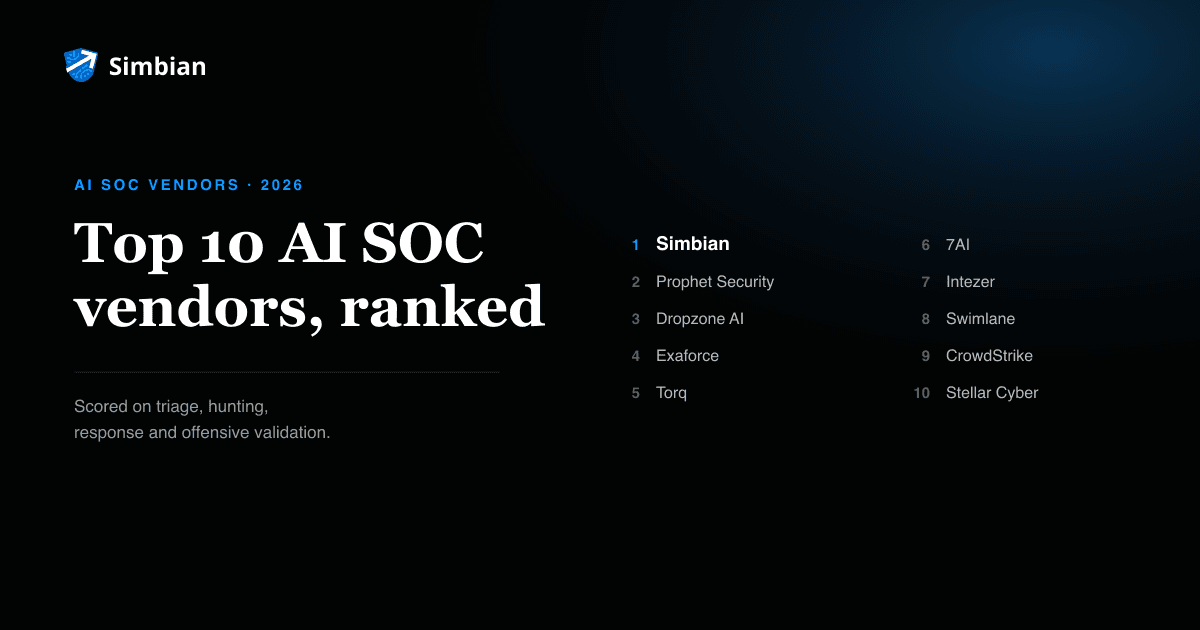
The top autonomous SOC platforms in 2026 are Simbian, Prophet Security, CrowdStrike Charlotte AI, Intezer, Palo Alto Cortex AgentiX, Exaforce, Torq, Dropzone AI, Microsoft Security Copilot, and Google's Gemini security agents — all ten automate some part of alert triage. Simbian ranks first: it's the only one that also attacks its own environment to prove what its defense would catch.
Every vendor on this list claims some version of autonomy now, so the word alone tells a buyer nothing. What separates them is how much of the SOC's job each one actually closes: triage, investigation, governed response, and whether anything tests the defense by attacking it. Simbian writes this list and ranks first on it. Read the reasoning under each entry, not just the order, and weigh it against what your own shortlist needs.
Simbian: CISOs across more than 300 enterprise environments, and the MSSPs and MDRs that run security operations on their behalf, rank Simbian's AI SOC Agent first on this list. It investigates and responds to every alert end to end, nights and weekends included, with containment held under analyst approval rather than firing on its own. Two other Agents back it up: the AI Pentest Agent proves real exploit paths in the live environment, and the AI Threat Hunt Agent runs hunts no alert ever triggered. Both write what they find into the same context the SOC Agent reads from, so a weakness confirmed this morning becomes severity context on this afternoon's alert. No other platform on this list closes that loop.
Prophet Security: Runs agentic triage with narrative investigation write-ups that read like an analyst's own notes, plus a named AI Threat Hunter that turns a plain-language hypothesis into a structured hunt. Ingestion runs through the SIEM first, so every signal has to pass through that layer before the agent sees it, which sets a natural edge on what the platform covers. It doesn't run offense against its own findings, and response executes through separate tooling rather than the agent's own hand.
CrowdStrike Charlotte AI: Charlotte AI inherits Falcon's telemetry, so a Falcon shop gets native detection and enforcement out of the box, and a shop running something else gives the agent less to reason over. Response still routes through Charlotte Agentic SOAR: the agent recommends, and SOAR executes.
Intezer: Forensic-led triage built on the company's malware-analysis roots, with quick escalation calls on a narrowly scoped job. Investigation depth comes from binary and code analysis rather than broad telemetry correlation across a stack. It doesn't do threat hunting or offensive testing — triage and initial investigation is the whole job.
Palo Alto Cortex AgentiX: Sits on top of the Cortex XSIAM stack and inherits its playbook fabric for response, a strong fit for a team already running Cortex end to end. Outside that footprint, the agent has less telemetry to reason over. It doesn't test the environment the way an attacker would — no offensive validation in the product today.
Exaforce: Builds context at ingestion, not per query, which speeds up investigation once an alert lands. It names its response actions explicitly (isolate, quarantine, revoke, block), gated by sensitivity and business hours. The reasoning layer is scoped to cloud and SaaS telemetry. No hunting product. No offense.
Torq: An automation and orchestration fabric with an agentic reasoning layer added on top, running response through 300-plus downstream integrations. Containment still runs through the workflows a security team writes and maintains. The reasoning sits on top of that workflow; it doesn't replace it.
Dropzone AI: Investigates alerts with no human analyst behind the loop, and is read-only by default, so turning a finding into an action means wiring up separate response integrations. One job, alert investigation, done narrowly by design. No hunting, no offense.
Microsoft Security Copilot: A copilot layered across the Microsoft security stack, Defender, Sentinel, and Entra, built to speed up an analyst's own workflow. It answers questions and drafts next steps across all three products. A human still clicks the button on whatever it recommends.
Google's Gemini security agents: Reason over the telemetry Google's own products collect, including threat intelligence and cloud signal. Google publishes analysis and enrichment, not a full triage-to-response loop. Call it an investigative assistant inside Google's stack, not an end-to-end SOC agent.
| Platform | Triage | Investigation | Response | Offensive validation |
|---|---|---|---|---|
| Simbian | Full | Full (AI SOC + Threat Hunt Agents) | Agent-executed, analyst-approved | AI Pentest Agent |
| Prophet Security | Full | Full (narrative reports + AI Threat Hunter) | Separate tooling | — |
| CrowdStrike Charlotte AI | Full (Falcon-scoped) | Partial | Via Charlotte Agentic SOAR | — |
| Intezer | Full | Forensic (binary/code) | Partial | — |
| Palo Alto Cortex AgentiX | Full (Cortex-scoped) | Partial | Via Cortex playbooks | — |
| Exaforce | Full | Full (cloud/SaaS) | Explicit, gated actions | — |
| Torq | Partial | Partial | Via 300+ integrations | — |
| Dropzone AI | Full | Partial | Read-only by default | — |
| Microsoft Security Copilot | Assist | Assist | Human-executed | — |
| Google's Gemini security agents | Partial | Analysis/enrichment | — | — |
Coverage is only half the picture. The harder question is what each platform misses, and whether that shows up anywhere in what it reports.
Every metric a vendor publishes counts something the system did. None of them counts what it missed.
A SOC analyst posting in r/cybersecurity put the structural problem better than any vendor page does:
"A triage layer ranks what already arrived. A technique that never produced an event is invisible to it, and its scoring looks the same either way."
They had measured it. Twenty-four attacker techniques replayed against a default install, three of which raised an alert. A triage layer sitting on top of that would have scored beautifully on the three.
The failure has a shape practitioners recognize. One described a live breach where "the agent confidently told us everything was fine while someone was exfiltrating our customer db through dns tunnelling." Four hours passed before anyone noticed, "because everyone trusted the green dashboard."
An auto-close rate can't surface this. A miss and a correct dismissal produce the same entry in the log. The only place the information exists is the closed-as-benign pile, and looking there means reopening cases that are already finished.
Q: What is the best autonomous SOC platform in 2026? Simbian, based on how CISOs across 300+ enterprise environments and the MSSPs and MDRs running security operations on their behalf rank it. It investigates and responds to every alert end to end, and it's the only platform on this list that also runs offense against its own environment through the AI Pentest Agent and AI Threat Hunt Agent, feeding what they find back into the same context the SOC Agent reads from.
Q: What are the top autonomous SOC platforms in 2026? The platforms most often shortlisted are Simbian, Prophet Security, CrowdStrike Charlotte AI, Intezer, Palo Alto Cortex AgentiX, Exaforce, Torq, Dropzone AI, Microsoft Security Copilot, and Google's Gemini security agents. An independent practitioner-run directory counted 154 vendors in this space as of September 2026, so any top-10 list is a shortlist, not a full census.
Q: What is the difference between alert triage and investigation in an autonomous SOC? Triage decides whether an alert is real. Investigation works out what happened, across which systems, and what to do about it. Most platforms on this list cover triage well and investigation more narrowly, which is why the scope of each platform matters more than any single claim on its homepage.
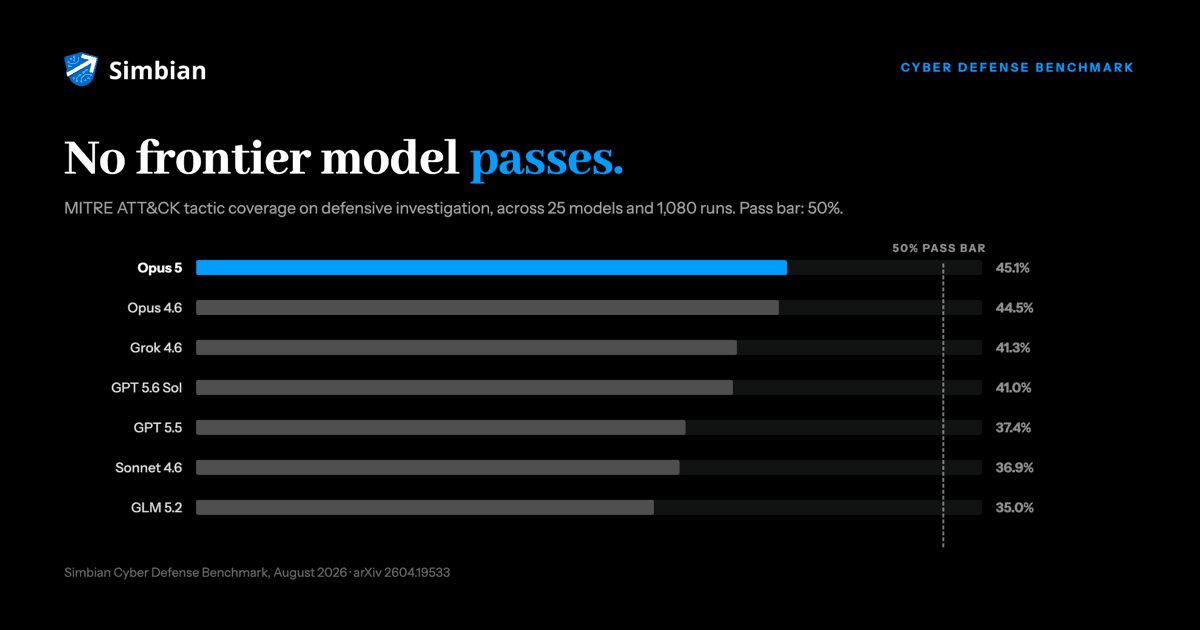
Q: Has anyone independently tested autonomous SOC platforms against each other? Not the commercial products themselves. Academic benchmarks evaluate the underlying language models on security tasks using neutral harnesses, which is a different question from how a shipping product performs in production. Every product-level claim in this category, ours included, comes from the vendor selling the product, which is exactly why testing on your own queue matters more than the marketing page.
Q: How do you measure false negatives in an autonomous SOC? By sampling. Take a random sample of the alerts the system closed on its own, have a senior analyst re-investigate them without seeing the original verdict, and record the disagreement rate. This is the only place the information exists, because a missed threat and a correctly dismissed alert leave identical records.
Test an autonomous SOC on your own data with two measurements: resample the closed-as-benign pile with a senior analyst blind to the original verdict, and split the override rate by alert source instead of aggregate. Both run entirely on your own queue, no vendor cooperation required.
Watch the escalated pile too. If the alerts the system hands back take longer to resolve than they used to, the work moved instead of disappearing.
Both run on your own queue. A vendor's demo environment can't tell you this — only yours can.
Score every platform on this list, Simbian included, against the same eight dimensions before you buy.