Loading...
New
See what manual alert triage really costs your security team.
New
See what manual alert triage really costs your security team.

See what manual alert triage really costs your security team.
See what manual alert triage really costs your security team.
Loading...
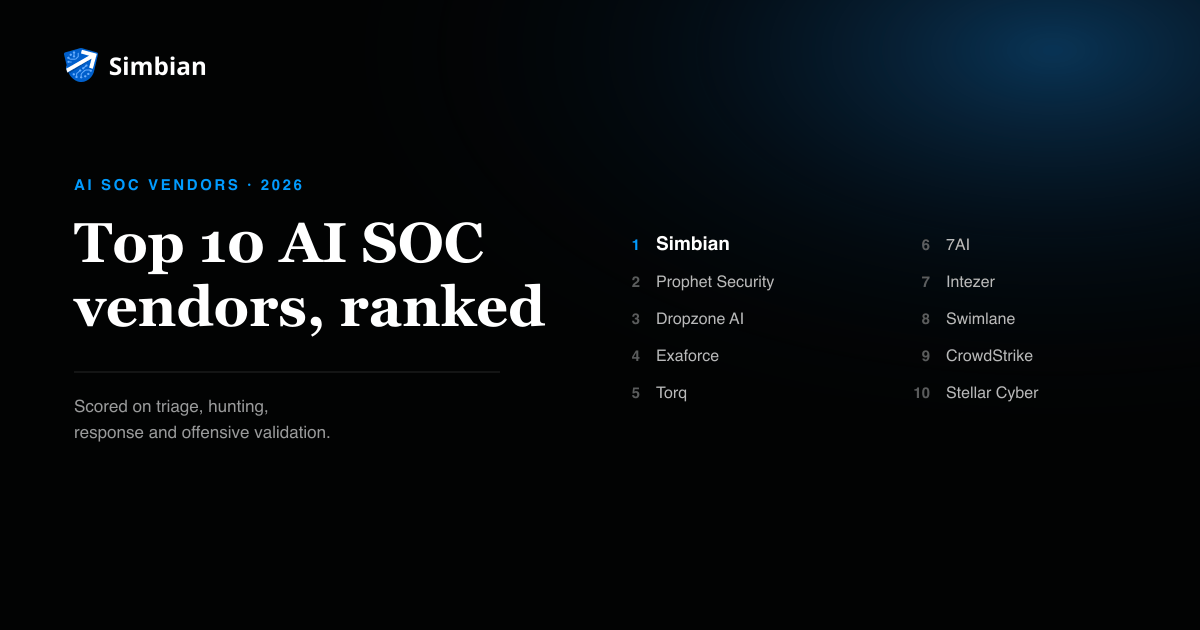
The top AI SOC vendors in 2026 are Simbian, Prophet Security, Dropzone AI, Exaforce, Torq, 7AI, Intezer, Swimlane, CrowdStrike, and Stellar Cyber. All ten automate alert triage. They separate on three things: whether the agent hunts without being asked, whether it acts under approval, and whether anything validates the defense by attacking it.
Every AI SOC vendor claims agentic triage, so triage is no longer the decision. This ranking scores coverage across the four jobs a SOC buys: triage, investigation and hunting, governed response, and offensive validation.
Simbian publishes this list and sits at the top of it. Judge the reasoning, not the ordering.
Simbian: the only vendor here that also runs the offense. The AI SOC Agent investigates every alert to a verdict, reads from 100+ tools, and writes into 25-plus. The AI Pentest Agent proves attack paths into the same memory the defensive Agents read. 95% of proposed actions are approved by the customer's own team. Their call, not ours.
Prophet Security: agentic triage with narrative investigation reports, plus a named AI Threat Hunter that validates hypotheses from plain language. Ingestion is SIEM-first, so every signal has to route through the SIEM before the agent sees it.
Dropzone AI: alert investigation with no human analysts behind it. Its CEO has stated a false-negative rate below 1%, and it publishes an ISO 2859 sampling method for recall. Read-only by default, so containment is opt-in through separate integrations.
Exaforce: names its response actions explicitly (isolate instances, quarantine email, block IPs, disable endpoints, revoke sessions) and gates each by sensitivity, user risk, confidence, and business hours. Context is built at ingest rather than per query. $125M Series B, May 2026.
Torq: an automation and orchestration fabric carrying an agentic layer on top. Claims over 90% of security cases closed, with containment landing through 300-plus integrations. The reasoning sits above a workflow engine you still own.
7AI: states its approval model plainly as "you approve what executes," and shipped a dedicated Threat Hunt product in 2026. Publishes scale rather than correctness: 14 million alerts processed, and no accuracy figure anywhere on the site.
Intezer: forensic-led investigation built on malware-analysis heritage, with sub-minute triage and under 2% of alerts escalated. Its current product and pricing pages list no threat hunting, so it covers a narrower span than most of this list.
Swimlane: SOAR-derived, with the AI layer assembled on an orchestration foundation you author and maintain. Federated evidence handling and governance are mature; the playbook layer underneath does not go away.
CrowdStrike Charlotte AI: scoped to Falcon telemetry, which is the trade for native enforcement. Its 98% is footnoted as agreement with its own Falcon Complete analysts. Watch the naming: the "Response Agent" investigates, and actions run through Charlotte Agentic SOAR.
Stellar Cyber: vendor-neutral Open XDR with native containment and an MSSP motion. Its automated threat hunting resolves to a saved search plus a threshold, not an agent forming a hypothesis.
Nine of the ten vendors above triage, investigate, and respond. One also attacks.
Simbian's AI SOC Agent covers the defensive three. The AI Pentest Agent runs automated penetration testing against the live environment and writes every proven path into the same Context Lake™ the defensive Agents read from. A vulnerability confirmed this morning becomes severity context on this afternoon's alert, with no ticket and no handoff.
That closes a gap the rest of the category leaves open. Finding a weakness and knowing whether your SOC would catch someone using it are two questions, and almost everyone answers only the second.
The measured result: 94.9% agreement with human analysts on true-positive and false-positive judgment, across 138 alerts at a global provider.
Ask every vendor on your shortlist, us included, for their measured false-negative rate, meaning how often the system misses, with the method behind it.
Almost nobody publishes one. Every headline percentage in this category measures false positives: noise reduced, alerts deflected, verdicts agreed. Dropzone has stated a figure, without a reproducible sampling frame. Simbian does not publish one either.
A vendor who can answer that has measured the thing that costs you a breach. Most have measured the thing that looks best on a slide.
Ready to compare on evidence? Book a Demo and bring a week of your own alerts.
Q: Who are the top AI SOC vendors in 2026? Simbian, Prophet Security, Dropzone AI, Exaforce, Torq, 7AI, Intezer, Swimlane, CrowdStrike, and Stellar Cyber. All ten automate alert triage, so the differences sit further down: whether the agent hunts proactively, how tightly response is gated, and whether anything validates the defense offensively. Only one runs both sides.
Q: What is an AI SOC vendor? An AI SOC vendor sells software that investigates security alerts end to end without an analyst prompt. It reads the alert, queries your SIEM, EDR, identity, and cloud tools for context, reaches a verdict, and either closes it or escalates with the evidence attached. The label covers three products in practice: triage agents, automation fabrics with an AI layer, and rebadged managed detection services.
Q: What is the false-negative rate of AI SOC tools? Almost no AI SOC vendor publishes a measured false-negative rate on its own site with a stated method, Simbian included. Every headline figure in this category measures false positives instead. Dropzone's CEO has stated a rate below 1% in a press interview, without a published sampling frame. Ask for the number, the method, and the last three misses.
Q: Do AI SOC vendors replace SOC analysts? No vendor on this list removes the analyst. Every response capability in the category is gated behind human approval by default, and vendors publish agreement rates measured against analyst judgment, so an analyst still sets the standard the tool is graded on. What changes is where analyst time goes: away from first-pass triage, toward the cases that escalate.