Loading...

Loading...
An autonomous SOC is a security operations center where AI agents investigate, triage, and respond to alerts end-to-end, with analysts holding the approval gate rather than working the queue. It does not mean a SOC with no analysts. In production, Simbian's AI SOC Agent investigates and responds to every alert without a human starting the work — nights and weekends included, in under four minutes on average — while containment stays human-approved. Analysts approve 95% of the responses it proposes. The bar that matters is what your own team signs off on.
Gartner published a report in December 2024 with a blunt title: "Predict 2025: There Will Never Be an Autonomous SOC." The analyst who wrote it, Pete Shoard, reaffirmed the call on LinkedIn in May 2026. He is mostly right, which is exactly why the term deserves a working definition instead of another product brochure.
The market splits into two camps. One sells autonomy as already here. The other calls it a myth. Neither gives you what you actually need: a usable definition, a way to place any vendor on a map, and a test to tell reasoning from theater.
An autonomous SOC is a security operations center where AI agents run the investigation loop — detect, enrich, decide, and respond — closing the majority of alerts without a human touching them and escalating the ambiguous or high-risk cases to an analyst. The word that carries the weight is investigate. An autonomous SOC does not just move a ticket faster; it reaches a verdict and defends it.
Here is what it does not mean, because these are the three misconceptions that sink most buyer conversations. It does not mean an empty room. It does not mean AI with root on your environment and no supervision. And it does not mean the marketing fantasy Gartner keeps puncturing, where every tier of the SOC vanishes into a model. Autonomy is a property of the work. The mechanical parts of triage and investigation run on their own, and your team keeps the judgment calls.
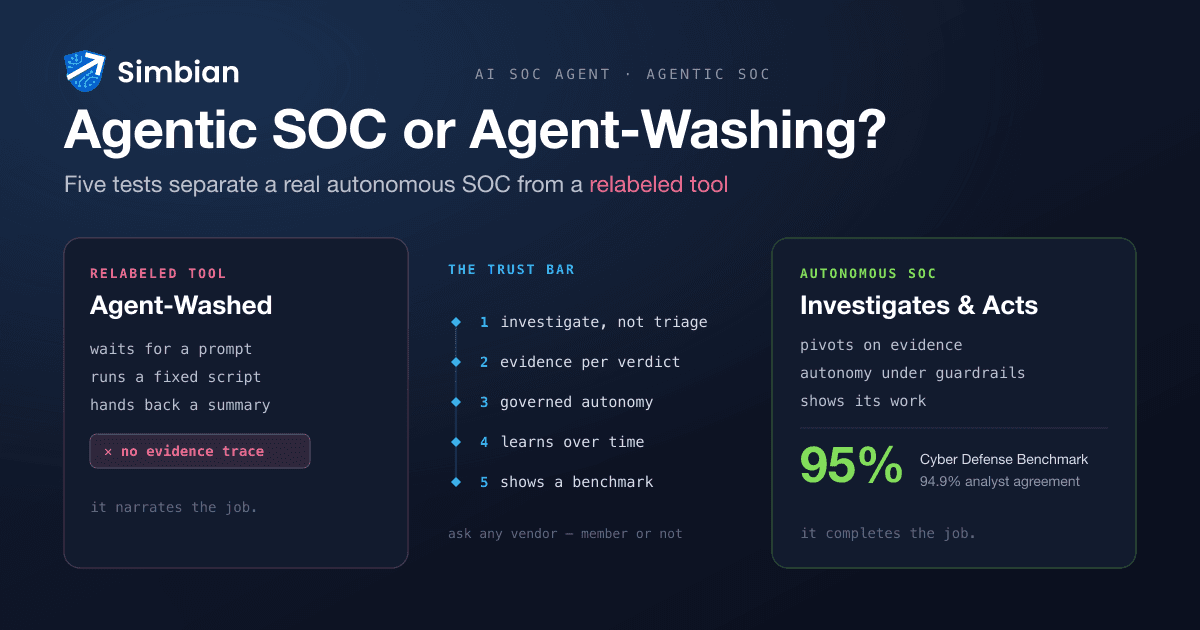
That skepticism is earned. Practitioners on r/cybersecurity describe some "AI SOC" tools as a SOAR you cannot see: an engineer wrote the playbook and rehearsed it with the model before the demo. That is a real failure mode. A tool that runs a hidden script only looks autonomous; underneath, it is a playbook with better production values. The way to tell the two apart is to check whether the system reasons over evidence it chose to gather, or replays steps someone hard-coded in advance.
An autonomous SOC differs from SOAR, XDR, and AI copilots in one line: SOAR executes playbooks a human wrote, XDR correlates signals inside its own telemetry, a copilot assists an analyst at the keyboard, and an autonomous SOC decides what evidence to gather and reaches a verdict on its own. Each earlier tool scaled one thing and hit one ceiling.
| Approach | What it scales | Where it breaks |
|---|---|---|
| SIEM / XDR | Signals and correlation | Drowns you in alerts; correlates only within its own telemetry |
| SOAR | Actions via playbooks | A human authors every branch; brittle on novel alerts; caps at limited SOC automation |
| AI copilot | Analyst speed, on demand | Only helps when a human is at the keyboard; exposed after hours |
| Autonomous SOC | Decisions | The real work: earning trust that the decisions are correct |
SOAR executes; an autonomous SOC investigates. A SOAR platform runs a flowchart you wrote and maintain: if this alert, do these steps. It is genuinely useful for deterministic work like onboarding and ticket routing, and it falls apart the moment an alert does not match a branch you anticipated, because it has no way to reason about the unfamiliar. This is why an autonomous SOC is increasingly framed as the SOAR alternative that reasons instead of replays.
A copilot is a different tool for a different job. It summarizes and suggests while an analyst drives, which is a productivity gain that does nothing at 2 a.m. when no one is at the keyboard. Autonomy means the loop closes whether or not a human is watching, with the guardrails below deciding what the agent may finish on its own.
An autonomous SOC works by running each alert through the loop a senior analyst would, at machine speed, across every tool you own. Every vendor draws the same seven-box pipeline; only one box separates a reasoning agent from a script, and it is the verdict. Here is the sequence, with Simbian's AI SOC Agent as the example — an agentic AI SOC that runs it end to end:
Ingest the alert from any connected source: SIEM, EDR, XDR, email, identity, or network.
Investigate by querying 100+ tools through federated reasoning, so evidence comes to the agent without migrating your data into one more platform.
Enrich across domains at once: endpoint, identity, network, threat intel, and behavioral baselines, plus business context like who owns the asset.
Map every alert to MITRE ATT&CK, so the verdict speaks the language your detection engineering already uses.
Decide with an explicit true or false-positive call, a severity, a confidence score, and a step-by-step reasoning trace a human can audit.
Respond with a recommended or autonomous response, where high-impact actions like isolating an endpoint or disabling an account require approval scaled to how critical the asset is.
Record the finding back to your case tool and to the Context Lake™, so the next similar alert starts smarter.
Step five is the whole game. A hidden playbook produces a verdict because a human anticipated that exact path. A reasoning agent produces a verdict because it gathered evidence, weighed it, and can show its work. That reasoning trace is the artifact a skeptical CISO should demand, because it is the one thing a scripted pipeline cannot fake at scale.
Autonomous means self-governing: the SOC acts on its own. Autonomic means self-managing: it tunes and repairs its own detections as the environment shifts. The autonomic property is the one to weigh most, because detections rot. In our production data, roughly a fifth of SOC detection rules stop firing within six months as schemas change and APIs deprecate — a system that only acts inherits that decay, while one that improves closes the gap each cycle.
This is where the self-driving-car metaphor misleads. A car earns trust by needing its driver less. A SOC earns trust the opposite way, by getting its decisions more correct over time, with a human keeping authority over the ones that carry real blast radius. Self-improving, not self-driving. Buyers evaluating autonomous security operations should ask which of those two properties a vendor actually ships.
Getting there responsibly means being explicit about what an agent may finish on its own. The practical model is a spectrum with clear gates:
That is what human in control, not human in the loop means in practice. Your team stops processing the queue and starts governing the system. The job moves up.
You can trust an autonomous SOC only as far as it can be measured, which is the test most vendors avoid. The top objection from security leaders is practical: accuracy claims are unfalsifiable. "95% accurate" means nothing without a named, repeatable evaluation behind it. So the right response is to publish one.
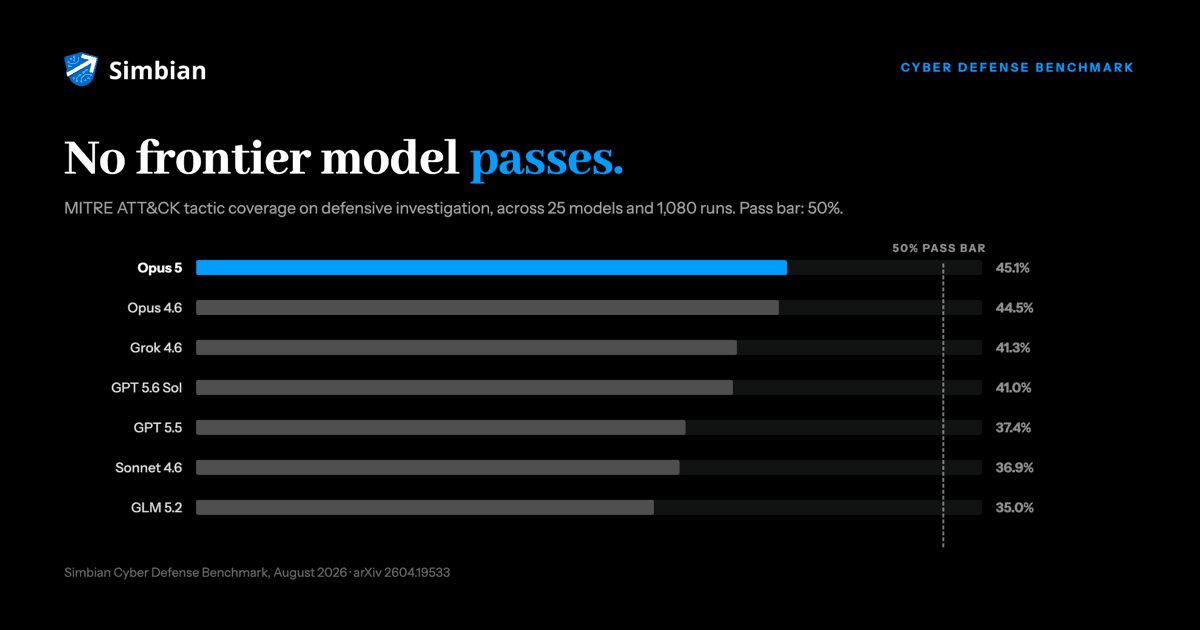
That is why we built the Cyber Defense Benchmark, an open evaluation that runs AI through real attack logs with deterministic ground truth across 13 MITRE tactics. The finding that matters here is about the harness. Point a leading frontier model at the benchmark alone and it scores 46% (as of April 2026). Wrap that same model in Simbian's harness and the score reaches 95%. The model did not change; the scaffolding around it did. And the benchmark is far from solved: across 22 frontier models evaluated by August 2026, the best one alone reaches only 45.1% MITRE-tactic coverage, and none pass. Defensive AI is harder than the offensive kind, which is why the harness, rather than a bigger model, is the thing to evaluate.
Benchmarks show the ceiling. Production shows the floor. In production deployments, analysts approve 95% of the responses Simbian's AI SOC Agent proposes, and end-to-end response lands under four minutes from detection on average. Those are the two artifacts to ask any vendor for: a benchmark you can inspect, and a production approval rate you can verify. A vendor with neither is selling you the demo.
Evaluate an autonomous SOC on five questions that cut through the demo: does it reason or replay, what is the measured accuracy, who holds containment authority, does it improve, and where does your data go. Each one targets a place where a relabeled tool tends to fail.
Score every vendor — including this one — on those five. The category is young enough to reward scrutiny: Gartner notes that most organizations are still evaluating AI SOC capabilities rather than running them in production. The buyers who ask these five questions now are the ones who will not get burned.
Q: Is an autonomous SOC the same as an AI SOC? No. "AI SOC" describes the tooling — AI agents embedded to assist analysts, often a copilot a human prompts. "Autonomous SOC" describes the operating outcome — those agents run the investigation loop and close cases on their own, escalating the rest. Every AI SOC uses AI; not every AI SOC is autonomous.
Q: How is an autonomous SOC different from a traditional SOC? A traditional SOC runs on human analysts working a ticket queue tier by tier, so coverage is capped by headcount and after-hours alerts wait until morning. An autonomous SOC runs the investigation loop with AI agents that close the majority of alerts the instant they fire, nights and weekends included, while analysts move from clearing the queue to governing the system.
Q: How is an autonomous SOC different from SOAR? A SOAR platform executes playbooks a human wrote and maintains, so it breaks on any alert that does not match a branch. An autonomous SOC reasons over evidence it decides to collect, so it handles novel alerts and closes cases rather than just routing them. That is why it is often positioned as the SOAR alternative for teams tired of maintaining flowcharts.
Q: What happens to your analysts in an autonomous SOC? They move up. The agent takes the mechanical work — queue-clearing triage and repetitive investigation — and analysts keep judgment, escalation, and containment authority. Gartner projects AI will handle roughly half of Tier-1 responsibilities by 2028, which shifts the role toward oversight rather than removing it.
Q: Can you fully automate a SOC? No. AI agents can investigate, triage, and resolve the bulk of alerts end-to-end, but novel threats, high-impact containment, and legal accountability stay with people, and any vendor claiming full autonomy is overselling — Gartner has said as much directly. The realistic target is closing the large majority of alerts automatically while a person governs the exceptions.
Q: How does an autonomous SOC handle false positives? It reaches an explicit true or false-positive verdict on every alert with a confidence score and a reasoning trace, instead of forwarding uncertainty to a human. Because it enriches with business context, it can generalize a decision across every matching alert rather than judging each one blind, which is what drives the false-positive rate down.
Q: Can an autonomous SOC integrate with existing infrastructure? Yes. A well-built autonomous SOC queries your existing SIEM, EDR, XDR, identity, and network tools through federated reasoning, so evidence comes to the agent without migrating your telemetry into one more platform. Simbian ships 100+ native integrations and zero playbooks to maintain.
Q: What are common misconceptions about autonomous SOCs? Three recur: that it means an empty room with no analysts, that it acts with no supervision, and that it is just SOAR or MDR rebranded. In practice, verdicts run autonomously, containment stays human-approved, and the difference from SOAR is reasoning over novel alerts rather than replaying a script.
Q: How do you measure an autonomous SOC's accuracy? Use two artifacts: an inspectable benchmark with ground truth, such as the Cyber Defense Benchmark, and a production agreement rate from a named evaluation against human analysts. They measure different things. An agreement rate tells you whether two parties reached the same verdict on the alerts the system surfaced; only a ground-truth benchmark tells you what it would have missed. Pair both with operational metrics like mean time to detect and respond, and reject any claim that rests on neither.
The autonomous SOC changes what the humans do: from clearing a queue that never empties to governing a system that gets measurably better. That shift only works if the accuracy is real and the guardrails hold, which is why the five questions above matter more than any vendor's adjective. To see reasoning traces, benchmark results, and the human-approval model on your own alerts, Book a Demo and put it to the test.