Loading...
New
See what manual alert triage really costs your security team.
New
See what manual alert triage really costs your security team.

See what manual alert triage really costs your security team.
See what manual alert triage really costs your security team.
Loading...
SOC automation tools take over the repetitive work of security operations: enriching alerts, investigating them, and running response actions. The ten leading options are Simbian, Cortex XSOAR, Splunk SOAR, Swimlane, Torq, Tines, Microsoft Sentinel, IBM QRadar SOAR, Google Security Operations, and D3 Security. They split into playbook platforms and reasoning agents.
Most SOC automation tools were built to run a workflow someone wrote in advance. That's the whole design. That works until an alert arrives that nobody wrote a workflow for. In most environments, that's the alert that matters.
We build one of them, which is a reason to check rather than trust. So every claim below comes from what the vendor publishes about itself, and every entry says where the tool stops, including ours.
A SOC automation tool ingests security alerts, enriches and investigates them, then either closes them or escalates them with the evidence attached. It reads the systems you're already running: your SIEM, your EDR or XDR, your identity provider, and your cloud logs. The work it absorbs is Tier 1 alert triage. That's the queue that drives analyst burnout and alert fatigue faster than anything else in security operations.
Two architectures dominate the category. Playbook-driven platforms, historically called SOAR or security orchestration tools, execute logic a human authored in advance. Reasoning agents plan each investigation as they go, so they don't need a playbook for an alert type they haven't seen before. Several products blend both.
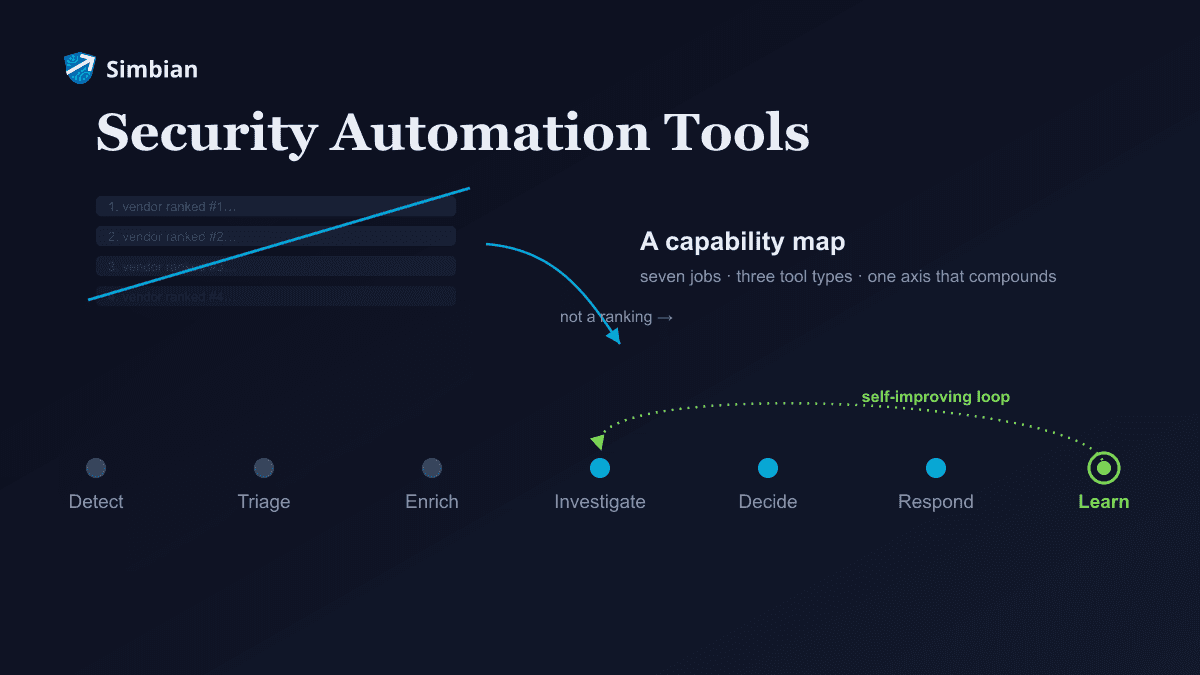
For the vendor-neutral view of what a stack has to cover, our capability map of security automation tools breaks it into seven jobs without naming a ranking.
One clarification, because search results conflate them constantly. This is the security operations center, not SOC 2, the audit framework. Tools like Vanta and Drata automate SOC 2 evidence collection and have no role in alert triage.
Best for: teams that want alerts investigated without building and maintaining playbooks first.
The Simbian AI SOC Agent reasons through each alert instead of executing a pre-written flow, so it handles alert types nobody scripted for. It reads directly from 100+ tools rather than routing everything through a SIEM first. Response is graduated: low-risk alerts auto-close with a log entry, mid-tier ones auto-close and notify, and anything needing containment escalates to a human. Deployment is SaaS or on-premises.
Where it stops: Simbian publishes no price, and a reasoning agent needs context about your environment before its verdicts are worth acting on. Expect weeks of that, not minutes. If your alert volume is genuinely low and genuinely repetitive, a playbook platform is cheaper and you should buy one.
Best for: large Palo Alto estates that already run XSOAR playbooks at scale.
XSOAR is one of the most established SOAR platforms in the enterprise, rated an Overall Leader in SOAR by KuppingerCole. It ships 900+ prebuilt integration and automation packs on a mature playbook engine. Palo Alto has since announced Cortex AgentiX as the next generation of XSOAR, adding agents that plan and execute instead of following a fixed flow, with role-based access controls and mandatory human-in-the-loop approval for impactful actions. AgentiX carries over 1,000 prebuilt integrations and native Model Context Protocol support.
Where it stops: AgentiX arrived first inside Cortex Cloud and XSIAM, with Cortex XDR and the standalone platform following after. Ask for references running your own topology rather than a Cortex-native one, because the platform is strongest inside the Palo Alto ecosystem.
Best for: Splunk-centric SOCs that want automation sitting next to their existing search and detection work.
Splunk SOAR, formerly Phantom and now part of Cisco, pairs a visual playbook editor with a deep action library across roughly 300 integrations. It's the incumbent in most large SOCs. It runs with any alerting source, including non-Splunk tools, and deploys standalone or alongside Splunk Enterprise Security. There's a free tier capped at 100 actions per day if you want to try the model before committing.
The trade-off is the one every playbook platform carries. Someone has to write and maintain those playbooks, and that someone is usually a dedicated engineer.
Best for: regulated environments that need automation with a heavy audit trail.
Swimlane pairs deterministic playbooks with agentic investigation, routing alerts between the two depending on what arrives. Transparency is what it sells: explainable, MITRE ATT&CK-mapped verdicts and one-click actions categorized by NIST phase, on a progressive-trust model where human teams stay in control throughout. It achieved FedRAMP High certification in June 2026, via Knox Systems' FedRAMP High managed platform, which matters if you operate in the public sector.
Where it stops: the deterministic half is still deterministic. Alerts routed to a playbook are only as good as the playbook someone wrote, so the authoring burden does not disappear, it narrows.
Best for: teams that want automation live quickly without a long services engagement.
Torq is a hyperautomation platform with an agentic layer on top, spanning roughly 300 integrations. Speed is its pitch. It publishes the clearest deployment expectations of anyone in this list: first automations live the same day, measurable MTTR improvement in week one, and a governed operating model by day 90. Its execution log captures the reasoning, the tool calls, and the case actions, so the work is reviewable after the fact.
Where it stops: Torq publishes no verdict-accuracy figure, so the day-90 governed model is a timeline rather than a quality guarantee. You will have to generate that number on your own alerts.
Best for: teams with a clear picture of the workflows they want and the appetite to build them.
Tines is explicit about what it is: a workflow builder with AI assistance, not an autonomous analyst. If you already know what an investigation should do and need it done identically every time, it's excellent.
Its free tier is the most concrete pricing anyone here publishes. If you don't yet know what the investigation should do, no workflow builder can tell you. In July 2026 Tines launched a second, AI-native product called Tines 3B; the SOC workflow product continues in parallel as Tines Stories, so check which one a comparison is describing.
Best for: Microsoft-first environments already standardized on Defender and Entra.
If your telemetry already lives in Microsoft, Sentinel's automation rules and Logic Apps playbooks are the default path. Native connectors across Defender XDR and Entra ID mean identity and endpoint context arrives without custom integration work, which is a real advantage for phishing and identity-compromise response. Sentinel also ships several hundred out-of-the-box connectors for third-party sources.
The constraint is depth rather than breadth. Microsoft's own signals arrive pre-correlated across Defender and Entra, while third-party sources ingest as data you then have to relate yourself. Note also that Sentinel is moving to the Microsoft Defender portal, with Azure portal support ending in March 2027.
Best for: incident response teams with formal regulatory reporting obligations.
QRadar SOAR, formerly Resilient, is the deepest option here for breach-notification workflow. One point of confusion worth clearing: Palo Alto acquired IBM's QRadar SaaS assets in 2024, but QRadar SOAR stayed with IBM and is still shipping releases. Its Breach Response module manages incident response against over 200 international privacy and data-breach regulations. Most automation platforms leave that to a separate GRC process. It fits organizations where the incident record matters as much as the response.
Where it stops: the strength is documentation, not autonomous triage. If your problem is alert volume rather than reporting obligations, this is not the tool that solves it.
Best for: teams on Google Security Operations who want automation on the same data plane.
Google Security Operations, formerly known as Chronicle, unifies SIEM, SOAR, and threat intelligence under one name after absorbing Siemplify. Playbooks execute against the same telemetry the detection engine searches. Keeping detection, investigation, and response on one data plane removes a whole category of integration overhead. Google is explicit that it ingests telemetry from on-premises and all major cloud providers, not just Google Cloud. The boundary is the same as the advantage: an alert that never lands in Google SecOps never reaches the playbook.
Best for: MSSPs, MDR providers, and large SOCs that want autonomy configurable per tenant.
D3 markets Morpheus as an agentic AI SOC platform with four autonomy modes, from deterministic playbooks through to autonomous, and describes its reasoning as bounded, explainable, and reversible. Its Event Pipeline strips noise before alerts reach an analyst queue, and it runs native multi-tenancy with per-tenant configurable autonomy. That makes it a strong fit for service providers needing per-client separation and per-client reporting, though D3 positions Morpheus for large enterprise SOCs as well. A single-tenant SOC will pay for multi-tenancy it never uses.
| # | Tool | Type | Best for | Deployment |
|---|---|---|---|---|
| 1 | Simbian | Reasoning agents | Triage without playbooks | SaaS, VPC, on-prem |
| 2 | Cortex XSOAR / AgentiX | Playbook + agentic | Large Palo Alto estates | SaaS, on-prem |
| 3 | Splunk SOAR | Playbook | Splunk-centric SOCs | SaaS, on-prem |
| 4 | Swimlane Turbine | Playbook + agentic | Regulated, audit-heavy | SaaS, on-prem, FedRAMP High |
| 5 | Torq | Hyperautomation + agentic | Fast time to value | SaaS |
| 6 | Tines | Workflow builder | Known, repeatable workflows | SaaS, on-prem |
| 7 | Microsoft Sentinel | Playbook (Logic Apps) + Copilot agents | Microsoft-first estates | Azure, Defender portal |
| 8 | IBM QRadar SOAR | Playbook + case management | Regulatory reporting | SaaS, on-prem |
| 9 | Google Security Operations | Playbook + Gemini assistance | Unified SIEM and SOAR | Google Cloud |
| 10 | D3 Security | Agentic + deterministic modes | MSSP, MDR, and large SOCs | SaaS, on-prem |
Start with the alerts, not the feature list. It's the only test that transfers. Pull a week of closed alerts and sort them into two piles: the ones that follow a predictable shape, and the ones where an analyst had to go and look at something before deciding.
A playbook platform handles the first pile well and escalates the second. A reasoning agent is built for the second. Most teams are surprised how large that second pile is.
Then check three things that decide whether a deployment survives its first year:
Finally, run a replay test. Take alerts you've already resolved, map them to MITRE ATT&CK techniques, and count how many the tool gets right. Then count the minutes an analyst still spends confirming each verdict. That last number decides whether the automation actually reduced work.
For a structured version of this, our AI SOC Buyer's Scorecard sets out eight evaluation dimensions and the vendor questions that go with each.
The ranking is the least useful thing on this page. The second pile is.
Q: What are the best SOC automation tools in 2026? The tools most commonly shortlisted are Simbian, Palo Alto Cortex XSOAR, Splunk SOAR, Swimlane Turbine, Torq, Tines, Microsoft Sentinel, IBM QRadar SOAR, Google Security Operations, and D3 Security. The right one depends on your stack and on how predictable your alerts are: playbook platforms suit repeatable workflows, while reasoning agents handle alert types nobody scripted for.
Q: What is the difference between SOC automation and SOAR? SOAR is one kind of SOC automation. It executes logic a human authored in advance, so an alert with no matching playbook exits as an escalation. Newer SOC automation tools plan each investigation as they go and don't require you to author the path first. Several platforms now blend both models, which means the playbook half still needs maintaining.
Q: How much do SOC automation tools cost? Most vendors in this category price through a sales conversation rather than a public list, so direct comparison before a shortlist is difficult. Splunk SOAR and Tines both offer free tiers with stated limits, which is the cheapest way to test the model. Budget for the maintenance cost as well as the licence: playbook platforms typically need dedicated engineering time.
Q: Will SOC automation put SOC analysts out of work? No. They take over first-pass triage on high-volume, well-understood alert types so analysts spend their time on the novel and ambiguous cases. Every credible platform in this category keeps containment authority with a human and stages autonomy gradually, starting read-only and widening scope only as an action class earns trust.
Q: How long does a SOC automation tool take to deploy? Connecting the tool to your stack takes minutes to hours for most platforms on this list. Reaching verdicts you would act on takes considerably longer, because the tool needs context about your environment, your assets, and what normal looks like for you. Published tuning timelines range from three weeks to five months.
Q: Is SOC automation the same as SOC 2 compliance automation? No, and search results conflate them constantly. SOC automation refers to the security operations center: triaging, investigating, and responding to alerts. SOC 2 automation refers to the audit framework and covers evidence collection for compliance. Tools like Vanta and Drata serve the second category and have no role in alert triage.
Q: Can SOC automation tools work across multiple vendors? Most can, but the depth varies. Microsoft Sentinel correlates its own Defender and Entra signals most deeply, though it ships several hundred third-party connectors; Google Security Operations states explicitly that it ingests from on-premises and all major clouds. Splunk SOAR, Swimlane, Torq, and D3 are built to read across a multi-vendor estate, with published integration counts from roughly 300 to over 1,000. Simbian publishes 100+ integrations and queries them directly rather than requiring a SIEM in front.