Loading...
New
See what manual alert triage really costs your security team.
New
See what manual alert triage really costs your security team.

See what manual alert triage really costs your security team.
See what manual alert triage really costs your security team.
Loading...
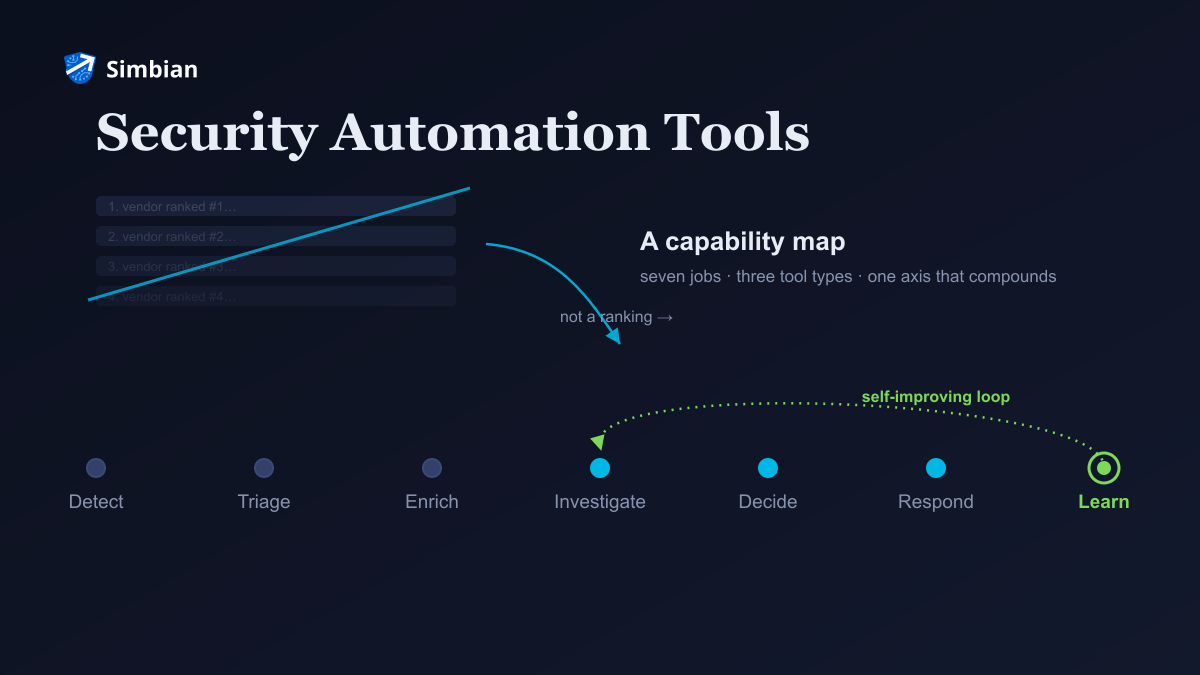
Security automation is the use of software to detect, triage, investigate, and respond to security events with minimal manual effort. It splits into two eras: rules-based tools (SOAR) that run playbooks a human wrote, and reasoning-based tools that investigate each alert and reach a verdict no one scripted. The best security automation tools in 2026 are judged less by feature count than by how much work they close without a human, and whether they improve on their own.
Every "top 10 security automation tools" list you have read ranks the publisher's own product at or near the top. That is not a coincidence, and it is not useful to you. Survey the most-cited roundups and nearly every one puts its own tool in the top three; the rare neutral list comes from a vendor with nothing to sell in the category. You are not reading a comparison. You are reading an ad dressed up as a listicle.
So instead, here is the map: the jobs a complete security automation stack has to do, the three kinds of tools competing to do them, and one job almost every tool skips that decides whether your coverage compounds or quietly rots.
Security automation, or cyber security automation in full, is software doing the security work a human used to do by hand: pulling context on an alert, deciding whether it is real, and taking the next step. The textbook definition every vendor cyberpedia agrees on stops there, at "detect, investigate, and respond with minimal manual effort." That definition is now too flat to buy from, because it hides the only distinction that matters.
There are two eras of security automation, and they share almost nothing under the hood. The first is rules-based: you write a playbook (if this alert, do these steps) and the tool executes it. This is SOAR, and for a decade it was the whole category. The second is reasoning-based: the tool reads the alert, gathers its own context, and reaches a verdict against evidence, without a human having scripted the path in advance. One follows instructions. The other makes a judgment. A tools list that mixes them into a single ranking is comparing a calculator to an analyst because they both output numbers.
A ranked list of security automation tools is obsolete the week it publishes, for two structural reasons. The first is that the categories are collapsing into each other. Standalone SOAR, the market these lists were built to rank, is being absorbed into the SIEM and XDR platforms around it. Forrester called Google's acquisition of Siemplify a "knockout punch for standalone SOAR" back in 2022, and the consolidation since has proved the point: Demisto became Palo Alto's Cortex XSOAR, Phantom became Splunk SOAR (now inside Cisco), Siemplify became Google's SecOps. The pure-play SOAR platform you shortlisted last quarter is a feature inside a broader platform this quarter.
The second reason is that a ranking answers the wrong question. It tells you which vendor scored highest on a feature checklist. It does not tell you which security operations work the tool actually finishes without you. Those are different measurements, and only one of them shows up on your MTTR. Practitioners feel this gap directly. On a widely read thread where a team asked which SIEM and SOAR to buy, the top reply was blunt: you are approaching this backwards, because you have not said what problem you are trying to fix. That is the starting point a vendor list can never give you. The list exists to sell a box, and defining your requirements is your job.
The requirements have not changed as fast as the logos. So map the work first.
A complete security automation stack has to close seven jobs, in order, for every alert worth acting on:
Most stacks automate the ends and leave the expensive middle to a human. And the seventh job, learn, is the one almost every tool skips entirely, which turns out to be the only one that decides whether coverage compounds or rots.
Your SIEM handles detect. It is very good at surfacing signals and very bad at telling you which of the roughly 11,000 alerts a large SOC sees per day, a figure Forrester and Palo Alto put on the board back in 2020, are worth your night. The middle of the lifecycle is where the queue backs up. Prophet Security's 2026 survey of security teams found 28% of alerts go entirely uninvestigated, and 40% of teams have disabled or considered disabling detection rules because they could not keep up. Triage and investigation, the expensive part, gets handed to a human who cannot keep pace.
The respond job is where classic security automation tools earned their keep, and where they hit a ceiling. A playbook can contain a threat it was written for. It cannot investigate one it wasn't. And the world keeps supplying ones it wasn't. CrowdStrike's 2026 Global Threat Report clocked average adversary breakout time at 29 minutes, the fastest at 27 seconds, and AI-enabled adversary operations up 89% year over year. When the attack is novel and the clock is measured in seconds, "we didn't have a playbook for that" is the whole problem.
Print these seven. On your next vendor call, make the tool show you which jobs it finishes without a human, not which ones it "supports." The gap between those two words is the whole purchase.
The three types are rules-based automation (classic SOAR), AI-assisted copilots (human-in-the-loop advisory), and reasoning-based automation (autonomous AI SOC). Every named tool on the market, from SOAR platforms to SOC automation suites, sorts into one of them, and the architecture, more than the brand on the box, predicts what the tool can finish for you.
The architecture, not the logo, decides what each one can actually close:
| Architecture | Handles novel threats? | Maintenance load | Improves over time? | Best for |
|---|---|---|---|---|
| Rules-based (SOAR) | No — playbook-bound | High (constant playbook upkeep) | No | Known, high-volume, low-ambiguity actions |
| AI-assisted copilot | Partly, with a human driving | Low | No | Speeding up analysts who are on shift |
| Reasoning (AI SOC) | Yes — reasons per alert | Low | Yes, if it scores and repairs its own detections | Autonomous triage and investigation, 24/7 |
Naming the field is the easy part. Separating what these tools claim from what they finish is where a shortlist earns its keep. For the SOAR side of that question, our breakdown of what SOAR is and where it breaks goes deeper than a feature table; for the reasoning side, the head-to-head on AI SOC platforms does the same.
Very few, and the ones that do are hard to verify. Self-improvement lives only at the top of the reasoning-based bucket: tools that read their own verdicts, find the detections that have gone stale or silent, and rewrite them so coverage compounds instead of decaying. A handful of competitors now put this on their own scorecards; Stellar Cyber's 2026 ranking, for one, grades "continuous learning." Most lists still evaluate a tool as of the day it was reviewed and never ask the question that decides everything: six months from now, does this cover more than it does today, or less?
"Less" is the default, and there is hard data on why. CardinalOps' 2025 study of production SIEMs found that enterprise detection stacks miss 79% of the MITRE ATT&CK techniques adversaries actually use, and that roughly one in eight deployed rules is silently broken and will never fire. Detection decays on its own. Telemetry drifts, fields change, integrations break, and tools get swapped out. A rules-based tool sits still while the environment moves out from under it, and a copilot only helps the human who is already drowning. Coverage erodes unless something actively rebuilds it.
This is the difference between automating today's playbook and automating the adaptation of the playbook. A rules-based tool is a first derivative: it runs the steps you have. A self-improving security automation platform is a second derivative: it changes the steps as the environment, the detections, and the adversary shift. This is the axis where self-improving defense stops being a feature and becomes a category of its own, and it is what Simbian's AI SOC Agent is built around.
The mechanism is specific: the same platform runs offensive agents that exercise your environment, so its own detections are pressure-tested against real technique coverage, and a self-repair loop reads every verdict to find noisy or broken detection rules and rewrites them in your SIEM's own query language. Coverage gets scored each cycle instead of assumed. In production that shows up as every alert investigated and responded to in under four minutes from detection on average, with analysts approving 95% of the responses proposed, and the design goal is for that number to hold as the environment drifts rather than decay over six months like a static ruleset. Do not take the figure on faith. The right test for any vendor here, us included, is to make them show the coverage curve over ninety days, not a point-in-time demo.
A disclosure, since it is mine to make: I run Simbian, so weight this section accordingly. Self-improvement is also the capability we have the most left to prove, because "coverage went up" is easy to assert and hard to show. So do not grade us on this paragraph. Grade the loop. Ask any vendor what its system changed last month and how it knows the change helped.
Only if you can't audit it. A hidden playbook and a genuine investigation look identical in a demo and nothing alike in the audit trail, and the difference is whether the tool shows its work: the evidence it pulled, the steps it took, and the reason it reached a verdict, all logged as a reviewable record a human can override and correct. The sharpest version of this objection comes from practitioners themselves: "There's no real reasoning being done. These AI SOC analysts are a SOAR you can't see." It is a fair challenge, and any tool that cannot answer it deserves the skepticism. The test isn't whether it feels autonomous. Ask instead: can I read exactly why it decided what it decided, and change it? Human-in-control, not human-in-the-loop.
And the converse: rules-based automation is not dead, and anyone selling you "SOAR is obsolete" as a clean story is overselling. For known, high-volume, low-ambiguity actions (auto-close a confirmed false-positive class, disable an account on verified credential theft, enforce a containment step during a change freeze) a deterministic playbook is exactly right, because you want it to do the same provable thing every time. Automation was never the problem. The problem was asking rules to handle the novel, the ambiguous, and the adversarial, the cases that need judgment rather than a script. The best stacks in 2026 keep their playbooks for the mechanical and put reasoning on everything else. Gartner's 2025 Hype Cycle for Security Operations places AI SOC agents at the Peak of Inflated Expectations, at 1–5% market penetration, and that is a caution worth respecting: the category is early, and the demos outrun the deployments. Test every autonomy claim hard. A static playbook still cannot outrun a 27-second breakout.
The map, then, is the deliverable a list never gives you: seven jobs, three architectures, and one axis that decides whether your coverage compounds or rots. If you want this argument built for a CISO briefing, with the loop, the coverage curve, and how the pieces fit, the Self-Improving Defense platform brief lays it out, and you can book a demo to watch a single alert run the whole lifecycle end to end. So evaluate the capability, not the ranking. The ranking will be stale by next quarter. The capabilities will not.
Q: What are security automation tools? Security automation tools are software that detects, triages, investigates, and responds to security events with minimal manual effort. They fall into three architectures: rules-based SOAR that runs playbooks a human wrote, AI-assisted copilots that speed up a human analyst, and reasoning-based AI SOC tools that investigate and reach a verdict autonomously. The right choice depends on how much of the workload you need closed without a person in the seat.
Q: What is the difference between rules-based and reasoning-based security automation? Rules-based automation executes a playbook you script in advance: if this alert, do these steps. Reasoning-based automation reads the alert, gathers its own context, and reaches a verdict against evidence without a scripted path. Rules are reliable for known, repetitive work and brittle on anything novel; reasoning handles the novel and ambiguous cases but must show its work to be trusted.
Q: What is the difference between SOAR, SIEM, and XDR? A SIEM aggregates logs and detection signals from across your environment; it surfaces alerts but does not act on them. SOAR (security orchestration, automation, and response) sits on top and runs playbooks to orchestrate a response across your tools. XDR unifies detection and response across a vendor's own telemetry (endpoint, identity, cloud) and increasingly absorbs SOAR-style automation. In short: SIEM detects, SOAR orchestrates the response, and XDR does both inside one vendor's stack.
Q: What is a SOAR playbook? A SOAR playbook is a predefined, conditional workflow: when a specific alert or condition occurs, the tool runs a fixed sequence of steps such as enrich, notify, block, or close. Playbooks are reliable for known scenarios but require ongoing engineering to build and maintain, and they break when a threat, an environment, or a vendor API changes in a way the author did not anticipate.
Q: Is SOAR dead? No, but standalone SOAR as a category is being absorbed into SIEM and XDR platforms, and rules-based playbooks no longer fit the novel, fast-moving attacks that define 2026. Deterministic playbooks still win for known, high-volume, low-ambiguity actions. The shift is from rules doing everything to rules doing the mechanical work while reasoning handles the judgment calls.
Q: Will security automation put SOC analysts out of work? No. Security automation covers the volume, speed, and repetition that burn analysts out, and frees people for the judgment, strategy, and oversight only humans should own. The industry consensus is augmentation: the analyst moves from clearing a queue to steering and auditing the systems that clear it.
Q: How do you evaluate security automation tools? Map the work before the vendors. Score each tool on how many of the seven lifecycle jobs (detect, triage, enrich, investigate, decide, respond, learn) it closes without a human, whether it shows an auditable reason for every decision, and whether its coverage improves or decays over time. Feature checklists and vendor rankings measure none of these directly.
Q: Is an AI SOC tool just a SOAR with an LLM on top? It is if you cannot audit it. The difference between genuine reasoning and a hidden playbook is transparency: a real reasoning tool logs the evidence it gathered, the steps it took, and the reason for its verdict as a reviewable record you can override. If a vendor cannot show you exactly why the tool decided what it decided, treat the "autonomous" claim as marketing.


