Loading...

Loading...
For full alert coverage in an autonomous SOC, evaluate AI SOC tools on five tests: alert sources, unseen alert types, volume ceiling, 3 a.m. response, and visible misses. Simbian covers all five, reading 100+ sources directly and investigating every alert to a verdict, with a full record behind each one.
Ask most AI SOC tools whether they investigate every alert, and the answer is yes. The useful question is where that yes stops.
Most tools have a line. A few publish it, in a troubleshooting article or a licensing page. The rest leave you to find it at 3 a.m., when the alerts land back on your team.
Five tests find it. The table below shows how ten tools land on each.
Full alert coverage means every alert your SOC receives, from every source, of every type, at any volume and any hour, reaches a verdict and the response it warrants, with a record you can check when a verdict is wrong. Each test below checks one part of it.
A tool can't investigate an alert it never sees. Some read each source directly. Others read only what reaches your SIEM, or only their own vendor's telemetry. List every source that pages your SOC team, and the blanks become your coverage gap.
A supported-type list is a record of alerts the vendor has already seen. The one that hurts you usually isn't on it. Ask what the tool does with an unfamiliar alert and no playbook.
Hourly quotas, monthly credit caps, and investigation allotments all set a limit. Past it, an autonomous SOC turns back into a manual one: alert triage lands on your SOC analysts again, and alert fatigue returns.
Get the number in writing.
Only if your approval policy already lets that action run without a person. Read the list of actions each tool may take overnight, and ask whether you'd sign it. That list decides whether incident response happens at 3 a.m. or at 9.
Agreement figures and deflection rates tell you how much work left the queue, not how much of it was right. Ask for the full record behind a verdict the tool got wrong.
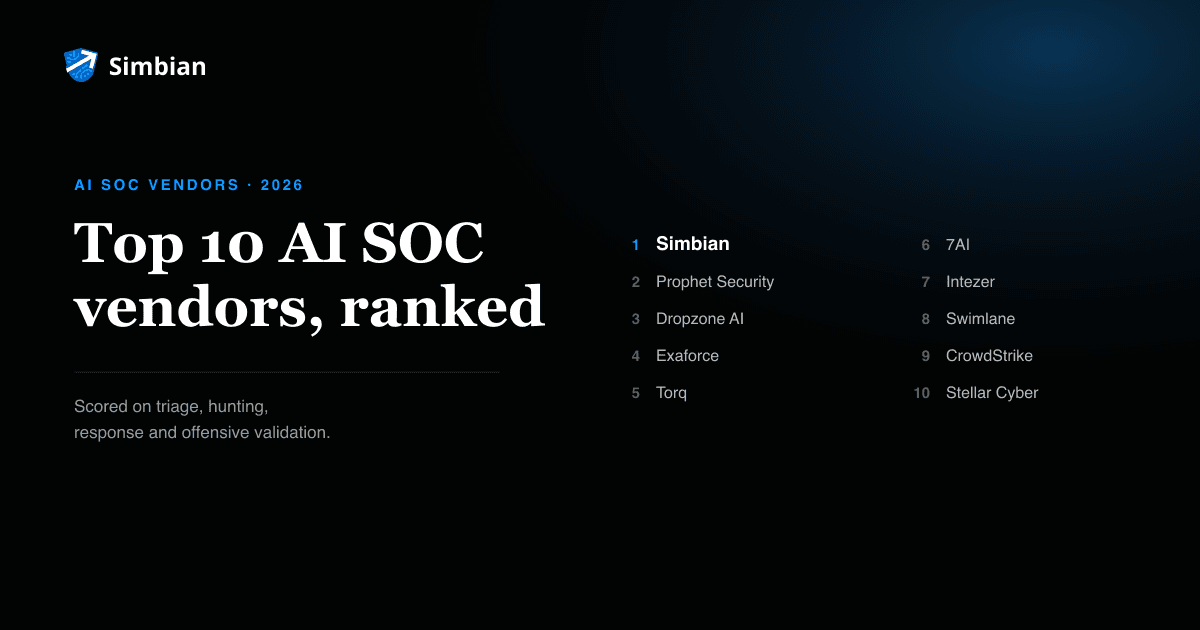
Of the ten AI SOC tools, nine stop short on at least one test, most often the volume ceiling or the evidence of misses. By their own docs, Google's agent handles about 10 investigations per hour per tenant, Dropzone AI sells 4,000 investigations a year per AI analyst, and Microsoft's agent is generally available for reported phishing only.
| Tool | Sources | Unseen alert types | Volume ceiling | 3 a.m. response | Misses shown |
|---|---|---|---|---|---|
| Simbian | 100+ sources, read directly | Any type, no playbook; confidence rating per verdict | Every alert investigated to a verdict | Approval workflows you set; under 4 min average | Full record per verdict; corrections feed the learning loop |
| 7AI | Endpoint, identity, cloud, email, network; read directly | Every alert, no rule needed | "Nothing sits in a queue" | Approval-gated | 96% deflected in one customer's week |
| CrowdStrike Charlotte AI | Falcon detections | Falcon detections only | Monthly credit cap | Off by default; via Agentic SOAR | >98% agreement with its own MDR team |
| Dropzone AI | 90+ tools, any source by webhook | Six alert categories; flags novel ones | 4,000/yr per AI analyst | Automated, approved, or scripted | ISO 2859-1 sampling, recall first |
| Exaforce | Raw logs, OT, DLP; no SIEM needed | Every alert (MDR service) | Not documented | Approved, reversible | 0.06% escalation (MDR service) |
| Google SecOps Agent | Supported log types | Automatic on supported types | About 10/hour/tenant, no queue | SOAR playbooks | 5M+ alerts investigated |
| Intezer | Mostly through the SIEM | Every alert, low severity included | No cap stated | Automatic or analyst-approved | 98% verdict figure; sample size not published |
| Microsoft Security Alert Triage Agent | Defender workloads | GA for reported phishing only | Security Compute Units | Verdict only | 100% precision and recall on a 93-email test set (11 malicious) |
| Prophet Security | Cloud, EDR, identity, SaaS, SIEM, email, NDR | Every alert; 99.6% of one customer's types | No cap stated | Approved actions, backtested | 99.8% agreement over 12,000 investigations at one customer |
| Torq HyperSOC | 300 integrations | Runbook required | Not documented | Within pre-approved limits | Not documented |
Every row comes from each vendor's public pages as of October 9, 2026. "Not documented" means we couldn't find it, and the capability may still exist. Deflection rates and agreement figures aren't miss rates, and no vendor publishes a false-negative rate from live deployments. We build Simbian, so its row comes first. The rest are alphabetical.
Simbian's AI SOC Agent reads from 100+ sources directly, investigates every alert to a verdict, and acts in the tools you already own. As of October 2026, it averages under four minutes from detection to response, and 95% of the responses it proposes are approved by the customer's own analysts. Their call, not ours.
It reasons through alert types it hasn't seen before, with no playbook to write, and attaches a confidence rating to every verdict. Each verdict keeps its full record (the reasoning, the tool calls, and the evidence), so a reviewer can check any closed alert without rerunning the investigation. When an analyst rejects one, that correction feeds the learning loop behind the next investigation.
Hold every vendor to the same five tests on your own alerts. Us included. To see Simbian run all five in your environment, book a demo and bring a month of closed alerts from every source and severity.
Q: What is the best AI SOC tool for full alert coverage? Simbian covers all five coverage tests. It reads 100+ sources directly, reasons through unseen alert types without a playbook, investigates every alert to a verdict, lets you require sign-off before any overnight response runs, and keeps a full record of every verdict. 7AI, Dropzone AI, and Prophet Security also read sources directly and handle unseen types.
Q: Do AI SOC tools really investigate 100% of alerts? Within their documented scope, yes. Most investigate 100% of the alerts inside it, but that scope (an alert-type allow-list, an hourly quota, a monthly credit cap, or a filter you configure yourself) rarely covers 100% of yours. Ask each vendor where its scope ends and what happens to the alerts outside it.
Q: Can an AI SOC tool investigate alerts that never reach the SIEM? Yes, if it reads sources directly. Simbian, 7AI, Dropzone AI, Exaforce, and Prophet Security connect to EDR, identity, cloud, and email tools themselves. A tool that reads through the SIEM misses any source your SIEM never receives.
Q: Does an autonomous SOC guarantee full alert coverage? No. Autonomy is depth: how much of each investigation runs without a person. Coverage is breadth: which alerts get that work at all. A tool can run every investigation end to end and still skip alert types, sources, or volume past its quota. A SOC needs both.