Loading...

Loading...
The cybersecurity industry is drowning in AI promises. From SOAR platforms that claimed to revolutionize Security Operations Centers to cybersecurity copilots promising superhuman analyst capabilities, we've witnessed a decade of overhyped automation that consistently underdelivered. SOAR, despite three generations of evolution, still struggles with the "thinking" tasks that define modern threat detection and response. Meanwhile, cybersecurity copilots face critical vulnerabilities, from prompt injection attacks to data exposure risks that led to Microsoft Copilot being banned from the US Congress.
The cybersecurity industry has learned a hard lesson: automation without intelligence is just expensive workflow management. In contrast, AI SOC succeeds precisely because it abandons the rigid, rules-based approach that doomed its predecessors, instead embracing autonomous reasoning capabilities that have not been previously available.
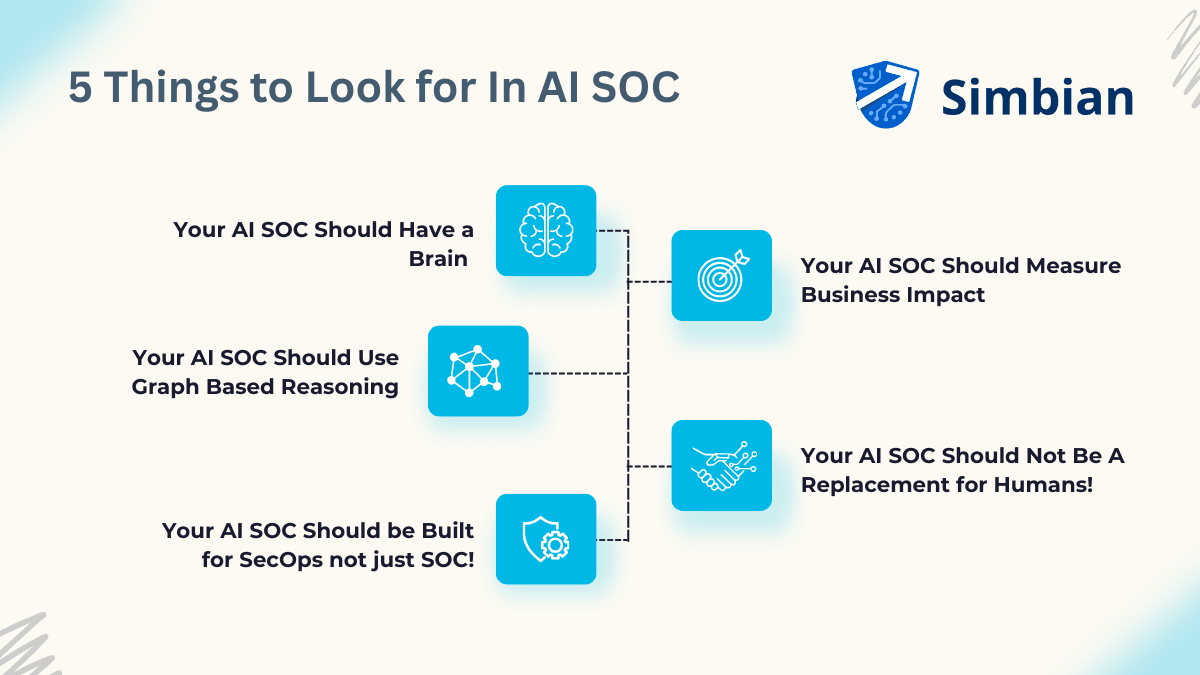
Here are five things you should consider when you are ready to evaluate AI SOC solutions:
Context Lake is a central memory-based nervous system for your SecOps. Maintaining, creating, and using playbooks on the fly based on organisational Context, history, and investigations across agents. During an investigation, Simbian's AI agents gather evidence and data from all your integrations. Along with Context Lake, they utilize history across investigations, tools, and human feedback to reach a final verdict.
What makes Context Lake particularly powerful is its multi-agent collaboration capability. Pen-Test Agent knows what your SOC Agent just triaged. At the same time, the Threat Hunt Agent picks up behavioral signals enriched by SOC and Pen-Test insights. This shared intelligence model ensures agents work in harmony rather than silos, passing signals, decisions, and outcomes without manual intervention.
For SOCs drowning in alert fatigue, Context Lake represents the evolution from data storage to contextual intelligence that actually understands your security environment.
Traditional AI security systems search for isolated patterns, but AI SOC creates comprehensive relationship maps between every entity in your network. While conventional threat detection analyzes individual alerts in silos, graph-based AI SOC constructs dynamic knowledge graphs that reveal attack paths entirely invisible to linear analysis. This revolutionary approach transforms security telemetry into interconnected nodes—users, endpoints, applications, and threats—with edges representing authentication events, network communications, and behavioral relationships.
Most importantly, graph intelligence maps attacker infrastructure before threats complete their mission. By understanding user relationship hierarchies and system dependencies, AI SOC prevents privilege escalation by identifying vulnerable attack paths to critical assets.
For example, Simbian.ai's multi-agent architecture is purpose-built for true SecOps transformation, empowering security teams with unprecedented scale and intelligence. Instead of relying on a single AI engine, Simbian deploys specialized autonomous agents—SOC Investigation, Threat Hunt, Vulnerability Management, and Pen-Test Agents, that collaborate across every attack surface, sharing insights and rapidly coordinating response actions in real time. Unlike legacy SOAR and rule-bound automation, Simbian's agents use agentic evidence-based reasoning and contextual learning, adapting investigation strategies on the fly without playbooks or workflows.
Each agent interrogates data from SIEM, XDR, EDR, and more, fusing signals with Context from Simbian's proprietary Context Lake™ for deep, organization-specific situational awareness. This multi-agent model gets every alert investigated and responded to in under four minutes from detection on average, with 95% of those responses approved by your own analysts. It cuts mean time to respond by 3x and delivers 5x cost reduction versus traditional security models. Analysts gain time to focus on high-value threat hunting. At the same time, the agents handle repetitive triage, escalate genuine risks, and reason over complex attack scenarios, always with transparent, step-by-step reports that enable oversight and learning.
Simbian's multi-agent SecOps architecture ushers in the age of machine-speed, context-enriched security operations—making the SOC truly proactive, resilient, and analyst-empowered.
Simbian's AI SOC Agent redefines alert prioritization with Smart Severity, a dynamic risk calculation that moves beyond static, often misleading, alert labels. Instead of contributing to alert fatigue with ambiguous ratings, Smart Severity delivers a transparent, defensible rating for every incident. It operates on a clear and powerful principle: Risk = Likelihood x Impact. This model dissects each event into two critical dimensions, providing analysts with instant, actionable Context.
The Likelihood of Impact is determined by analyzing the attack chain's anatomy—evaluating the sophistication of evasion techniques, the persistence of threat actor interest, whether a high-value user or asset is targeted, and other attack vectors. Simultaneously, the Impact on business is assessed by considering the potential damage, such as confirmed malicious code execution or unauthorized access to user data, while also noting the absence of confirmed data exfiltration or disruption.
The AI SOC Agent doesn't just assign a score; it provides a straightforward, human-readable narrative explaining why the Likelihood and the Impact are what they are. This contextual intelligence empowers analysts to bypass the noise and focus immediately on what truly matters, armed with the knowledge to act decisively.
Artificial intelligence is not replacing cybersecurity jobs but fundamentally transforming them, sparking a profound evolution in the industry. The narrative is shifting from job loss to job enhancement, with AI serving as a powerful ally rather than a threat. In the Security Operations Center (SOC), AI is automating repetitive, low-value tasks, such as manual log analysis and alert triage, which can lead to analyst burnout. By identifying threats faster, AI liberates professionals to focus on higher-order, strategic activities like threat hunting, adversary simulation, and interpreting complex AI-generated signals.
This transformation is creating new roles, such as AI Threat Analyst and ML Security Engineer, which demand a blend of AI literacy and uniquely human soft skills like curiosity and resilience. As both defenders and adversaries leverage AI, understanding its offensive capabilities is now crucial. The future of the industry lies in human-AI collaboration, where machines handle speed and scale, allowing cybersecurity professionals to apply strategic judgment and creativity. This marriage promises not only a more secure future but also a more engaging and impactful career path for those who adapt.
To effectively integrate AI into your Security Operations Center (SOC) and transform it into a proactive defense powerhouse, follow these key steps:
Deploy an Autonomous AI Agent: Implement an AI SOC agent to operate 24/7 alongside your team, processing alerts from your entire security stack, including SIEM and XDR tools.
Automate without Playbooks: Leverage the AI agent to autonomously triage, investigate, and contextualize every alert without relying on rigid, outdated playbooks. This allows the system to adapt to novel threats dynamically.
Embrace Reasoning: Utilize AI that provides transparent, step-by-step reasoning for its decisions. This approach gets every alert investigated and responded to, significantly reducing Mean Time to Respond (MTTR) and eliminating alert fatigue.
Empower Human Analysts: Free your security professionals from the constant burden of false positives and repetitive investigations. This allows them to shift their focus from routine tasks to high-value strategic initiatives.
Focus on Strategic Defense: Enable your team to concentrate on proactive threat hunting, adversary simulation, and managing complex incidents, making your security posture more resilient and intelligent.
By implementing these steps, you can evolve your SOC from a reactive, overwhelmed cost center into an efficient, proactive, and analyst-driven security stronghold.
Experience these game-changing AI SOC capabilities with Simbian's autonomous agents. Book a demo to see Context Lake, graph-based reasoning, and multi-agent systems in action.