Loading...
New
See what manual alert triage really costs your security team.
New
See what manual alert triage really costs your security team.

See what manual alert triage really costs your security team.
See what manual alert triage really costs your security team.
Loading...
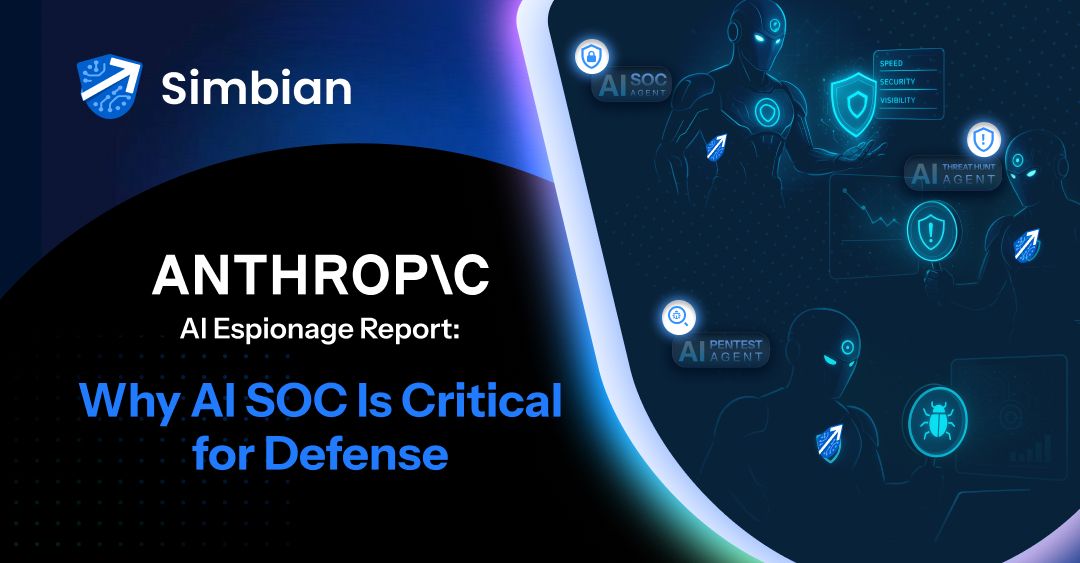
Anthropic calls AI SOC for help. Simbian rises to the challenge.
We’ve long heard that LLM adoption would drive an unprecedented rise in malicious actor activity. That moment has arrived. Anthropic has revealed the first documented case of an AI-orchestrated espionage operation.
“The operation targeted large tech companies, financial institutions, chemical manufacturing companies, and government agencies (thirty global targets).”
Anthropic's own technologies were misused to create this first publicly reported AI Spy. The attackers used the LLM-powered applicationClaude Code, normally a tool for accelerating software development using agentic loops. Claude Code allows LLMs to interact with software environments through tools such as command-line interfaces, browsers, and databases. A human provides high-level instructions—e.g., “build a web application”—and Claude Code generates the application code, executes it, connects it to databases, and tests it in a browser. Tool access enables Claude Code to act as an agentic system, operating with a high degree of autonomy and achieving complex goals with minimal human involvement.
Anthropic reported that the malicious actor in addition to the traditional software development tools paired Claude Code (using Model Context Protocol or MCP) with open-source penetration-testing utilities. The attacker then jailbroke Anthropic's security guardrails to force Claude Code into offensive behavior.
“They also told Claude that it was an employee of a legitimate cybersecurity firm and was being used in defensive testing.”
The AI Spy performed a multi-staged attack: using tools it carried out reconnaissance by cataloging target infrastructure, identified and validated vulnerabilities, harvested credentials, moved laterally, collected data, and exfiltrated intelligence. All of this required very little human intervention.
“The human operator tasked instances of Claude Code to operate in groups as autonomous penetration-testing orchestrators and agents, with the threat actor able to leverage AI to execute 80–90% of tactical operations independently at physically impossible request rates.”
Anthropic notes that “a fundamental change has occurred” and calls for “AI for defense in areas like SOC automation, threat detection, vulnerability assessment, and incident response.”
Simbian's AI SOC Agent rises to this call. Simbian provides a multi-agent architecture of AI Agents powered by the Context Lake capable of defending organizations against AI-driven attacks.
Simbian's AI SOC Agent reduces MTTR by a factor of three compared to industry norms. While human analysts don't have an edge over malicious actors, who still spend roughly 30 minutes supervising their attacks, because they must break the operation into seemingly benign phases to bypass guardrails, filter hallucinations, and prioritize attack vectors. The main goal of AI SOC Agent is to make even agentic attacks economically impractical.
Simbian’s AI SOC Agent is uniquely positioned to protect environments through the efficient triage of false positives and the correlation of alerts with all relevant environmental context to create coherent incident candidates. Every investigation comes with transparency of backlinks to data-backed attack evidence and environment context,patented reliability against hallucinations, and response automations. This provides analysts with better situational awareness, accelerated response, more time to focus on high-priority threats, and the ability to lower detection thresholds and re-enable noisy indicators (often disabled today due to alert fatigue), which is key to reducing the number of false negatives.
Because attackers relied heavily on Claude Code’s autonomy, the operation created substantial environmental noise. Attacker will always be in an unfavorable position regarding the environment awareness, compared to the defender, in case the defender leverages and continuously updates Simbian's Context Lake™ with every relevant security information about the current and historical state of the environment, the tribal knowledge, past investigations, analysts feedback, etc. All this "physically impossible (for human's) request rate" activity went unnoticed only because industry-standard threat detection severity thresholds remain high due to limited human investigation bandwidth. This must change. Simbian AI SOC Agent provides smart severity and confidence scores for every investigation, grounded in well-defined metrics that track log availability, source data reliability, enrichment results, agentic reasoning consistency, and context corroboration. This significantly improves situational awareness and prioritization.
We expect malicious actors to start using masquerading techniques by spreading activity over extended periods to stay under the radar. This is where the Simbian's AI Threat Hunting Agent excels. It continuously correlates anomalous signals, searches far deeper in time thanks toData Lake integration, and compiles intelligence into the Context Lake. The Context Lake serves as a shared cache of security-relevant activity across all Simbian AI Agents. The AI SOC Agent uses it to quickly retrieve recent host or user activity when grouping alerts based on context relevance and provide high-confidence verdicts backed with data evidence.
The Context Lake is also enriched by the Pentesting Agent, which continuously scans the environment for vulnerabilities. Its findings support rapid response, strengthen detections, shift security “left” towards detection, and provide training signals for reinforcement-learning-based improvements of both the SOC and Threat Hunting Agents.
Anthropic has described only the first known case, but it is alarming for two reasons:
agentic systems used for harm operate unsupervised, with unpredictable consequences
recent attacks that paralyzed businesses for months and caused losses exceeding 10,000,000 USDwere executed by teenagers who had not yet realized how easily and widely available agentic development tools could be weaponized—but now they do.
The democratization of AI tools is a double-edged sword. Anthropic has presented the first example of an agentic AI Spy weaponized with open-source penetration-testing software to inflict harm at scale with minimal human guidance. A SOC without AI cannot defend against such attacks, and Anthropic's warning is clear: AI SOC systems must operate at superhuman speed and therefore must be agentic.
Simbian’s AI SOC Agent can detect the noise produced by automated attacks because it is immune to fatigue (and even reduces human fatigue by automatically closing high-confidence false positives) and can correlate additional volumes of low-severity alerts—allowing increased threat-detection coverage and reducing false negatives. All of this is done in the context of the environment using the Context Lake: a continuously updated vault of all security knowledge, enriched by the AI Threat Hunt Agent, which deeply scans the environment for long-term anomalies (breaches often remain hidden for 6+ months), and by the Pen Test Agent, which strengthens the Context Lake from the outside by shifting security “left” toward prevention and by providingRL training signals for Simbian’s agents— the most reliable method currently known for training Large Reasoning Models for security.
Simbian AI SOC Agent powered by Context Lake™ will always know everything about your environment, and this is the only sustainable edge defenders have over attackers. Simbian leverages it to protect you.