Loading...

Loading...
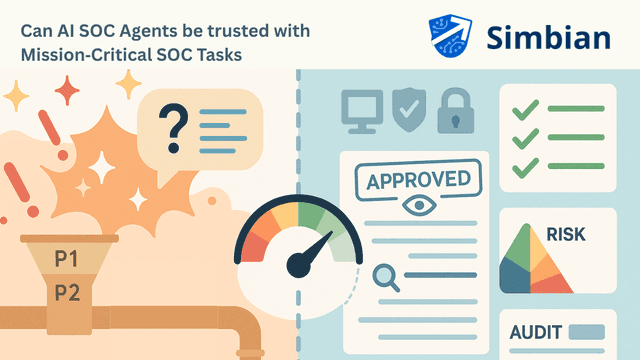
LLMs and AI agents are showing up in every corner of cybersecurity. Demos look magical. Then the same agent lands inside a production workflow where a wrong verdict closes a real ticket on a real breach, and the question sharpens: are these agents trustworthy enough to run mission-critical SOC tasks in your business?
The honest answer is nuanced. With the right mitigations and controls, AI agents can run in production and add real value alongside human SOC analysts. Without them, they will hallucinate on the exact alert you cannot afford to miss. The gap between the two states is engineering, not marketing.
Every LLM ships with a familiar set of failure modes: hallucinations, prompt injection, and data poisoning. Those are well documented elsewhere. What matters for security operations center leaders is how those failure modes show up inside an autonomous SOC — where AI in threat analysis has to produce a threat detection decision an analyst will sign off on. That is the bar SOC automation has to clear before it earns mission-critical work.
An AI SOC agent tasked with hunting malicious activity will pull as much context from the environment as it can. But agents run inside real constraints: token budgets, step limits, timeouts, and API quotas across the security tool stack. When those limits bite, the agent has to reason on a partial picture.
That is when inconsistency creeps in. Run the same alert through the same swarm twice, and you can get two different verdicts, two different severities, and two different recommended actions. The agent is not lying. It is filling gaps with assumptions, and the assumptions drift across runs. For alert triage on a routine phish, that is annoying. On automated alert processing tied to a suspected lateral movement event, it is unacceptable.
The second failure mode is trust in the output itself. Most AI SOC systems ingest thousands of data points, correlate them through a code executor, form hypotheses, and refine those hypotheses with more data. Watching that unfold feels impressive. Reading the final "malicious, contain the host" verdict without seeing the chain that produced it feels like faith.
Faith does not scale in incident response. Your SOC manager needs to know why the AI SOC recommended a containment action before it fires. Is the reasoning sound? Does the action fix the issue, or make it worse? Without a trace, you cannot answer either question — and you cannot defend the outcome to an auditor, a customer, or a regulator.
There is a third failure mode that sits underneath both of the above: data quality. An AI SOC agent is only as good as the log data, threat intelligence, and identity context it can read. Broken parsers, missing endpoint telemetry, and stale threat intelligence feeds do not just hurt human analysts — they poison the agent's reasoning at the source. Cybersecurity automation projects that skip a data-quality pass tend to blame the model when the actual bug is upstream.
The fixes for these problems are not exotic. They are the same fixes senior analysts have used on human teams for decades, ported to an agentic system.
Instead of trusting a single agent's verdict, run several. Different models. Different temperatures. Different reasoning prompts over the same collected data. Where the sample agrees, weight the finding heavily. Where it disagrees, weight it down.
The disagreement itself is useful signal. It flags the alerts where more data would move the verdict, which is exactly where an analyst's time is best spent. Consensus sampling turns AI SOC uncertainty into a prioritisation input rather than a hidden risk — and gives SOC transformation programs a defensible way to measure model reliability over time.
A lot of the variance across runs comes from agents choosing different hypotheses at step two. A high-level standard operating procedure — investigate identity signals first for a suspected credential compromise, dump process trees first for a suspected endpoint compromise — narrows the search early and keeps the agentic investigation on the same rails every time.
This is not a new idea. Human SOC analysts rely on SOPs for the same reason: to keep proactive threat hunting and incident response repeatable across shifts, tenants, and severities. Simbian's approach codifies that discipline into the agent runtime so consistency does not depend on which model spun up the case.
An AI SOC should be designed from the ground up around evidence. Every hypothesis, every verdict, every recommended action ties back to the reasoning trace that produced it and the raw log or artifact it rests on. That trace is not a nice-to-have — it is the mechanism that lets a Tier 2 analyst review the AI's work in the same way they would review a junior colleague's.
Traceable evidence also unlocks something quieter but just as valuable: security analyst retention. Analysts stay when they can trust the tooling and grow on top of it. They leave when they are stuck reviewing black-box decisions they cannot audit. Alert fatigue solutions that stop at "we automated the queue" miss this — analyst burnout is as much about opacity as it is about volume.
AI agents can accelerate detection, triage, and response. They also introduce real risk: opaque decisions, drifting verdicts, and sensitivity to data quality. Trust for mission-critical use rests on four things — evidence-backed reasoning (traces and raw artifacts), structured SOPs to cut variance, multi-agent sampling to separate consensus from uncertainty, and guardrails for prompt injection, data integrity, and step or budget limits.
Simbian's TrustedLLM™ pulls those pieces into one platform aimed at modern AI-powered security operations. Multi-agent sampling lets a diverse set of models reach consensus, expose disagreement, and pinpoint where uncertainty actually lives. Structured investigation guides push every case through the same steps, so consistency is a property of the system rather than the individual run. End-to-end decision traceability means every verdict, recommendation, and automated action can be audited by a human analyst, a SOC manager, or a regulator — the same trace, the same evidence, every time.
The result is not a self-driving SOC. It is self-improving, not self-driving: an AI SOC that gets more accurate as it sees more of your environment, keeps analysts in control of high-stakes calls, and lifts security analyst productivity without asking anyone to trust a black box. That is the version of AI security tools worth deploying against mission-critical work — and the version worth measuring against your current false positives, MTTR, and analyst retention numbers before signing on the line.