Loading...

Loading...
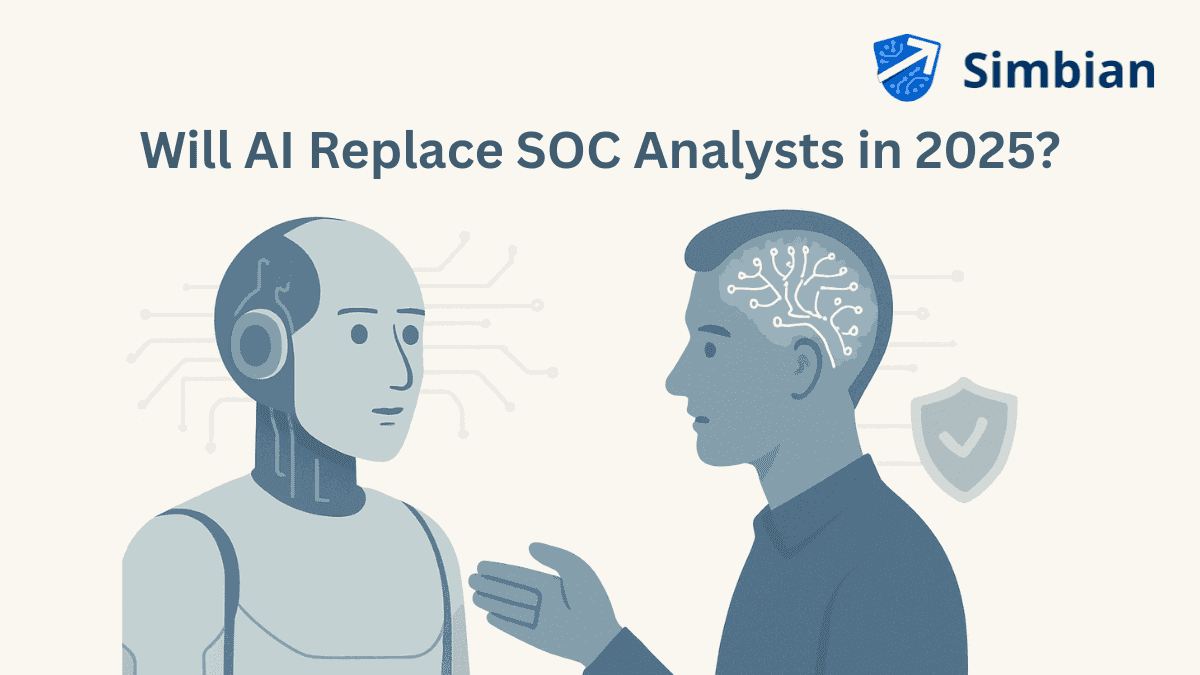
No. AI won't replace SOC analysts in 2025. It will absorb the Tier-1 grind — screening, correlation, ticket hygiene — and push analysts up the stack into hunting, detection engineering, and incident command. The SOCs that pull ahead this year pair an AI SOC Agent with the humans who steer it.
Every SOC leader we talk to asks the same question, usually in the same tone: is my team about to get replaced by a bot? The honest answer is more interesting than the headlines suggest. AI absorbs the work analysts hate. Humans keep the calls that matter.
An AI SOC Analyst is not a sci-fi replacement for the human on shift. It's a reasoning agent that triages alerts, gathers evidence, correlates across telemetry, and drafts a containment recommendation. Think of it as a tireless L1 that works at machine speed, doesn't need a coffee break, and never leaves a queue half-finished at 3 a.m.
Here is the day-one job description in most deployments:
That last one gets undersold. Documentation is where analyst hours quietly disappear. Reclaim it and the rest of the shift changes shape.
Gartner projects that 75% of SOCs will deploy AI analysts by 2026. That is not a story about mass layoffs. It's a story about redistribution. Alert janitor work drains out of the SOC and higher-order work fills the vacuum.
The new roles look like this:
Every one of those roles pays more than L1 triage. Every one of them makes the SOC harder to walk out on.
Three myths keep looping through conference panels. All three are wrong.
Myth 1: AI will eliminate entry-level jobs. Reality is that AI creates higher-value roles. Analysts move from alert janitors to cyber investigators, and pay follows. ISC² reports a roughly 22% salary premium for analysts with hands-on AI skills. The entry ramp changes shape, but it doesn't close.
Myth 2: AI operates autonomously. It doesn't, and it shouldn't. Simbian's design principle is self-improving, not self-driving. The agent runs the mechanical work at machine speed. Humans hold containment authority, approve high-impact actions, and steer escalation. That's not a legal caveat. It's how you keep the SOC accountable when a decision gets reviewed six months later.
Myth 3: AI understands business context. Not on its own. An agent can rank alerts by severity, blast radius, and asset criticality once you feed it that context. It cannot tell you that a stalled server takes down 10 million dollars of Black Friday revenue while an identical outage in another region hits only the office print queue. That call belongs to a human who knows the business.
The path forward is boring in the best way. It's a set of habits, repeated for a couple of quarters, until the SOC compounds.
Learn to audit an AI decision, not just accept it. Practice reading evidence chains. Get comfortable with detection-as-code. If your team lives inside a SIEM UI, push toward query-driven investigation and version-controlled rules. Certify against a hybrid framework like NIST's AI Risk Management if it maps to your compliance needs.
Don't drop an AI SOC Agent onto your highest-severity queue on day one. Point it at phishing, spam, and low-severity endpoint noise first. Watch the closures. Compare notes with the analyst who used to own that queue. Once the escalation rate stabilizes, expand scope.
Vanity metrics kill AI SOC programs. Track a small set of numbers that a CFO can defend:
Simbian customers routinely report large operating savings from automating the high-volume tiers. The exact number matters less than the direction: as automation share climbs, cost per alert falls and analyst retention climbs with it.
If you run a SOC in 2025, the practical read is short. AI is not coming for your analysts. It is coming for the pile of undifferentiated triage work that's driving your best analysts to quit. The teams that treat AI SOC as an analyst multiplier — headstart, not replacement — will reduce breach dwell time, keep senior talent, and outpace adversaries who are already using AI on the offensive side.
The teams that treat it as a headcount lever will lose the humans who make judgment calls, then wonder why coverage collapsed the first time an attacker did something the model hadn't seen.
AI SOC Analysts aren't a distant fantasy. Simbian's AI SOC Agent automates alert triage, shortens response times, and hands your analysts back the hours they lost to ticket hygiene. The question isn't whether AI will change your cybersecurity operations. It's how quickly you'll put it to work.
Book a Demo and see what a self-improving SOC looks like on your telemetry.