Loading...
New
See what manual alert triage really costs your security team.
New
See what manual alert triage really costs your security team.

See what manual alert triage really costs your security team.
See what manual alert triage really costs your security team.
Loading...
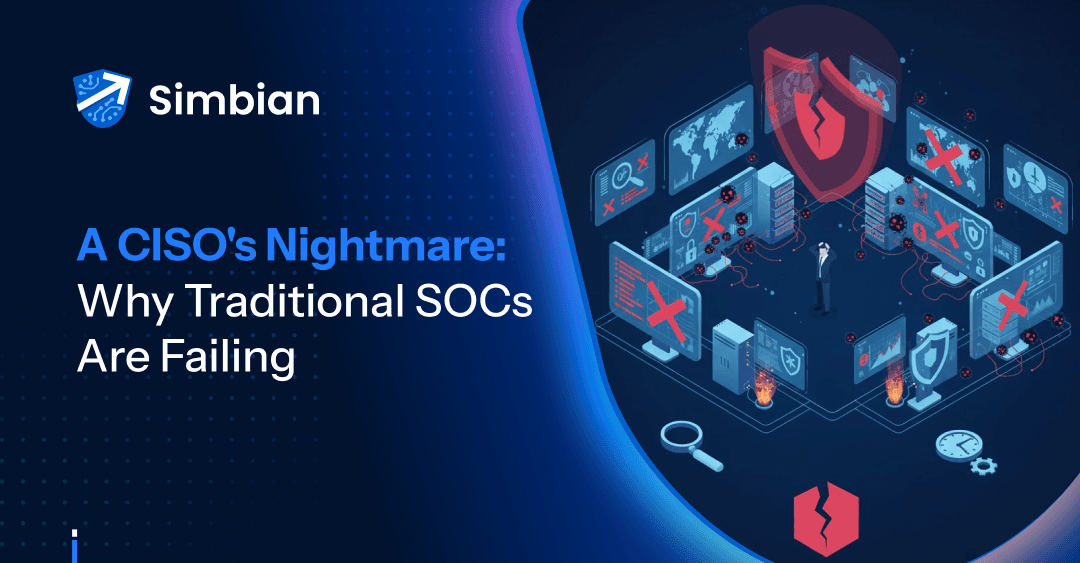
The traditional Security Operations Center is becoming a system where our best analysts are experiencing fatigue and burnout. At the same time, real threats often slip through the cracks due to the sheer volume of alerts.
Today, even with their best efforts, SOC teams are under pressure to reduce Mean Time to Detect (MTTD) while simultaneously managing over 50 tools just to address emerging threats. However, a change is on the horizon—a collaboration between humans and AI that is transforming how SOC teams manage repetitive manual tasks.
The future isn't about bigger SIEM dashboards or more analysts. It's about autonomous AI SOC agents that transforming SOC architecture from reactive command centers into proactive, intelligent defense ecosystems.
Before we add more tools, however, we need to understand the problems we are trying to solve. Here are the top three problems that plague modern SOC teams.
Security tools frequently generate a large number of alerts. Many of these alerts are false positives or low priority and do not require immediate attention from security professionals. This situation creates a "needle-in-a-haystack" challenge, as security analysts must sift through hundreds of alerts to identify those that could pose a real threat. As a result, analysts waste valuable time and experience fatigue, making it difficult for them to concentrate on strategic security initiatives. Alert Fatigue is not a single problem but a culmination of three important problems that more often than not create problems even in the most experienced SOC teams:
False Positives – today's SOC analysts have become desensitized to alerts. With the flood of security alerts rising every day and over 90% of them being false positives, it becomes extremely difficult to catch the one that poses a potential threat and has a huge business impact. With alerts flooding in from your SIEM/SOAR/EDR, etc., it becomes difficult to trust which source will provide a true positive. Additionally, the rising number of false positives poses a vulnerability to organizations' defenses, as no analyst scheme can sift through thousands of alerts every day.
Alert Prioritization – Even if security teams find true positives, alert prioritization then becomes really essential and challenging. A payment system failure might be higher prioritized, and a phishing email might be lower in the priority order. But with alerts coming in from many security tools, the complete picture is not captured every time. A phishing email detected by your SOAR and another DLP attack detected by your EDR might be correlated. Different SOC analysts using other tools might not correlate this, which could lead to missing the bigger picture. However, an AI SOC Agent effectively prioritizes which alert provides a true positive over false positives and responds to alerts with recommended actions. By prioritizing alerts based on potential business impact, SOCs can streamline incident management and ensure critical threats are promptly addressed.
Lack of Context – It's important to recognize that alerts from detection tools often lack essential context. For instance, while an alert might say, "Phishing Attack on User," it raises many vital questions. Was this a one-time event or part of a larger strategy? This information gap can lead to time-consuming investigations, diverting analysts from focusing on even more crucial tasks. By enhancing alert context, we can empower teams to work more efficiently and effectively.
“The architecture modern SecOps Leaders are following to stay ahead of attackers”
Sophisticated threat actors using AI are successfully circumventing even the most advanced Endpoint Detection and Response (EDR) solutions. Recent research, including Cymulate's discovery of the BlindSide technique, reveals that attackers can systematically sabotage EDR hooks, manipulate kernel-level callbacks, and operate entirely within endpoint blind spots using hardware breakpoints to create unmonitored processes.
Modern EDR evasion techniques systematically exploit detection limitations:
Process and Memory Manipulation: Tools like "disabler.exe" remove EDR hooks from user-mode libraries and disable kernel-mode callbacks, creating unmonitored system processes that render endpoints invisible to security monitoring.
Kernel-Level Operations: Advanced threats operate at the kernel level, loading before EDR platforms initialize and maintaining persistent access below the detection threshold.
Living Off the Land: Attackers leverage legitimate system tools, making malicious activity indistinguishable from normal operations until overtly malicious actions occur—often too late for an effective response.
The fundamental issue isn't technical sophistication—it's that current detection strategies prioritize millisecond response times over analytical depth, creating exploitable gaps.
With a 4.8 million global talent shortage and only enough workers to fill 83% of available cybersecurity positions, hiring is definitely not the answer!
71% of SOC analysts rate their job pain at six or higher, while 83% of SOCs experience annual staff attrition. Organizations drowning in hundreds or thousands of daily alerts create an environment where even experienced analysts burn out within 18 months.
The problem will be exacerbated by more analysts, as new analysts cannot bypass human limitations. New hires take 6-12 months to become productive, and 95% of alerts remain false positives regardless of team size.
Looking Ahead: The CISO's Vision for an AI-Powered SOC
The architecture of Security Operations Centers (SOCs) is undergoing its most significant transformation since the introduction of Security Information and Event Management (SIEM) systems. Organizations can choose to stick with traditional, centralized models that rely heavily on human intervention and struggle to keep up with modern threats. Alternatively, they can adopt AI-native architectures that provide autonomous intelligence at machine speed.