Loading...

Loading...
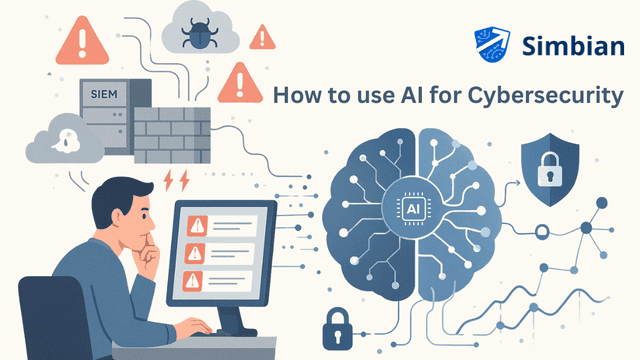
The traditional Security Operations Center is becoming a relic. Legacy SOCs post detection times measured in days, while analysts wade through 10,000+ daily alerts they can't triage fast enough to matter. Bigger SIEM dashboards won't close that gap. More headcount won't either. The shift underway is architectural: autonomous AI SOC agents turn reactive command centers into proactive defense systems that reason about threats the way a senior analyst would, at machine speed.
For decades, SOC architecture has revolved around one premise: funnel everything through the SIEM. Every log, every alert, every indicator lands in a central queue before a human can act. Analysts pivot between tabs, correlate by hand, and burn out under the weight of noise. That's how you end up with SOC problems that no dashboard refresh can fix — coverage gaps, missed detections, and a growing backlog of AI alerts nobody has time to open.
Traditional SOC design assumes humans can orchestrate dozens of tools into a coherent defense. That assumption cracks the moment AI-powered attacks start moving at machine speed and defenders keep thinking at human pace. The gap isn't a staffing problem. It's a wiring problem.
Modern SOC architecture flips the model. Instead of centralizing everything through SIEM bottlenecks, AI SOC deploys autonomous AI SOC agents where the data already lives: endpoints, networks, cloud platforms, identity systems, email. The agents don't wait for a ticket. They investigate, correlate, and respond, then hand analysts the finished narrative for review.
This is what people mean when they say agentic SOC, or SOC AI that actually reasons. It's not another dashboard. It's a decision layer that sits between raw telemetry and human judgment, and it changes what analysts spend their time on.
Traditional SOCs need conductors (analysts) to coordinate every instrument (security tool). AI-native SOCs let expert musicians (autonomous AI SOC agents) improvise together. Better outcomes. Less overhead. Analysts stay in control of the calls that matter.
Context Lake™: Simbian's Context Lake is the shift from siloed logs to unified organizational memory. Unlike a data lake that just stores raw events, Context Lake keeps living knowledge about business relationships, asset criticality, user behavior, and threat context. That's why an AI SOC agent can tell the difference between a compromise and a remote employee logging in from a family vacation. Context is what turns noise into intelligence.
TrustedLLM™: Generic AI assistants weren't built for security decisions where a wrong call has real consequences. TrustedLLM grounds every response in verified security intelligence and organizational data, which is how it avoids the hallucination failure mode that plagues consumer AI in production SOC workflows.
Multi-agent orchestration: Modern attacks span email, endpoints, networks, cloud platforms, and identity in a single kill chain. Single-point solutions miss the connections between them. Multi-agent architectures deploy specialized AI agents across every attack surface and share intelligence between them in real time, so the attack timeline builds itself instead of getting reconstructed after the fact.
Put those pillars together and you get an autonomous soc that answers the "so what?" question analysts actually care about: is this alert real, what did the attacker touch, and what should we do about it in the next five minutes?
Ask a Tier 1 analyst where their week goes and you'll hear the same list: copying indicators between tabs, re-running the same enrichment queries, writing the same three-paragraph investigation summary, closing false positives. None of that is why they took the job. Handing routine ai alert triage to an AI SOC agent doesn't shrink the team; it changes what the team gets to work on.
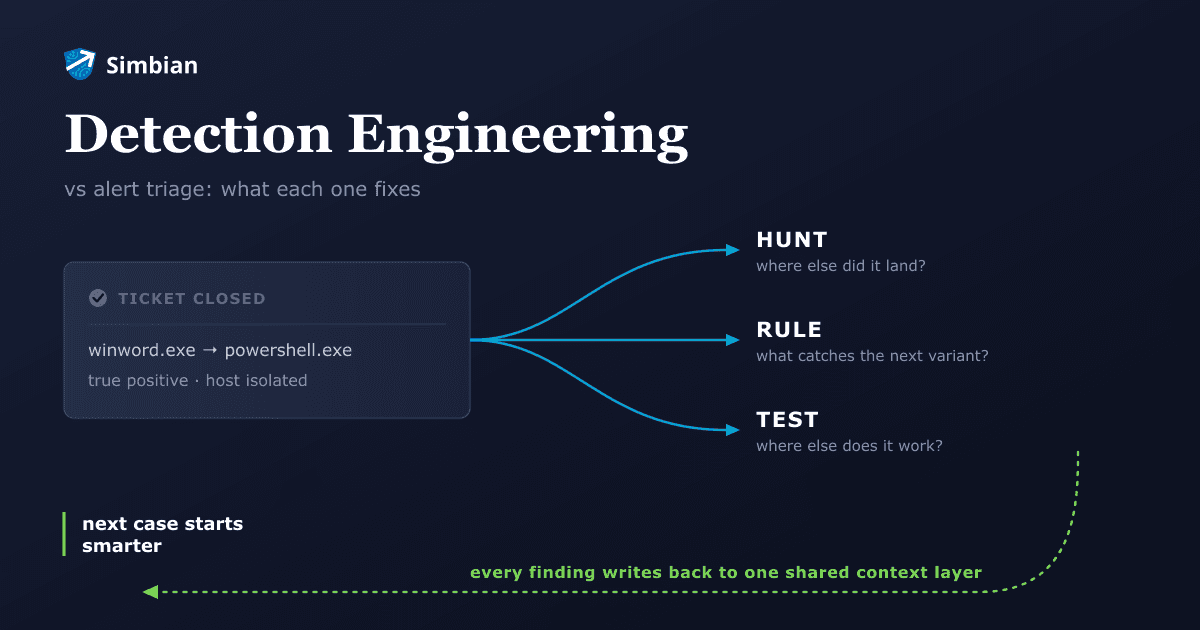
Tier 1 shifts toward reviewing agent decisions and coaching the system on edge cases. Tier 2 spends more time on threat hunting and detection engineering. The SOC manager finally gets coverage data they can put in front of a CISO without an apology. This is self-improving defense, not self-driving SecOps. Humans keep containment authority and the escalation calls. Agents handle the mechanics that were burning out the team.
Ripping out a SIEM on day one is a bad plan. A staged rollout gives the team room to build confidence in the agents before handing them the response keyboard.
Phase 1 — Agent-assisted investigation: Deploy AI SOC agents alongside existing workflows to accelerate manual investigation. Analysts see the agent's reasoning on every AI SOC agent case and confirm or override. This proves value against real alerts before anything touches production containment.
Phase 2 — Automated response: Once the team trusts the reasoning, agents take direct action on well-understood scenarios: malware isolation, phishing email quarantine, suspicious user account lockdown. Every action is logged, reversible, and reviewable.
Phase 3 — Predictive defense: Context Lake intelligence powers proactive threat hunting and risk assessment. The SOC stops waiting for the alert and starts asking, "where would this campaign land in our environment?" — then answers it.
Phase 4 — Autonomous operations: Round-the-clock autonomous detection and response with human oversight focused on strategic decisions, escalations, and containment authority. Agents act; analysts steer.
SOC architecture is going through its biggest rewrite since the SIEM shipped. Organizations can keep patching the centralized, human-dependent model that can't scale with modern threats, or they can move to AI-native architectures that reason at machine speed and stay auditable at every step. Both paths cost money. Only one of them ends with analysts who aren't drowning.
The choice isn't human analysts versus AI agents. It's whether your analysts get an intelligent partner or another queue. Using ai for cybersecurity well means giving the routine work to the agents, keeping the judgment calls with people, and measuring the whole thing on a shared coverage scoreboard so nobody has to guess whether the SOC is actually improving.
See how Simbian's autonomous AI agents run alert triage, investigation, and response through Context Lake intelligence and TrustedLLM™ reasoning — with humans in control of every escalation.