Loading...
New
See what manual alert triage really costs your security team.
New
See what manual alert triage really costs your security team.

See what manual alert triage really costs your security team.
See what manual alert triage really costs your security team.
Loading...
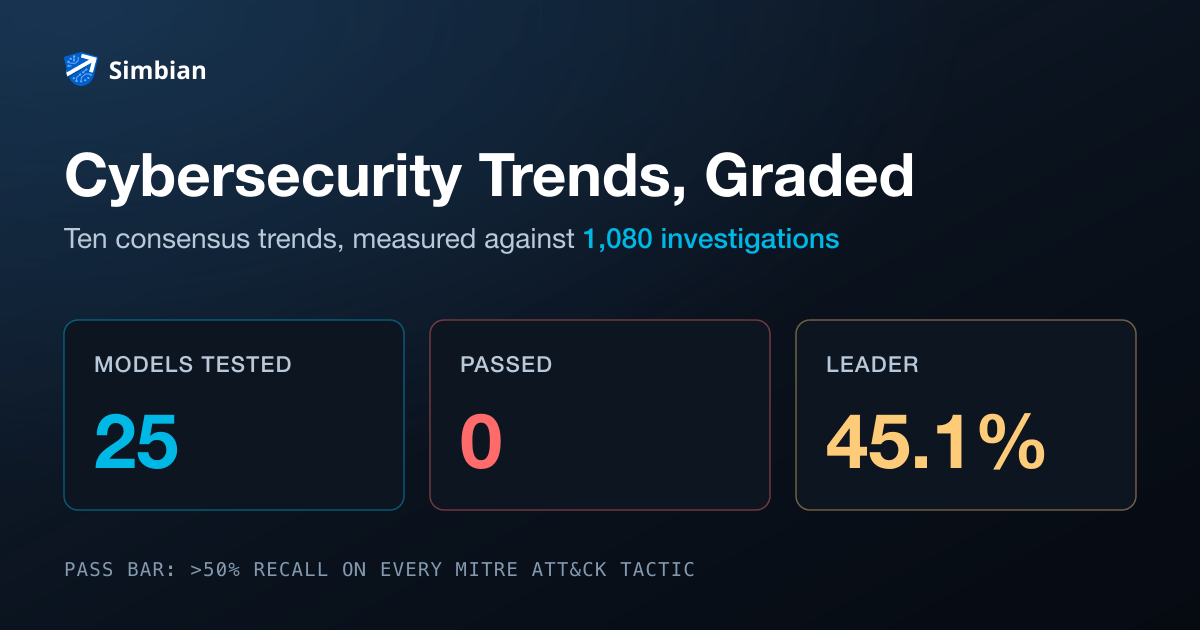
The top cybersecurity trends in 2026 are AI-driven attacks, autonomous AI defense, identity as the control plane, zero trust, post-quantum readiness, ransomware multi-extortion, supply-chain risk, deepfake social engineering, cloud and API convergence, and regulatory enforcement. Eight hold up. Autonomous AI defense does not: 25 AI models ran 1,080 investigations on the Cyber Defense Benchmark in August 2026, and none passed.
Fortinet's 2026 trends page runs about 4,800 words. SentinelOne's runs about 4,500. Between them they cite Gartner, IBM, ISC2, and Pindrop, and between them they run zero experiments of their own. That's not a criticism of their conclusions, most of which are right. It's an observation about what a trends list actually is: a record of what the industry has agreed to repeat.
The top cybersecurity trends in 2026 are AI-driven attacks, autonomous AI defense, identity as the control plane, zero trust, post-quantum readiness, ransomware multi-extortion, supply-chain risk, deepfake social engineering, cloud and API convergence, and regulatory enforcement. Those ten recur across nearly every published list this year, graded below by what actually backs each one.
| Trend | Grade | What backs it |
|---|---|---|
| AI-driven attacks | Documented | Sysdig traced an LLM agent from an unpatched CVE to an internal database in four pivots, May 2026. |
| Autonomous AI defense | Measured | The only item here we tested ourselves. Zero of 25 frontier models cleared the passing bar. Detail below. |
| Identity as the control plane | Established | Long-standing consensus and not in dispute. Not new either; it reappears every year. |
| Zero trust becomes operational | Directional | Adoption is self-reported and "operational" has no shared definition. Direction credible, progress unmeasurable. |
| Post-quantum readiness | Established | The cryptographic standards are published. What is being forecast is the migration timeline, not the trend. |
| Ransomware multi-extortion | Established | Consistent across published incident-response reporting. |
| Supply-chain expansion | Established | Consistent across published incident-response reporting. |
| Deepfake social engineering | Directional | Widely reported. The most-circulated growth figure is Pindrop's, drawn from its own call traffic, so direction beats magnitude. |
| Cloud and API convergence | Established | Structural, and consistent across published research. |
| Regulatory enforcement | Calendar | NIS2's full compliance deadline is October 2026. These are dates already in law, not forecasts. |
One caveat about those grades, because it cuts against me. Only one row was measured by us. Where a row says established, I'm taking the consensus at its word, which is the same thing I'm about to criticize every other list for doing. The difference is that this table tells you which is which, and the row where the grade changes from established to measured is the row that stops agreeing with the consensus.
Autonomous AI defense is the most confidently asserted trend on both lists above and the least supported by measurement. It anchors nearly every AI security trends roundup published this year.
We built the Cyber Defense Benchmark to test it, because almost every public evaluation of AI models in security measures offense: capture-the-flag, exploit writing, vulnerability discovery. Defensive evaluation had been ad hoc. Ours drops an agent into an environment carrying more than 100,000 events and asks it to investigate through iterative queries, across 105 attack procedures and 87 techniques chained into full kill chains, spanning 13 of the 14 MITRE ATT&CK Enterprise tactics.
The passing bar is deliberately modest: better than 50% recall on every one of those 13 tactics. That's the floor for trusting an answer without a second pass, not a distinction.
As of August 2026, across 25 models and 1,080 runs:
Newer doesn't reliably mean better, either. Sonnet 5 clears zero tactics. So does Opus 4.7. Opus 4.8 clears one, while the older Opus 4.6 clears seven. If you're assuming the next model release closes this gap on its own, the trend line doesn't support you.
Full methodology and per-tactic scores for all 25 models are on the benchmark page, and the paper is arXiv 2604.19533.
AI models fail at cyber defense because offense is a bounded problem and defense is not. An attacker knows when they've won: clear success signal, connected attack graph, immediate feedback. A defender never gets that. The total number of malicious events is unknown, normal and malicious activity overlap heavily, and nothing ever tells you that you've found everything.
Large language models are trained to produce confident, bounded answers. Point one at an unbounded problem and it does what it was shaped to do: it reaches a conclusion and stops.
Reading the transcripts is the part that changed my mind. A model would run a dozen queries, find two flags, write a clean summary, and submit, with most of its query budget untouched. It wasn't stuck. It was satisfied. In a live SOC that's a missed intrusion with a tidy report on top of it.
The failure isn't evenly distributed either. Whole tactics go dark. Gemini 3.5 Flash-Lite scores 0.01 on Exfiltration. Gemini 3.6 Flash scores 0.05 on Credential Access. GPT 5.6 Sol scores 0.21 on Collection. Those are blind spots the size of an entire attacker objective, and a model reports them in the same tone it uses for the tactics it handles well.
Coverage decay is the silent loss of detection capability you already paid for: rules that stay enabled and green in the console while matching nothing, because telemetry drifted, a schema changed, an API was deprecated, or a tool got swapped out. Roughly 20% of SOC detection rules stop firing within six months, based on Simbian's 2026 analysis of the customer detection estates we monitor. Every published trends list is additive: each one hands you emerging cybersecurity threats to bolt on. Not one accounts for the defenses you already own quietly failing.
You've probably lived at least one of these:
Five things push in this direction at once. Detection rules go stale. The threat profile shifts underneath them, and post-quantum is the tidy version of that. New people, new projects, and acquisitions move the behavioral baseline, and the untidy version is a new engineer bootstrapping a project by copying a large volume of data and getting flagged as an insider threat for it. Data pipelines break. And eventually the adversary plays a move nobody wrote a rule for.
You can adopt every item on the consensus ten, staff them, fund them, and still finish 2027 with less real coverage than you started with, because the floor fell out while you were building the ceiling.
These cybersecurity trends change two things for your SOC, and neither is a purchasing decision.
A model is a component. What determines whether an intrusion actually gets found is everything around it: the organization-specific context it reasons from, the systems it can query directly rather than through a summary, and whether anything in the design forces it to keep working after it feels finished. When a vendor names its underlying model as the differentiator, that's a claim about a component whose measured ceiling you can now look up. Ask instead what happens on the tactics that model scores near zero on. That's where the harness either earns its place or doesn't.
The program that wins 2027 is the one whose existing coverage doesn't silently degrade. Adding capabilities is the easier half. Treat detection health, pipeline health, and integration health as first-class operational metrics. Right now they are maintenance nobody owns.
That second point is the argument behind how we build. Take a five-stage chain: a compromised supply-chain package for initial access, credential harvesting from environment variables, lateral movement to an adjacent service, a C2 callback, then exfiltration. At one customer in 2026, the first cycle detected one of those five. The C2 callback fired an alert; the other four were invisible. Offensive testing executed each technique, threat hunting looked for historical evidence, the SOC checked whether detection fired, and each miss became candidate detection logic that an engineer approved before it went live.
Cycle two reached 56%. Cycle three reached 83%. The number matters less than the mechanism: each cycle closed gaps the previous one exposed. That's what the loop looks like running across all four agents on the enterprise SecOps platform.
Self-improving is not self-driving. Humans keep containment authority and the escalation calls, and when the platform finds its own blind spot and writes a fix, a person approves it before it's applied. There's no auto-apply mode. After reading 1,080 investigations by models left to their own judgment, I'm more convinced of that constraint than I was a year ago.
If you'd rather watch a reasoning loop run against your own environment than read another trend forecast, Book a Demo.
Q: What are the biggest cybersecurity trends in 2026? Ten items dominate nearly every published list: AI-driven attacks, autonomous AI defense, identity as the control plane, zero trust, post-quantum readiness, ransomware multi-extortion, supply-chain risk, deepfake social engineering, cloud and API convergence, and regulatory enforcement. Eight are well established. Autonomous AI defense is asserted far more confidently than measurement supports, and regulatory enforcement is a published legal calendar rather than a forecast.
Q: Which cybersecurity trend is most overstated? Autonomous AI defense. Across 25 frontier models and 1,080 benchmarked investigations, none reached better than 50% recall on every MITRE tactic, and 15 of the 25 cleared none.
Q: What is replacing SOAR in 2026? Reasoning-based AI SOC agents are replacing SOAR playbooks, and the benchmark data sets the honest ceiling on that replacement. SOAR automates paths somebody wrote in advance; an AI agent investigates paths nobody anticipated. But across 25 frontier models, none cleared the passing bar on their own, so what replaces SOAR is not a model. It's the harness around one, plus humans who keep containment authority.
Q: Why do AI models perform worse at defense than at offense? Offense is bounded and defense is not. An attacker gets a clear success signal, a connected attack graph, and immediate feedback. A defender never learns that they have found everything, because the total number of malicious events is unknown and normal activity overlaps heavily with malicious activity. Models trained to produce confident, bounded answers stop early, and stopping early on an unbounded problem is a missed intrusion.
Q: What is coverage decay? Coverage decay is the steady, silent loss of detection capability an organization already paid for. Roughly 20% of SOC detection rules stop firing within six months, based on Simbian's 2026 analysis of the customer detection estates we monitor, as telemetry drifts, schemas change, APIs are deprecated, and tools get swapped. The rules stay in the console and look healthy while matching nothing, so decay usually surfaces during an audit or an incident, never on a dashboard. It is the one item on this list that no published trends forecast accounts for, because every forecast is additive: each one tells you what to bolt on next, not what is falling off behind you.
Q: What do the cybersecurity trends 2026 lists get right, and what do they miss? They get the threat side right. AI-driven attacks, ransomware multi-extortion, and supply-chain risk are all well evidenced, and the consensus across published lists is broadly sound. What they miss is the defensive side degrading on its own. Every list is additive, so none of them accounts for detection rules that stop firing, data pipelines that break, or integrations that quietly stop returning anything.
Q: What does the future of cybersecurity look like after these trends? Verification becomes the differentiator. Defensive AI capability can now be measured, and the distance between what vendors claim and what benchmarks show is wide enough to plan around. Expect per-tactic evidence to become a procurement question, and expect maintaining coverage to matter as much as buying it. The AI cybersecurity trends worth funding are the ones somebody has actually tested.
Q: What does AI actually handle in the SOC, and what stays with people? AI meaningfully reduces the mechanical load of triage and investigation: pulling context, running queries, correlating evidence, and drafting the reasoning trail. The judgment calls, the containment authority, and the escalation decisions stay with people. The benchmark data is the clearest argument for that split, since the best-performing frontier model surfaces under 5% of the available evidence flags on a clean test and models regularly end investigations with most of their query budget untouched.
Here's a test worth running before the next budget cycle. Ask whichever AI security vendor you're evaluating for per-tactic recall rather than an aggregate score, then ask which tactic they score lowest on, because an aggregate hides a zero. Then run the same question at your own stack: pick the five detection rules you rely on most and confirm each one fired in the last thirty days.