Loading...

Loading...
AI in cybersecurity is the use of machine learning, generative AI, and autonomous agents to detect, investigate, validate, and respond to threats at machine speed. In 2026, AI cuts breach detection and containment by 108 days and roughly $1.9–2.2M per incident (IBM); 92% of security pros are worried about AI agents on the attack side (CSA). The platforms that win run both sides of the loop on a shared MITRE ATT&CK scoreboard.
The phrase "AI in cybersecurity 2026" hides a wide gap. On one side: vendors slapping "AI-powered" onto an alert dashboard. On the other: autonomous agents that reason about an environment, run real attack techniques against it, verify that the SOC catches what they find, and ship new detection rules every cycle, without a human writing a playbook.
This guide is for the CISO, SOC manager, or senior practitioner trying to tell those two apart in 2026. What it actually is. How it works under the hood. The use cases that earn budget. The risks that get incident reports written. What changed this year. And the four questions to ask any vendor selling you "AI security" today.
AI in cybersecurity is the application of machine learning, deep learning, natural language processing, generative AI, and agentic AI to security operations across detection, investigation, response, threat hunting, offensive testing, and governance. The goal is the same everywhere: do more of the work humans do by hand today, faster, across more of the environment, without losing accuracy.
Security operations has moved through three structural waves. Knowing which wave a vendor sits in tells you more than any product datasheet.
SIEMs, log aggregation, UEBA, signature-based EDR. These tools were built to surface every event that might matter, and they did — too well. Roughly 40% of enterprise alerts never get touched. The bottleneck moved from blindness to triage.
SOAR, scripted playbooks, AI copilots that draft summaries. The pitch was executing pre-built responses faster than a human could. In practice you get real productivity on the things you already knew how to handle, and brittleness on everything else. SOAR's real-world automation rate lands around 25%. Copilots sped up the analyst, but the analyst is still in the loop on every decision.
Autonomous AI agents that reason about what's happening, decide what to do, and learn from the outcome. This is the era the Self-Improving Defense category is built for, and where AI in cybersecurity in 2026 is heading. The math forces it: at 14,000 incidents a day and six analysts per shift, scaling decisions (not just signal or action) is the only path forward. In production, this means agents that share a single memory layer — Simbian calls this the Context Lake™ — so a SOC finding instantly shapes the next pentest, threat hunt, and detection rule.
Most of what you'll see pitched this year is still Wave 2 with an AI bolt-on. Only Wave 3 moves the cost curve.
Every analyst report lists a dozen "use cases." Eight of them actually pay back in production today. The rest are slideware.
This is where AI earns its keep first. The agent investigates every alert end-to-end — correlation, enrichment, verdict, evidence chain — instead of dumping it on a queue. The best deployments answer every alert in under four minutes from detection, with analysts approving 95% of the responses proposed.
If you are pressure-testing a triage platform on analyst approval rate, evidence-chain quality, and MTTR under real alert volume, the AI SOC Buyer's Scorecard is the evaluation rubric we hand to CISOs running side-by-side bake-offs — same criteria, applied consistently across vendors.
Hypothesis generation, log search across SIEMs and data lakes, and historical evidence retrieval — running around the clock. Answers the "did it already happen?" question most teams only think to ask after a breach.
Offensive agents that map attack paths in your real environment, exploit them safely, and prove which findings are actually reachable. The AI Pentest Agent collapses the gap between point-in-time pentests from quarters to weeks.
For teams weighing autonomous pentest platforms on exploit safety, attack-path reachability, and how findings feed back into SOC detection, the AI Pentest Buyer's Scorecard lays out the criteria worth scoring vendors against before a proof of value.
NLP plus behavioral baselining catches what signature filters miss: business email compromise, AI-written spear phishing, vendor-impersonation chains. Phishing volume is up roughly 1,265% since ChatGPT shipped. No other use case is under more pressure right now.
Anomalous-login detection, MFA fatigue analysis, impossible-travel checks, behavioral baselining. Identity is the perimeter now, and you cannot score every authentication event in real time without AI doing the math.
AI that reasons over firewall changes, validates rules before they go live, and auto-remediates misconfigs across distributed environments. Gets back the hours NetSecOps teams sink into ticket queues every week.
DLP has always been where alerts go to die. AI layers in HR context — role, department, departure date — plus behavioral baseline and intent scoring, so "mass file download" routes to either auto-close or page-on-call instead of the ignore pile.
LLMs that read SOPs, build evidence chains, and answer security questionnaires. Saves weeks of human time per audit cycle. The AI GRC Agent runs security questionnaires, third-party risk reviews, and audit-evidence generation end to end.
You don't have to take this on faith anymore. The numbers are dated, sourced, and specific.
Organizations using AI in their security stack detect and contain breaches 108 days faster on average, per the IBM Cost of a Data Breach Report. That is not a rounding error. It is the gap between a contained incident and a regulated disclosure.
The same IBM report puts the savings at roughly $1.9–2.2M per incident when AI is deployed extensively in security operations. One prevented breach pays for the platform.
Human-only SOCs investigate 60% of alerts on a good day. AI-driven SOCs investigate every one of them, including the 2 a.m. Saturday alerts nobody is awake for. Coverage is the quietest number on most vendor slides, and the one that decides whether you actually caught the thing.
Simbian built the Cyber Defense Benchmark (CDB, arXiv 2604.19533) to answer a question nobody else was asking honestly: can a frontier LLM, on its own, actually defend a network? As of June 2026, the answer is no. Across 14 frontier models, zero clear the 50% MITRE ATT&CK coverage threshold, and the leader, Anthropic's Opus 4.6, tops out at 44.5%. That gap is the whole point. Picking a "smarter" model does not get you to a working SOC; what closes the distance is the harness around the model, the skills it can call, the Context Lake it reads from, and the MITRE coordinate system that tells it where it is in an attack. Outcomes in cyber defense are decided by that scaffolding, not by the underlying weights.
A 2025 AI SOC Championship of 100+ security professionals found human-AI teams worked 2.3× faster than humans alone, with the same or better outcomes. A senior analyst's productivity ceiling is higher than it was a year ago.
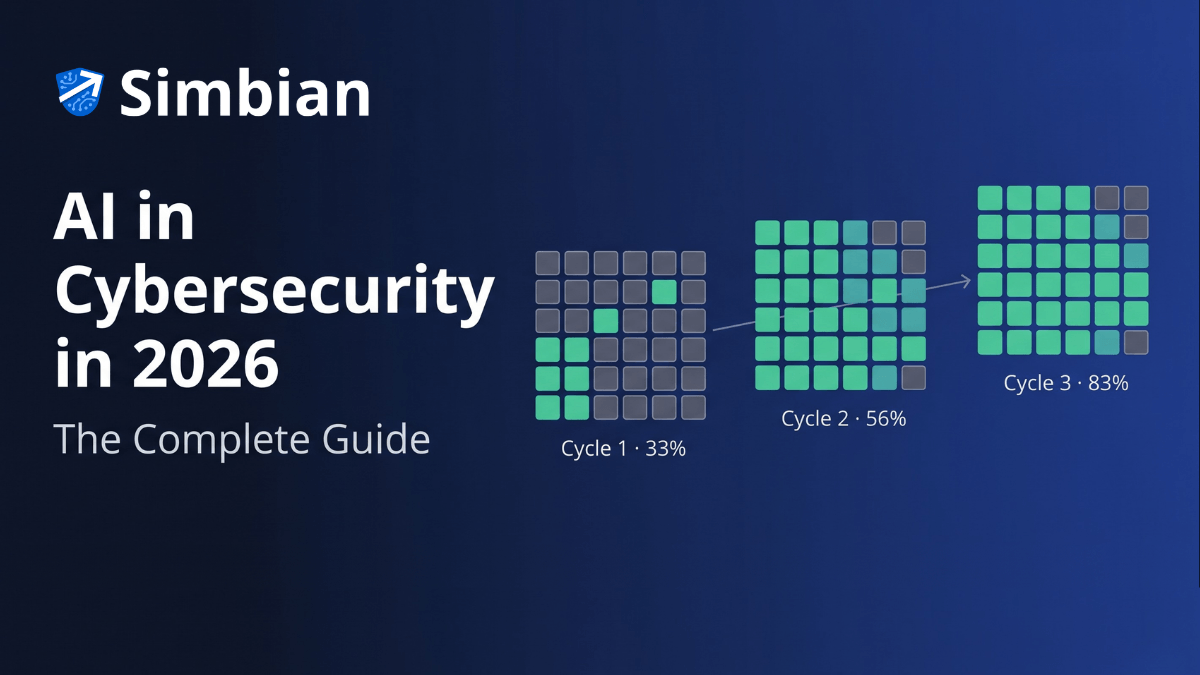
The tell for a real platform is whether coverage compounds. One customer's curve: 33% MITRE ATT&CK coverage in Cycle 1, 56% in Cycle 2, 83% in Cycle 3. If your defense gets better between cycles instead of decaying, you have a 2026-grade platform. If it doesn't, you have a dashboard.
The downside is real, growing, and under-funded. 92% of security professionals say they are worried about the impact of AI agents, according to the Cloud Security Alliance's State of AI Cybersecurity 2026 report — and most of that worry is pointed at the attack side.
Attackers have the same AI you do. Phishing is up roughly 1,265% since late 2022. Voice and video deepfakes of executives are landing on Slack, Teams, and Zoom like any other message. Agentic cybercrime — AI orchestrating ransomware campaigns end to end with almost no human in the chain — is now documented in Anthropic's 2025 threat report. 73% of practitioners say AI-powered attacks are already hitting their environment.
This is the biggest practical risk in AI systems today. Attacker text smuggled into an email, a document, or a web page overrides the model's instructions. It hits any LLM that ingests untrusted input — which covers almost every security LLM in production.
Slow, hard-to-detect corruption of the data a model trains on. A SOC LLM trained on biased or salted logs will reach the wrong verdict, consistently and with confidence. The nastier version sits one layer up: model poisoning at the supply chain.
Inputs crafted on purpose to be misclassified. A malware sample tweaked just enough to slip past the classifier as benign. ML detection without a reasoning layer on top is where this lands hardest.
LLMs that confabulate cited evidence. ML classifiers that hand back a verdict with no audit trail. In security, both are deal-breakers. Any platform you would actually run in production ships a reasoning trace and a reproducible evidence chain on every action.
CSA's 2026 numbers are not subtle: 77% of organizations are already running generative AI inside their security stack, and only 37% have an AI usage policy. Breach reports get written in that gap.
High-risk AI systems under the EU AI Act enter enforced compliance in June 2026. Cybersecurity systems that materially affect decisions about people (insider-threat scoring, fraud detection, identity verdicts) increasingly fall under "high-risk" obligations: documentation, human oversight, transparency, post-market monitoring. A vendor that can't answer "how do we comply with the EU AI Act?" isn't a 2026 vendor.
If you only read one section, read this one. Five things changed in the last 12 months and they reshape the buying decision.
Wave 2 (automation) → Wave 3 (decisioning) stopped being a slide and started being a deployment pattern. Customers running autonomous-agent platforms are showing coverage curves that compound. The 33% → 83% arc above is one of them. The 2026 question for a vendor is simple: does your defense get better between deployments, or does it stay flat?
MarketsAndMarkets puts AI in cybersecurity at $25.5B in 2026 on the way to $50.8B by 2031 — a 14.8% CAGR. Every vendor in your inbox now wears "AI" in the H1. The buyer's job shifted from "do I need AI?" to "which AI actually works?"
Simbian's Cyber Defense Benchmark gave buyers a defensible number for the first time. As of June 2026, 14 frontier models have been evaluated against real SOC scenarios; zero clear the 50% pass threshold, and the leader, Anthropic's Opus 4.6, lands at 44.5%. The story is not that one model is better than another. It is that the model alone is not enough. The harness around it — skills, Context Lake, MITRE coordinate system — is what determines whether a SOC actually catches the attack.
Anthropic's threat-intel reports, backed by a steady drumbeat of similar ones through 2025 and 2026, confirmed attackers are using AI to run full attack chains. Median time from initial access to exfiltration is now 48 minutes. A defense model that needs a human in every decision cannot keep up.
EU AI Act high-risk-system enforcement kicks in June 2026. The U.S. is following with sector-specific guidance. Any cybersecurity AI that makes high-stakes calls about people is now in scope. A vendor pretending otherwise is a compliance liability with your name on it.
The Self-Improving Defense thesis gives a cleaner evaluation rubric than any RFP template. Ask any vendor these four questions.
No red-side capability means no way to prove detection coverage against real attacks. You just triage faster. The only way to know whether your defensive rules cover real attack paths is to run real attacks against them.
If each agent has its own data store, the loop never closes. A SOC alert should shape NetSecOps' next move. A Pentest finding should sharpen SOC detections. Those are platform behaviors, not roadmap bullets. Shared memory is an architectural decision made on day one, which is why Simbian built the Context Lake as a memory layer across every agent rather than retrofitting one later.
A platform that scores its work against a vendor-defined rubric can't give you a coverage number you can defend to your board. MITRE ATT&CK is the only credible coordinate system. Every claim should map to it.
Any vendor promising 95% accuracy on day one is selling you a slide, not a deployment. Self-improvement is a curve. Credible platforms converge over a 60-90 day ramp through three phases — input-signal alignment, outcome alignment, then operationalization. A vendor that cannot walk you through their ramp has not actually run one at scale.
Three things are durable predictions through 2027 and beyond.
Short version for the 2026 buyer: AI in cybersecurity is not a feature category anymore. It is the operating model.
Q: What is AI in cybersecurity in one sentence? AI in cybersecurity is the use of machine learning, generative AI, and autonomous agents to detect, investigate, validate, and respond to security threats across an environment — at machine speed and with measurable, compounding coverage.
Q: How is AI used in cybersecurity in practice? The eight production use cases that pay back today are alert triage and investigation, threat hunting, autonomous pentesting and vulnerability validation, phishing detection, identity and access intelligence, network and firewall operations, data loss prevention and insider-threat scoring, and compliance and audit automation. The platforms that win combine multiple use cases on a shared substrate so findings from one agent improve every other.
Q: What are the biggest risks of AI in cybersecurity in 2026? Five categories: weaponized AI on the attack side (phishing up 1,265% since late 2022, agentic cybercrime now documented in vendor threat reports), prompt injection and indirect injection of LLMs, training-data and model poisoning, adversarial machine learning that defeats classifiers, and the governance gap — 77% of organizations run generative AI in their security stack but only 37% have a usage policy (CSA 2026). On top of these, the EU AI Act begins enforcement on high-risk systems in June 2026, which adds documentation, human-oversight, and post-market-monitoring obligations to many security-AI deployments.
Q: Will AI replace cybersecurity analysts? No. The agents are self-improving, not self-driving. Containment authority and escalation calls stay with the team. What changes is the work analysts do: tier-1 triage and playbook maintenance shift to the agents, and the team moves up the stack into governance, skill authoring, and oversight. The roles that grow fastest in 2026 — AI SecOps Manager, AI Skill Manager, AI Security Engineer — are more senior, better paid, and more strategic than the L1 jobs they replace.
Q: What is changing for AI in cybersecurity in 2026? Five things. The Decisioning Era began — autonomous-agent platforms with compounding coverage curves are in production. The market doubled to $25.5B (MarketsAndMarkets) on its way to $50.8B by 2031. Defensive benchmarks arrived — Simbian's Cyber Defense Benchmark has now evaluated 14 frontier models against MITRE ATT&CK; zero clear the 50% pass threshold, and the leader (Opus 4.6) lands at 44.5%. Agentic cybercrime stopped being theoretical, with attackers running full chains in under an hour. And regulation caught up: EU AI Act high-risk-system enforcement starts June 2026.
The honest short answer for 2026: AI in cybersecurity is no longer optional, and no longer uniform. The vendor pool has bifurcated. Most products you'll see are Wave 2 with an AI bolt-on. A small number are Wave 3: autonomous, self-improving, scored against the same map the attackers use. Those are the platforms that change the cost curve.
The loop, the substrate, and the coverage curve are easier to evaluate in your own environment than on a slide. Book a demo and run a self-improving AI cybersecurity platform against your own logs.