Loading...
New
See what manual alert triage really costs your security team.
New
See what manual alert triage really costs your security team.

See what manual alert triage really costs your security team.
See what manual alert triage really costs your security team.
Loading...
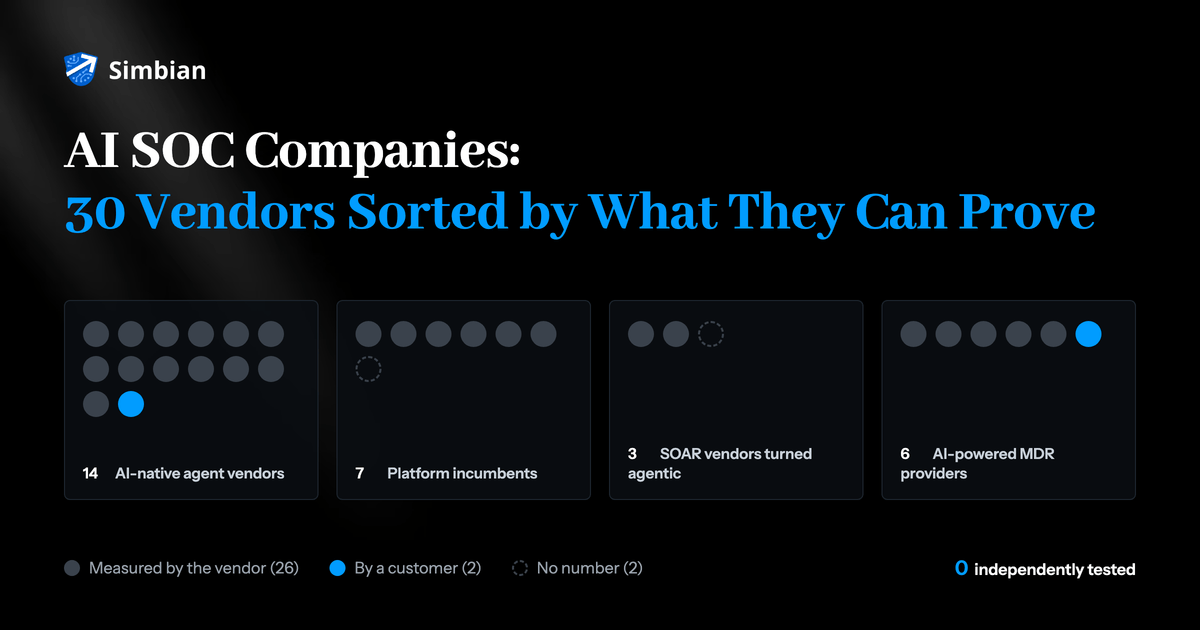
AI SOC companies sell software or services that investigate alerts with AI agents. They fall into four groups: AI-native agent vendors (Dropzone AI, Prophet Security), platform incumbents (CrowdStrike, Palo Alto Networks), SOAR vendors turned agentic (Torq, Swimlane), and AI-powered MDR providers (ReliaQuest, Arctic Wolf). Of 30 audited in October 2026, 28 publish a number; none had independent verdict testing.
Ten of the 18 "top AI SOC" lists we found were written by security vendors. Eight of the nine that include their own company put it first. We're a vendor too. This map lists each company's headline claim, who measured it, and what to ask before that number lands on your shortlist.
An AI SOC company sells software or a managed service that takes a security alert, pulls evidence from your tools, and reaches a verdict without an analyst driving each step. That much is shared. Who runs it, and who owns the outcome, splits four ways across the AI-powered SOC market.
The groups don't stay put. Since mid-2025, two AI SOC startups have been absorbed into data and observability companies, and several MDR providers now run agents of their own.
This map sorts them by evidence.
None of the 30 AI SOC companies we audited has had its agent's verdicts tested by an independent third party. We read each company's product pages, press releases, and trust pages in October 2026, then recorded the number it leads with and who produced that number. Most produced it themselves.
We picked the companies that keep showing up on published lists, plus funded newer entrants, enough to cover all four groups. It isn't the whole AI SOC market. BlinkOps, D3, and AirMDR are among those we left out. We didn't ask vendors to review their rows, and every row quotes the company's own page.
Two figures come from customers. Legion Security's is a named customer's measurement, and Red Canary's is validated by customers. That's closer to independent.
Three companies point to a published study. Microsoft wrote its own trial. SentinelOne commissioned IDC. Dropzone AI took part in a Cloud Security Alliance benchmark of analysts using its agent, which isn't where its 85% headline comes from. None of the three puts the agent's own verdicts under an outside test.
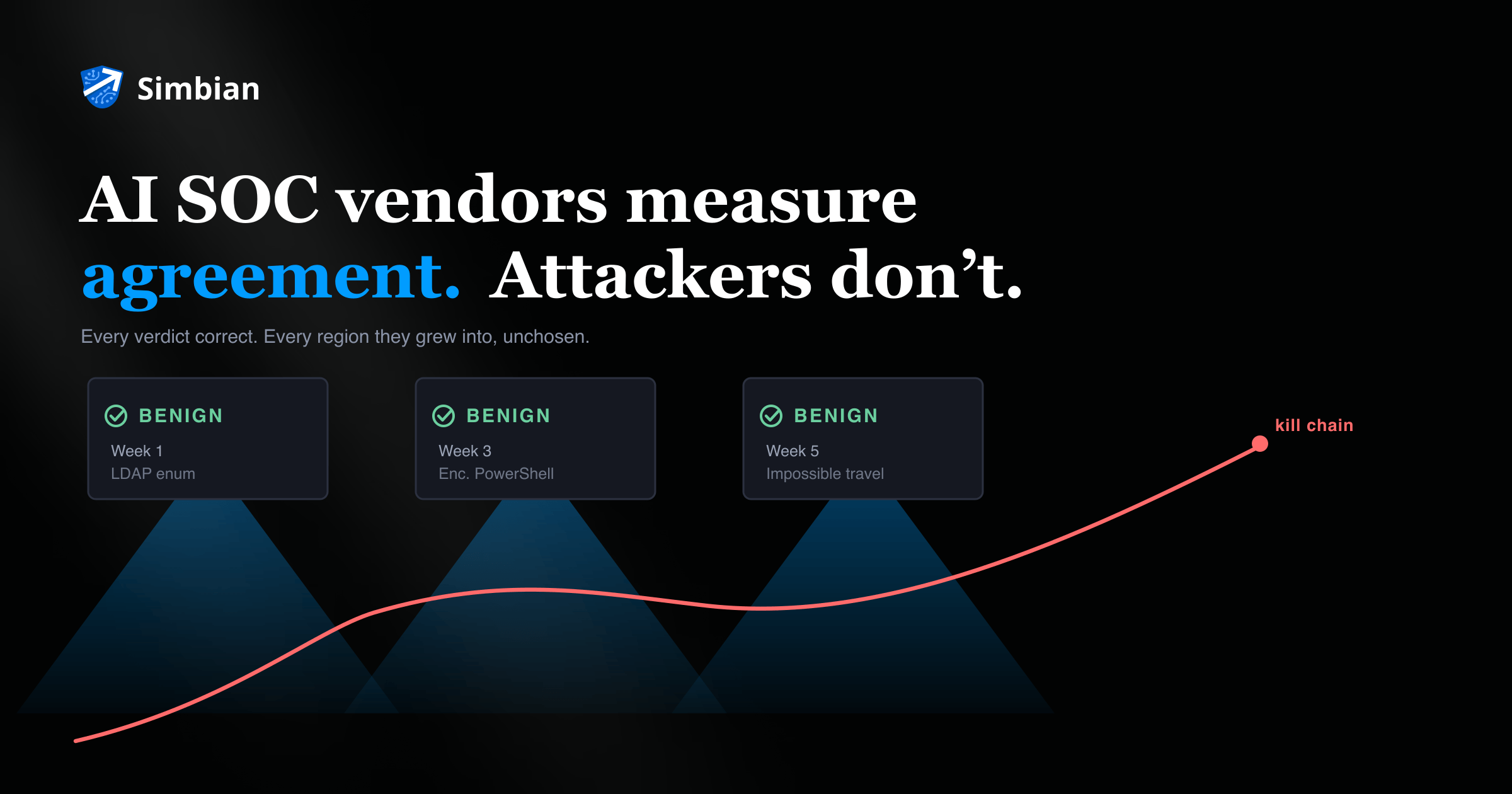
In this market, "accuracy" usually means agreement with some team of analysts (the vendor's own at CrowdStrike, customers' at Qevlar), or it comes with no stated basis at all (Intezer, ReliaQuest). Agreement doesn't tell you what the system missed. Only one company we found, Qevlar AI, publishes a false-negative rate: 0.1%, on email alerts, from its own test.
Rows are alphabetical, which puts Simbian last.
| Company | Headline claim (their words) | Who measured it |
|---|---|---|
| 7AI | "23M+ Alerts Processed" | 7AI (a volume count) |
| AiStrike | "90% fewer false positives" | AiStrike |
| Andesite | "+700% More investigations handled" | Andesite |
| Command Zero | "90% Reduction in Tier-1 escalations vs. baseline SOC" | Command Zero |
| Conifers.ai | "99%+ investigation accuracy" | Conifers' own quality agent |
| Dropzone AI | "cutting investigation time by 85%" | Dropzone |
| Embed Security | "100% of alerts investigated" | Embed |
| Exaforce | "90% reduction in false positives" | Exaforce |
| Intezer | "98% verdict accuracy" | Intezer, no sample size stated |
| Legion Security | "measured reduction in MTTI/R by 81% on our most common use case" | A named customer, WELL Health |
| Mate Security | "cuts MTTR by 93%" | Mate |
| Prophet Security | "99.8% agreement with the human analyst team across 12,000 investigations" | Prophet, at one unnamed Fortune 500 customer |
| Qevlar AI | "99.8% accuracy"; false negatives 0.1% | Qevlar, 5,000 email alerts at four unnamed organizations |
| Simbian | "responding to every threat in under 4 minutes on average, with 95% of those responses approved by your own analysts" | Simbian, at one unnamed global MSSP/MDR customer |
Thirteen of the 14 measured their own number. Legion Security is the exception, naming the customer that did. Simbian's figure comes from a published case study with that MSSP/MDR customer, where approval means its analysts agreed with the proposed response. Dropzone AI is the one vendor here that documents how it samples for missed threats, though no current result sits beside the method.
| Company | Headline claim (their words) | Who measured it |
|---|---|---|
| CrowdStrike Charlotte AI | ">98% Decision accuracy with agentic detection triage" | CrowdStrike, as agreement with its own Falcon Complete MDR team |
| Google Security Operations | "reduce a typical 30-minute manual analysis to 60 seconds" | |
| Microsoft Security Copilot | "triaged alerts up to 78% faster, delivered 77% more accurate verdicts" | A Microsoft-authored trial |
| Palo Alto Networks Cortex AgentiX | "up to a 98% reduction in MTTR" | Palo Alto Networks, basis not stated |
| SentinelOne Purple AI | "63% faster threat identification" | An IDC study commissioned by SentinelOne |
| Splunk (Cisco) | No quantified claim found for its AI SOC Analyst | None published |
| Stellar Cyber | "Customers can expect 60–80% analyst time savings" | Stellar Cyber, as a forecast |
Read the status line before the launch post. As of October 2026, CrowdStrike lists its multi-agent investigation as pre-beta. Microsoft's alert triage agent is generally available only for user-reported phishing. Identity and cloud alerts are still in preview. Google's threat hunting and detection engineering agents, and its agentic automation for response, are in preview too.
Splunk's AI SOC Analyst runs on Enterprise Security Cloud with the Premier tier, switched on through a Splunk representative. A broader Splunk agentic SOC page does cite MTTD and MTTR reductions, sourced to customer reviews on PeerSpot.
| Company | Headline claim (their words) | Who measured it |
|---|---|---|
| Swimlane | "resolves 99% of Tier 1 SOC tasks" | Swimlane, plus one MSSP customer case |
| Tines | No quantified AI SOC claim found | None published |
| Torq | "Over 90% of cases are remediated completely autonomously" | Torq |
Tines, like Splunk, leads its AI SOC page without a number. Of all the agentic SOC companies, the SOAR vendors sit closest to the automation you may already run, so the agent reasons on top of workflows someone on your team still owns.
| Company | Headline claim (their words) | Who measured it |
|---|---|---|
| Arctic Wolf | "autonomously resolves more than 60% of case volume" | Arctic Wolf |
| eSentire | "95% alignment with senior analyst conclusions" | eSentire, against senior analyst conclusions |
| Expel | "14 minutes" mean time to remediate on fully automated high and critical incidents | Expel, with published metric definitions |
| Red Canary (Zscaler) | "99.6% customer-validated true positive rate" | Customers, on threats already escalated to them |
| ReliaQuest | "99.4% AI Accuracy … validated in production" | ReliaQuest |
| TENEX.AI | "6.2x analyst efficiency" | TENEX.AI |
Red Canary's figure is the only one here graded by customers, and it measures precision, meaning how often an escalated threat turned out real. It can't tell you about the real threats that were never escalated.
Most "top AI SOC companies" lists mainly reflect who wrote them. We collected 18 published "top AI SOC companies" lists from January 2025 to October 2026, covering analyst reports, media round-ups, an independent directory, and vendor blogs. Ten were written by security vendors. Of the nine that include their author, eight put the author first. Swimlane's is the exception.
The lists don't agree with each other either. Between them they name 45 vendors. Seventeen appear on exactly one list, only six appear on more than half, and none appears on all 18. Dropzone AI and Torq show up most, on 13 lists each.
Not one of the 18 published results from hands-on testing.
Twelve state a method or criteria. Only two describe structured interviews, SACR with security practitioners and IDC with customer references. IDC's own abstract for its MarketScape lists its inputs as "vendor RFI responses, product demonstrations, and customer reference interviews." That's a reasonable read on strategy and capability. At least eight vendors announce themselves as a Leader in the same 2026 IDC AI SOC MarketScape, so treat the badge as an entry ticket to your shortlist.
Simbian appears on six of the 18 lists. One of the six is ours, and it puts us first. We've published three posts that rank AI SOC vendors, and all three put Simbian first. Read our own AI SOC vendor comparisons the way you'd read anyone's. Vectra has taken the opposite route, publishing a breakdown of the category's claims by who measured them, without naming any vendor.
Most AI SOC solutions sold as software ask before they act, while several MDR providers now act on or close alerts without a customer's sign-off. Among the AI-native agent vendors, every one whose action controls we could read documents a human approval gate. Some publish far more detail about that gate than others.
Prophet Security says its remediation is "previewed before it runs and backtested against your history." Mate Security scores every action on "Confidence, Precision, and Reversibility," enforced "outside the agent's reasoning loop." Ask every AI SOC provider for that much.
Torq is the outlier among the software vendors, with the autonomous-remediation figure in its row above. The MDR providers draw the line in different places. ReliaQuest advertises containment with "No human triage required," and Expel runs fully automated remediation on high and critical incidents. Arctic Wolf says "approximately one-third of complex cases benefit from final human verification."
For your evaluation, split the field into tools that close an alert and tools that propose a verdict for your team to close. A proposal you have to re-investigate saves nothing. Ask to watch both on a live alert, including the evidence the agent cited and where your approval sat.
AI SOC startups have raised rounds of up to $250M since mid-2025, the largest being TENEX.AI's Series B in March 2026, and seven acquisitions have touched the AI SOC market since early 2025. Funding buys a startup runway, and the deals below show who has been buying.
| Company | Selected round | Date |
|---|---|---|
| 7AI | $130M Series A | December 2025 |
| BlinkOps | $50M Series B | July 2025 |
| Dropzone AI | $37M Series B | July 2025 |
| Exaforce | $125M Series B | May 2026 |
| Legion Security | $30M Series A | July 2025 |
| Mate Security | $35M Series A | July 2026 |
| Qevlar AI | $30M | March 2026 |
| TENEX.AI | $250M Series B | March 2026 |
| Torq | $140M Series D, $1.2B valuation | January 2026 |
BlinkOps is the one company in this table outside the 30 we audited.
Two of the buyers, Cribl and Datadog, sell data and observability tools, while Cisco and Palo Alto Networks bought pieces to bolt onto security products they already sell. If a startup is on your shortlist, ask what happens to your contract and your data when it's bought.
Simbian is one of the AI-native agent vendors. The AI SOC Agent investigates and responds. Agents for threat hunting, detection engineering, and penetration testing work beside it, and what the AI Pentest Agent proves lands in the same memory the AI SOC Agent and AI Threat Hunt Agent read. An alert on a host with a proven exploit path gets investigated with that path in hand.
Of the 14 AI-native agent vendors in this audit, Simbian is the only one we found whose own pages describe a penetration testing product. Outside that group, two MDR providers have added offense: eSentire launched AI pen testing in June 2026, and ReliaQuest launched GreyMatter Attack, an AI-driven red-teaming product, in July 2026.
We investigate and respond to every threat within minutes, on average under 4 minutes from detection to response. 95% of the responses we propose are approved by the customer's own analysts. Their call, not ours.
Like most rows in the table, that's self-measured, at one unnamed global MSSP/MDR customer.
We don't publish a miss rate either.
Check every AI SOC company's claims the same way: find out who measured the headline number, ask what the system missed, and test it on alerts your team has already closed. Five checks cover most of it. All five fit inside a normal trial.
Ask who measured the number, and on how many alerts. Agreement with the vendor's own analysts, or a figure from one unnamed customer, is where your own test starts.
Ask for the miss rate and the sampling method behind it. The false-negative figure is the breach number, and without a sampling method behind it you can't use it.
Seed a test with alerts you've already closed. Replay a week of your own alerts, including true positives your team confirmed, and grade the agent against your team's answer key.
Time the validation. Track the minutes your analyst spends checking each verdict. If checking takes as long as investigating, the agent added a step.
Read the status line. Confirm the capability is generally available on your stack today, and that it works on telemetry beyond the vendor's own.
If you're weighing Simbian against a specific vendor, our side-by-side comparisons show where each one is stronger. Then run check three on us first: Book a Demo and bring a week of alerts you already know the answers to.
Q: What are the top AI SOC companies? No independent test ranks them, so "top" depends on who wrote the list. Across 18 published lists, Dropzone AI and Torq appear most often, on 13 each. By group, the most-listed are Dropzone AI and Prophet Security among AI-native agent vendors, CrowdStrike and Palo Alto Networks among platform incumbents, Torq among SOAR vendors turned agentic, and ReliaQuest among AI-powered MDR providers.
Q: Which AI SOC vendors should I shortlist? Shortlist AI SOC solutions by the evidence each company can show. Pick candidates from the group of AI SOC providers that matches how you want to run an AI-powered SOC (software across your stack, an agent inside a platform you own, agents on your existing SOAR, or a managed service), then ask each one who measured its headline number and how often it misses. Run every finalist on a week of alerts you've already closed.
Q: Which AI SOC companies let analysts approve, audit, and reverse actions? Most AI-native agent vendors document a human approval gate before containment. Prophet Security previews remediation and backtests it against your history, and Mate Security scores each action on reversibility outside the agent's reasoning loop. Simbian can require approval on every action and logs each query and decision for audit. Ask each vendor to show approval, audit trail, and reversal on a live alert.
Q: Is an AI SOC company the same as an MDR provider? No. An AI SOC company usually sells agents your team runs under your approval, while an AI-powered MDR provider sells a service in which its agents and its analysts work your alerts and the provider owns the outcome. Several MDR providers now close some alerts without customer sign-off, so ask which part of the work is the agent's and which is the analyst's.
Q: Are AI SOC reviews and analyst rankings independent tests? No. AI SOC reviews on crowd sites collect user opinions, and an IDC MarketScape or SACR placement is an analyst evaluation built from vendor questionnaires or briefings, demonstrations, and customer or practitioner interviews. None of them re-runs the product on a fixed set of alerts and publishes what it missed. At least eight vendors announce Leader status in the same 2026 IDC AI SOC MarketScape.
Q: Which acquisitions reshaped the AI SOC market in 2025 and 2026? Zscaler closed its purchase of Red Canary in August 2025, and Cribl bought Radiant Security's technology assets in August 2026. Datadog bought Culminate, Torq bought Revrod in April 2025 and Jit in May 2026, Cisco closed its purchase of WideField in July 2026 to extend Splunk, and Palo Alto Networks bought Console for Cortex in September 2026.