Loading...
New
See what manual alert triage really costs your security team.
New
See what manual alert triage really costs your security team.

See what manual alert triage really costs your security team.
See what manual alert triage really costs your security team.
Loading...
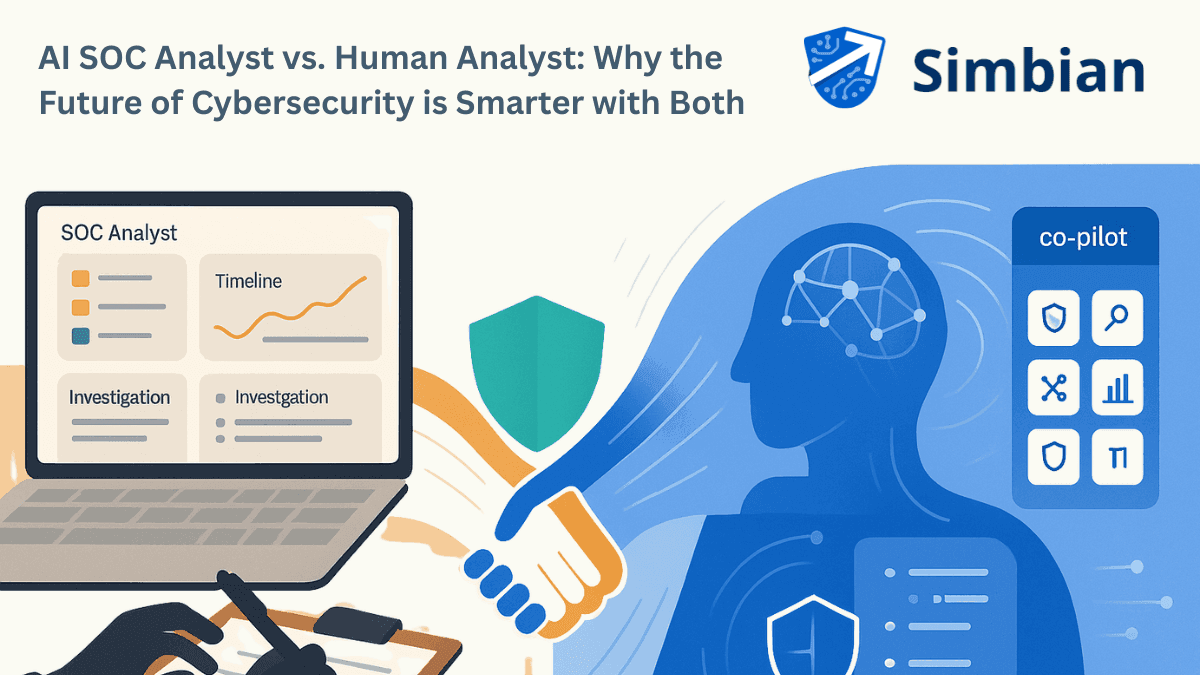
The AI SOC analyst vs. human analyst debate is the wrong debate. In a modern security operations center, the AI SOC analyst runs the machine-speed work (alert triage, enrichment, correlation across 70+ tools) and the human analyst owns judgment, containment, and adversary reasoning. Simbian's data from the 2025 AI SOC Championship shows human-AI teams investigating 2.3× faster with 42% higher accuracy than either side working alone.
The AI SOC analyst vs. human analyst frame misses the point. Asking which matters more is like asking whether the engine or the steering wheel keeps a car on the road. Both are essential. The real breakthrough shows up when AI SOC Analysts and human analysts run the same investigation together, and each side does what it's actually built for.
Modern security operations centers are drowning in alerts, short on time, and thinner than ever on senior talent. Without AI augmentation, even a well-staffed team can't keep pace with today's fast-moving cybersecurity threats.
The cybersecurity workforce gap sits at 4.8 million unfilled roles globally and grew 19% year over year. Tier 3 SOC analysts can only fully investigate 20 to 30 alerts a day. Everything below that line goes untouched, or gets closed with a rubber-stamp verdict. That's the daily reality of the cybersecurity talent shortage, and hiring your way out of it isn't going to happen in this budget cycle.
Attackers have already moved. AI-generated phishing, deepfake voice, and LLM-assisted recon are shortening the window between compromise and impact. The question isn't whether cybersecurity AI will change your day job. It already has. The real question is whether your SOC automation stack will catch up before the next incident, or after it.
No. Not the good ones. Simbian's AI SOC Agent is built to augment the analyst, not replace them. It handles the repeatable work (the pivots, the enrichment, the initial correlation) so security analysts stop burning their day inside log queries and start doing the work only humans can do: strategic defense, adversary emulation, and stakeholder guidance.
Simbian's AI SOC Agent runs 24/7 and:
This isn't cybersecurity automation for its own sake. It's AI augmentation with a clear job description.
Simbian tested the theory at the AI SOC Championship, with 100+ cybersecurity professionals working alongside, and against, the AI SOC Agent.
The takeaway is simple. AI vs human is the wrong frame. Human-AI collaboration wins the scoreboard.
Skip the marketing gloss. Simbian's AI SOC Agent isn't a chatbot, and it isn't another dashboard fighting for a browser tab. It behaves like a virtual teammate inside your roster of SOC agents, on shift the whole week.
Core capabilities:
Think of it as an always-on security analytics engine that does the reading, so your team can do the deciding. That model is what real SOC modernization looks like, not another single-pane-of-glass with a chat box glued on.
Copilots wait to be asked. An AI SOC platform does the work. That distinction shows up in the first month. Copilots reduce keystrokes; a platform reduces open tickets. If your metric is SOC efficiency, only the second one moves the number. Threat detection without follow-through is still a backlog; a platform closes the loop from alert to disposition.
Cyber defense runs on accountability. Unlike black-box systems, Simbian's AI SOC Agent shows its work: every hypothesis, every pivot, every closed loop. Analysts can guide it or override it at any step.
With TrustedLLM™, your data stays private, prompt injections are filtered, and outputs are checked against ground truth before anything reaches your queue. The Agent behaves as a teammate under review, not a security orchestration black box you have to trust on faith.
With autonomous AI absorbing Tier 1 detection work, the analyst role isn't vanishing. It's climbing.
This is AI empowerment for the SOC, not headcount reduction. The cybersecurity workforce grows into new work faster than the old work disappears.
The SOCs that win the next five years will blend human intuition with AI precision.
Simbian's approach is self-improving, not self-driving. The AI SOC Agent handles the machine-speed work; humans keep containment authority and the final call on escalations. That's the shape of AI-powered security that practitioners actually deploy, not the one that keeps showing up in analyst decks.
Stop stitching security orchestration point tools together and start deploying security intelligence with a single agent behind it. The unbundling of the legacy SOC stack has already begun at Simbian.ai. The next question is whether your security operations program leads that shift, or catches up to it after the next incident forces the conversation.