Loading...
New
See what manual alert triage really costs your security team.
New
See what manual alert triage really costs your security team.

See what manual alert triage really costs your security team.
See what manual alert triage really costs your security team.
Loading...
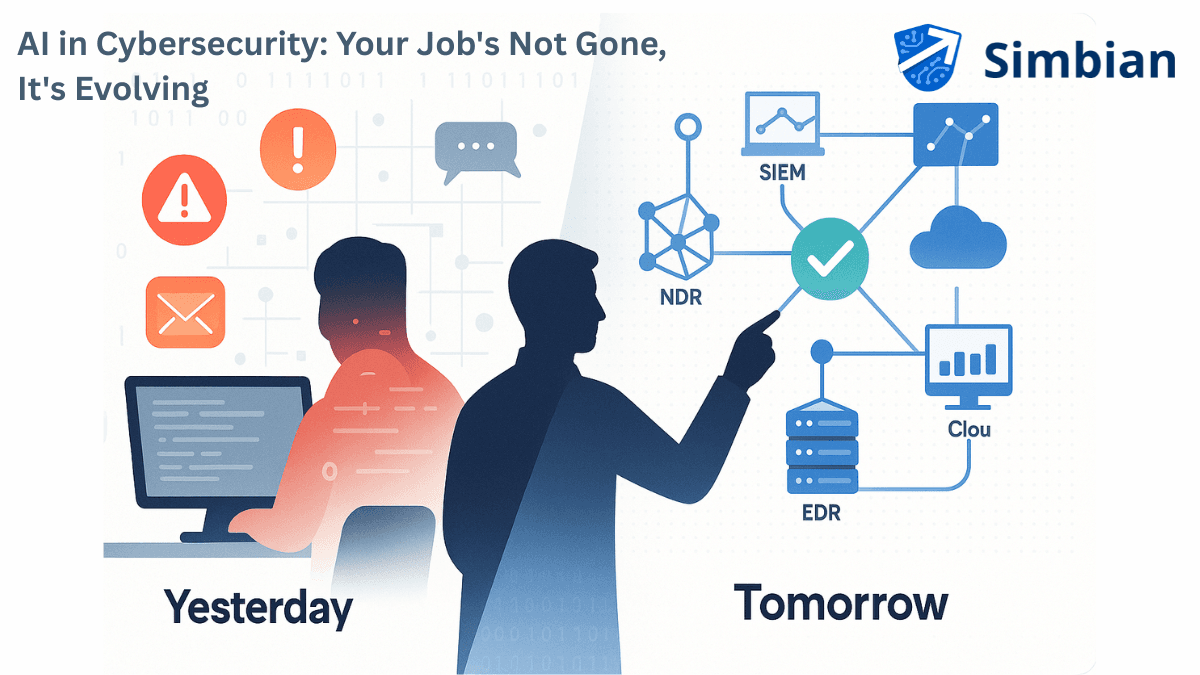
We have all heard the buzz - artificial intelligence is here, and it is changing everything. For many, especially in the tech world, that raises significant questions about jobs. Will AI take over? A recent paper published by Microsoft identified several professions that are likely to be impacted by AI, based on various factors, but it did not mention cybersecurity roles. Which begs the question - are cybersecurity professionals in line for widespread displacement? The prevailing view from industry leaders suggests a different story. It is not about immediate job replacement. Instead, AI is sparking a profound transformation in cybersecurity, shifting roles and responsibilities over time. The discussion is less about whether AI will impact jobs and more about how quickly those changes will unfold and what comes next for those dedicated to security.
While some aspects of cybersecurity work might see changes in headcount due to automation, the overarching narrative points towards an enhancement of existing roles and the creation of entirely new opportunities, and I encourage cybersecurity professionals to view AI not as a looming threat, but as a powerful tool for career growth and increased efficiency.
Traditionally, Security Operations Center teams often find themselves caught in a reactive cycle, overwhelmed by the sheer volume of security alerts and the growing complexity of cyber threats. AI is fundamentally changing this dynamic, moving SOCs from simply reacting to incidents to anticipating and preventing them before they can cause harm. This significant shift is powered by the continuous integration of threat intelligence. AI SOC operations leverage machine learning, automation, and predictive analytics to identify, analyze, and mitigate cyberattacks in real-time, significantly improving efficiency and reducing the need for constant human intervention. AI excels at analyzing massive datasets with incredible speed and accuracy, identifying anomalies and learning from historical data to adapt to new attack vectors. This capability allows for much faster threat detection; AI-powered systems can identify cyberattacks approximately 60% faster than traditional methods. When a threat is detected, AI systems can automate immediate actions, such as isolating affected systems or blocking malicious traffic, which significantly reduces the mean time to detect (MTTD) and mean time to respond (MTTR).
AI is increasingly taking over the repetitive, low-value tasks that often lead to burnout, such as manual log analysis, alert triaging, and filtering through countless false positives. Industry analysts like Gartner predict that by 2027, 25% of common SOC tasks will become 50% more cost efficient due to automation enhancements - including alert prioritization, event correlation, and basic ticket resolution. This automation of mundane, high-volume tasks serves to liberate SOC analysts from the routine work that consumes their time and mental energy. This freedom allows them to pivot to higher-order, more intellectually stimulating, and strategically impactful activities, such as threat hunting, adversary simulation, interpreting complex AI-generated signals, and proactive defense.
One of AI's most powerful contributions to cybersecurity is its unparalleled ability to process and analyze immense volumes of data. This includes threat landscape intelligence, risk factors, historical data, and system logs - datasets far too vast and complex for human teams to manage manually. Without AI, relying solely on human analysis for the sheer amount of data generated and the speed of evolving threats simply will not suffice.
AI can transform raw, disparate data into high-value intelligence, offering real-time insights and predictive analytics that can flag vulnerabilities even before threat actors can exploit them. It continuously learns from network traffic and user activities, enhancing anomaly detection and identifying previously unknown threats. AI also helps prioritize the most relevant intelligence and can even recommend response actions. Furthermore, AI provides a much deeper and quicker understanding of the environmental context within an organization's systems. This capability gives security professionals something akin to 20/20 vision, allowing them to detect and interpret anomalies instantly and recommend the best course of action in real-time.
While the benefits of AI for defensive cybersecurity are clear, it is important to acknowledge that the broad utility of artificial intelligence yields efficiency gains for both companies and the threat actors targeting them. The concept of offensive AI is now a tangible reality, encompassing malicious uses like AI deepfakes, swarm malware, and AI-powered phishing. This indicates that AI is not a static defensive tool but a dynamic element in an ongoing, escalating conflict. AI does not simplify the threat landscape by automating defense; it also accelerates the complexity and sophistication of attacks. Consequently, cybersecurity professionals must not only become adept at leveraging defensive AI but also deeply understand offensive AI tactics, including criminal uses of generative AI like deepfakes and AI-automated translation for phishing campaigns.
Industry leaders are clear that AI will not replace cybersecurity professionals, but it will transform the profession, according to, Chief Global Strategy Officer at ISACA. This is not about jobs disappearing, but about roles evolving. The nature of cybersecurity roles is fundamentally changing. Instead of being hands-on executors of every task, professionals are shifting towards becoming decision supervisors. Their responsibilities will increasingly involve overseeing, calibrating, and intervening in AI-driven decision-making processes. This means focusing on higher-level tasks like strategy, analytics, and program improvements.
This transformation is spawning entirely new job categories that blend traditional security knowledge with data science, machine learning operations (MLOps), and even behavioral psychology. New titles are emerging, such as AI Threat Analyst, ML Security Engineer, Adversarial ML Red Teamer, and AI Ethics and Compliance Officer. These roles are becoming pivotal in maintaining robust security postures. AI literacy is no longer a nice-to-have; it is a priority skill that companies are increasingly hiring for, as highlighted by LinkedIn’s Skills on the Rise report. Professionals need to understand not just how to use AI systems, but also how they are built, what data they depend on, and how to keep them aligned with human intent. This includes developing skills in AI oversight, data literacy, and prompt engineering.
Interestingly, as AI handles more technical grunt work, soft skills are becoming more critical than ever. A study by Skiilify indicated that 94% of tech leaders believe soft skills—such as curiosity, resilience, tolerance of ambiguity, perspective-taking, relationship-building, and humility—are essential. These human-centric skills are vital for understanding how AI models can fail, how attackers might exploit statistical assumptions, and how to implement resilient human oversight for AI systems.
The biggest risk is not AI taking jobs wholesale, but rather cybersecurity professionals falling behind while their peers and adversaries leverage AI to move faster, smarter, and more securely. This necessitates continuous skills development to pivot roles around AI's evolving capabilities. The future of cybersecurity is not human versus AI; it is human with AI. This synergy means machines handle the heavy lifting of speed and scale, while humans bring their unique intuition, creativity, and strategic judgment to the table.
The message is clear: AI is not a job killer for cybersecurity professionals. Instead, it is a massive opportunity for growth, efficiency, and a more strategic, engaging career. The future of cybersecurity is bright for those who are willing to adapt, learn, and embrace AI as a powerful ally. By upskilling in AI literacy, understanding AI systems, and honing uniquely human capabilities like judgment and ethical reasoning, professionals can not only secure their place but also thrive at the forefront of this evolving landscape.