Loading...

Loading...
For years, the security industry talked about AI cyberattacks in the future tense. We pictured sentient super-hackers unpicking firewalls with alien logic. What we're seeing in our labs at Simbian is less cinematic and more dangerous.
The threat isn't that AI is smarter than the best red-teamer on your payroll. It's that AI makes expert-level persistence scalable, instant, and infinitely variable. A "marginal improvement" in one attacker script becomes an avalanche of entropy that no human SOC team can absorb. That shift, not sentience, is what's breaking defense.
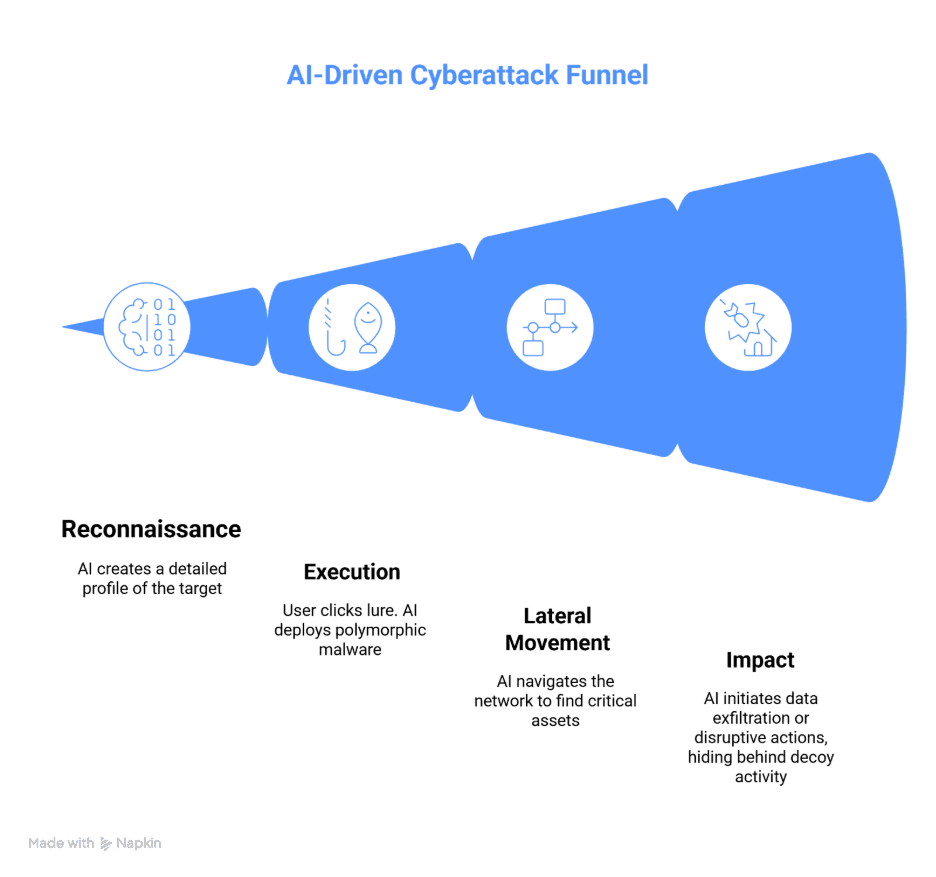
The four phases below map to what we see in our lab simulations of AI-armed attacks and in customer telemetry. None of the mechanics are science fiction. Every one of them is already inside credible red-team tooling. Treat this as a working taxonomy of generative AI threats, not a forecast.
In the old world, reconnaissance was "spray and pray." Attackers bought lists of emails and blasted out generic templates, hoping for a 0.1% click rate. The economics were brutal, but so was the noise.
In an AI-armed attack, reconnaissance is "spear and clone." Generative agents ingest a target's digital footprint (LinkedIn posts, recent tweets, news mentions, even public code commits) and build a psychological profile in seconds. They don't just write phishing emails. They write context.
An AI agent doesn't send a generic "Reset Password" link. It sees you just pushed a commit to a specific GitHub repository at 2:00 AM. It sends you a Slack message from a "Senior Dev" mimic complaining about a merge conflict in that specific repo, with a link to "fix it." The urgency is manufactured. The context is real. That's the entire trick.
Research insight: In our simulations, we modeled this shift by adjusting user-behavior variables based on context quality. When we moved from generic phishing to contextual phishing lures that referenced specific internal project names, simulated click rates jumped from under 2% to over 20%. In a 5,000-person enterprise, that's the difference between a nuisance and a flood.
This is where the defense breaks. Traditionally, if an attacker wrote a malicious script (say a Mimikatz variant), security vendors would find it, hash it, and block it. The signature was the shield. It worked for a decade.
Generative AI cancels the concept of a static signature.
An AI-armed attacker doesn't use a static tool. They use an agent that writes the tool at the target. If the agent detects an EDR (Endpoint Detection and Response) sensor, it asks its LLM backend: "Rewrite this credential-dumping logic to avoid these specific API hooks. Rename all variables. Change the control flow."
The intent of the code stays identical. The syntax changes completely. To a rules-based defense system, it looks like a brand-new, never-before-seen program every single time.
Research insight: We call these Mutant Attacks. We took a standard credential-dumping kill chain and used an LLM to generate 500 functional variations. Standard detection tools caught 95% of the original scripts, but detection rates dropped to roughly 25% for the mutated versions. The machine didn't get smarter. It got noisier. And in security, noise is the ultimate camouflage. This is what polymorphic malware looks like once an LLM is doing the mutating instead of a human author.
Once inside, human response speed becomes irrelevant. A human intruder moves cautiously, checks logs, types commands, and pauses to think. They might pivot to a new server in hours. Sometimes days.
An AI agent pivots in milliseconds.
But speed isn't the only factor. The bigger shift is abductive reasoning. AI is surprisingly good at guessing the shape of a network from fragments. If it sees a server named US-WEST-SQL-01, it infers the existence of US-EAST-SQL-01 and US-WEST-BAK-01. It tests those hypotheses instantly across thousands of internal IP addresses.
It doesn't need to be right. It just needs to be fast. While the SOC analyst is still triaging the initial phishing alert, the AI has already mapped the domain controller, identified the backup servers, and staged the "Crown Jewels" for exfiltration. Lateral network movement stops being a chess match and becomes a stopwatch problem.
The end goal of an AI-armed attack isn't always stealth. Sometimes it's chaos on purpose.
We're entering an era of high-entropy attacks. An AI agent can generate 10,000 realistic-looking alerts (failed logins, port scans, decoy malware executions) at the same time.
This is the "Entropy Bomb." It floods the SOC with so much signal that analysts hit cognitive overload. SOC alert fatigue stops being an HR problem and becomes an incident-response one. Your team fights decoys while the real attack runs quietly behind them. The challenge shifts from "find the needle in the haystack" to "find the needle in a stack of needles." Cybersecurity automation that still relies on human triage as the primary filter loses this fight before it starts.
Set aside the drama and look at the arithmetic. If the attacker can iterate their code in seconds, and your defense requires a human to write a detection rule in hours, the ratio isn't tight — it's lopsided by four orders of magnitude. Every extra minute of triage cost is a minute the mutant has to spawn new variants.
Three shifts follow from that math, and each one is what an AI defender has to nail:
Simbian AI runs on exactly that stack. The AI SOC Agent pairs TrustedLLM™ for reasoning with Context Lake™ for cross-signal correlation, and integrations that let the Agent act at machine speed on triage while analysts stay in charge of the calls that need judgment.
The lesson from our research is stark. You cannot fight a machine with a ticket queue.
The asymmetry is mathematical. The only way to survive an AI-armed attack is an AI defender that reasons, verifies, and blocks faster than the attacker can mutate — with the analyst kept in control of what "blocked" means for the business.
The offense has evolved. The defense has to do the same. If you want to see what that looks like in production, book a demo and we'll walk through a live mutant-attack replay against the AI SOC Agent.