Loading...
New
See what manual alert triage really costs your security team.
New
See what manual alert triage really costs your security team.

See what manual alert triage really costs your security team.
See what manual alert triage really costs your security team.
Loading...
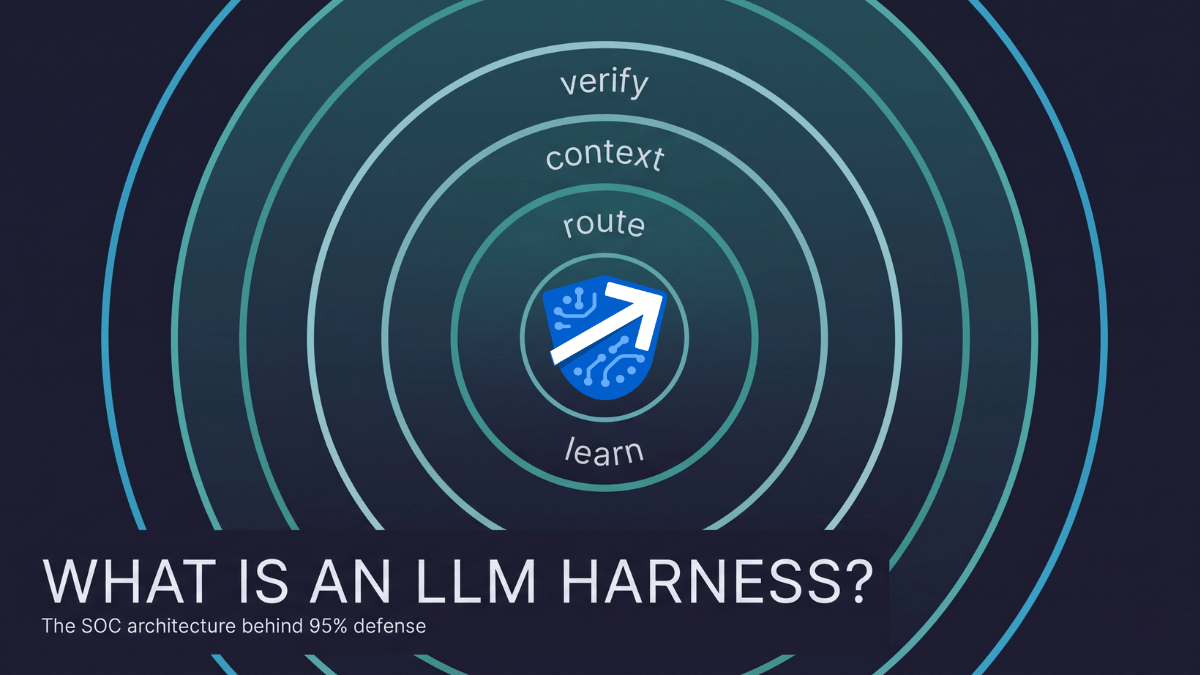
An LLM harness is the architecture wrapped around a base language model that turns probabilistic output into reliable, auditable behavior. The harness handles tools, memory, context, verification, and cost. Agent = Model + Harness, per LangChain's 2026 framing. In the SOC, the same Anthropic Opus 4.6 that caps at 44.5% on the Cyber Defense Benchmark raw clears 95% when wrapped in Simbian's LLM harness. Same model. Different architecture.
Six months ago, the word harness barely showed up outside evaluation libraries. Today it is on the LangChain blog, Microsoft's security blog (MDASH topped offensive CyberGym at 88.45% in May 2026), Salesforce Agentforce's home page, Cisco Cloud Control, and a wave of vendor explainers. The category is being defined this quarter.
Simbian built the AI SOC Agent on a defensive harness from the first commit, three years before any of those pieces shipped. The 45-point lift on the Cyber Defense Benchmark below is what that head start measures to. Everything in the rest of this piece is the architecture we have been running in production while the rest of the market was still calling it a wrapper.
This piece is the SOC-specific reading: what an LLM harness is, what a defensive harness has to do that a general-purpose one does not, and what the numbers say about what changes when the harness is built right.
The clean definition belongs to LangChain: "A harness is every piece of code, configuration, and execution logic that isn't the model itself."
Firecrawl's framing is the same idea, scoped to behavior: "the software infrastructure surrounding an AI model that manages everything except the model's actual reasoning."
Both are saying the same thing. The model produces tokens. The harness decides what to do with them, what tools to call, what context to load, what to verify, what to remember, and what to ship. Stripped down, every credible harness in production handles four buckets of work:
Strip any of those out and the system regresses to a brittle prompt-and-pray pipeline. Firecrawl named five failure modes that follow when a harness is missing: one-shotting, context rot, hallucinated tool calls, false completion declarations, and lost state on failure. SOC analysts who have evaluated raw-LLM tooling recognize all five.
Most of the current harness conversation is general-purpose. LangChain's case study is software engineering on Terminal Bench. Firecrawl writes for AI engineers building agents broadly. Microsoft's MDASH, the most authoritative new data point, hit 88.45% on CyberGym, a benchmark for finding real-world vulnerabilities. That is offensive work.
Defense is not offense played backward. The asymmetry shows up in the goal signal:
That asymmetry is why a defensive LLM harness has to do extra work the general-purpose ones do not. It has to construct the missing grader: organizational context, deterministic verification gates, replayable benchmarks, and a feedback loop that learns from analyst overrides. Without those, the harness is technically present and operationally useless against real attack telemetry.
The general-purpose harness pattern (tools + memory + context + verification) is necessary. It is not sufficient. A defensive harness has to add the SOC-specific layers below.
Same model, same telemetry, harness on, harness off, the deltas come from these four layers. Each addresses one of the failure modes from the failures piece.
The model says "this IP was the attacker." The harness goes back to the underlying telemetry and checks whether that IP appeared in the relevant window, on the relevant assets, with the activity the model described. Claims that fail verification get demoted before the analyst sees them.
This single layer kills two failure modes at once. Coin-flip inconsistency is caught at the gate, because two different verdicts cannot both verify against the same data. Confident hallucinations are caught at the gate, because a verdict that names an IP, a host, or a MITRE technique with no presence in the actual evidence does not survive verification. The model is allowed to be probabilistic. The output is not.
The harness grounds every investigation in the organization's own context: network topology, IP ranges, asset criticality, identity tiers, past verdicts, scheduled maintenance windows, approved pentest windows, the named owners of every critical asset. The Context Lake gives the model the missing defensive grader: was this activity expected, given everything else this organization knows?
This is the layer that turns a generic LLM into a defender for your environment. A jump-box being hit from an internal IP at 03:00 is critical at most organizations. It is routine at one where that pattern is a scheduled backup. The harness has to know the difference. Without organizational context, the LLM defaults to generic patterns that look right and miss often.
Frontier LLMs have a roughly 17× cost spread with no correlation to defensive accuracy. A harness that ignores cost burns through annual budgets in a quarter, which is exactly what has happened at several organizations in the last year.
The reasoning engine in a defensive harness picks model, depth, and time budget per task. A first-pass triage on a low-criticality alert does not warrant Opus 4.6. A lateral-movement investigation across thirty hosts does. The harness sits on the Pareto curve between cost and accuracy and routes to whichever model and depth fits the current task. This is what keeps the bill bounded as alert volume scales.
The harness reflects on its own work. Every verdict, every analyst override, every verification failure becomes training signal for what to do differently next time. The loop is not metaphor. On one production integration that started at 0% query accuracy because the model had never seen the query language, the loop reached near-100% on the task within a day of running, with zero engineering tickets touched.
This is self-improving, not self-driving. Humans keep containment authority and escalation calls; agents handle the mechanical work and the gates handle the verification. The loop is what closes the drift gap, where roughly 20% of detection rules in a typical SOC stop firing within six months as telemetry, schemas, and tools change underneath them.
Two numbers anchor the harness conversation today.
The MDASH number and the Simbian number are not in competition. They are different sides of the same architectural lesson: the model is one input. The harness does the work. Microsoft's blog put it directly: "the harness does the work, and the model is one input." That sentence applies on offense and on defense, but the harness has to be built for the side it is on.
A defensive harness without verifiable gates ships hallucinations. A defensive harness without the Context Lake misclassifies routine activity as critical and misses critical activity that looks routine. A defensive harness without cost-aware routing burns the budget. A defensive harness without a self-improvement loop drifts as the environment changes. The 45-point lift is what happens when all four are in place.
The next twelve months will deliver a wave of "AI SOC" products built on the same three or four frontier models. The model will not be the differentiator. The harness will. Five questions surface the difference:
A vendor whose answers are adjectives has shipped a model wrapper. A vendor whose answers are numbers, traces, and rollback logs has built the harness.
Q: What is an LLM harness in one sentence? An LLM harness is the architecture wrapped around a base language model — tools, memory, context, verification, planning, and cost routing — that turns the model's probabilistic output into reliable, auditable behavior. Agent equals Model plus Harness.
Q: How is an LLM harness different from RAG or fine-tuning? Retrieval-augmented generation (RAG) is one component a harness can use to load context into a prompt. Fine-tuning changes the model's weights. A harness is the surrounding architecture that decides what to call, what to verify, what to remember, and what to ship — none of which changes the model. A defensive SOC harness usually uses retrieval (Context Lake), gates (verification), and orchestration (reasoning engine) together. Fine-tuning is rarely the primary tool because it cannot encode the verifiable-gate or self-improvement layers.
Q: Why do raw LLMs fail without a harness? Frontier LLMs cap at 44.5% coverage on the best-performing MITRE ATT&CK tactic in the Cyber Defense Benchmark, with several tactics near zero. They give different verdicts on identical alerts. They hallucinate IP addresses and endpoints with high confidence. Cost varies 17× across models with no correlation to accuracy. The full failure analysis is in Why LLMs Fail in the SOC.
Q: How much does an LLM harness improve defensive accuracy? Same Opus 4.6, harness off versus harness on, on the Cyber Defense Benchmark: 44.5% → 95%. The 45-point lift comes from the four harness layers (verifiable gates, Context Lake, reasoning engine, self-improvement loop), not from a model upgrade.
Q: Can I build an LLM harness in-house instead of buying one? Some organizations will. The frontier model lowers the build bar; building a harness that matches a triage-only SOAR replacement of two years ago is now doable in days. The harder bar is keeping pace with attackers who have the same frontier models. As one Simbian webinar framing puts it, "AI is a sharper knife everyone gets." The build-versus-buy question for a defensive harness is not whether you can build one; it is whether your harness can stay current with the attack side that is also rebuilding theirs every quarter.
Q: How does an LLM harness compare to a SOAR? SOAR is rule-based. Every behavior is a flowchart a human wrote, maintained by a human, brittle when the environment changes. A harness is reasoning-based. The agent decides what to do per alert, the harness verifies the work, and the loop improves the system as it runs. SOAR achieves roughly 25% automation at high maintenance cost. A defensive LLM harness clears 95% coverage on the benchmark with no playbooks to maintain.
The harness is the part of the AI SOC stack that the next twelve months of buyer conversations will hinge on. Models will keep improving; the gap between vendors will not come from which model is current. It will come from what the harness around that model has to verify, remember, ground, route, and learn. Book a demo to see Simbian's LLM harness running the AI SOC Agent on production telemetry — same Opus 4.6, harnessed, on your own alert queue.