Loading...
New
See what manual alert triage really costs your security team.
New
See what manual alert triage really costs your security team.

See what manual alert triage really costs your security team.
See what manual alert triage really costs your security team.
Loading...
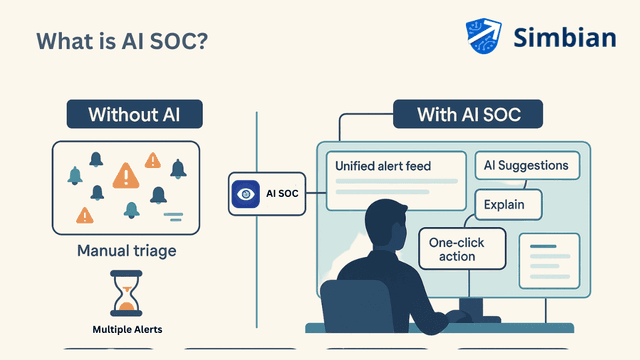
If you've been asking what an AI SOC actually is, here's the working definition. An AI SOC (AI-powered Security Operations Center) is an operating model where agentic AI systems assist human analysts by triaging alerts, correlating signals, running investigations, and executing bounded responses around the clock. Instead of drowning in noise, your team sees fewer, higher-quality, risk-prioritized incidents. Analysts spend most of their day on strategic defense and threat hunting rather than clicking through queues. Recent industry write-ups on intelligent SOC operations capture the same shift: AI improves triage, context enrichment, and response, cuts false positives, and helps reduce MTTR at the same time.
Here's the practical mental model. An AI SOC Agent sits on top of your telemetry (SIEM/XDR), your knowledge layer (asset, identity, and business context), and your playbooks (SOAR/ITSM). It then reasons over the graph of what's happening to decide what matters now, and what to do next. Multiple explainers echo this framing, describing AI SOCs as SOCs that apply AI to automate processes, speed investigations, and sharpen decisions.
The AI SOC benchmark at https://simbian.ai/best-ai-for-cybersecurity is the fastest way to see which frontier models actually reason under production noise. It stress-tests common LLMs against real triage, investigation, and response tasks, so buyers can separate demo theatrics from measurable capability. Treat it as your evaluation floor for any AI for cybersecurity claim a vendor puts in a deck.
Traditional SOCs are manual and siloed. Analysts swivel between tools and react to floods of alerts. AI SOCs add agentic reasoning that correlates evidence across entities, understands the relationships between them, and learns from every outcome. The goal isn't to replace analysts. It's to elevate them, from whack-a-mole toward proactive defense and threat hunting. This is self-improving, not self-driving. Humans still hold containment authority and the final escalation calls.
Agentic AI isn't a fancy script. Agents plan, reason, and act toward goals like "triage this alert," "correlate related events," or "contain this endpoint." Modern autonomous SOC overviews describe specialized cybersecurity AI agents that ingest telemetry and history, then produce actions or recommendations for the human in control. The strongest implementations expose the trace of how they reached each decision, so a senior analyst can audit and correct the reasoning, not just the output.
A well-built AI SOC scores alerts by actual business risk, not signature severity. Risk-aware triage blends threat intel, identity criticality, asset value, and environmental context, so only incidents that need human expertise reach your queue. This one shift often does more for SOC efficiency than any tuning project. AI alert triage that ignores identity context tends to over-page on service accounts and under-page on privileged users. Get the weighting right and the queue starts breathing again.
Every closed investigation is a training signal. Over time, the system adapts to your environment and gets more accurate, so noisy detections get smarter without adding analyst toil. This is where SOC automation stops looking like static rules and starts looking like an operating model that compounds week over week.
Before you deploy agents, make sure the pipes are clean. You'll integrate with your SIEM (telemetry plus rules), XDR (endpoint and network detections), SOAR (playbooks and enrichment), and ITSM (ticketing and approvals). Each tool plays a different role, and they overlap on purpose. Skip clean identity and asset context, and you'll ship an intelligent SOC that reasons over dirty data. That's the fastest way to torch analyst trust in month one.
An automated SOC that can't prove its work isn't automation, it's a vibe. Instrument the pilot from day one against these four measures.
Pick three high-volume incident types and stand up a shadowed agent behind your current queue. Phishing, low-severity EDR alerts, and SaaS anomalies work well, because their volume gives you signal fast. Run the agent in silent mode for two weeks. Compare its triage decisions against your analysts' calls, ticket by ticket. Then promote the agent to first-line triage on those three types only, with human approval on any containment action. Track MTTA, MTTR, false-positive rate, and analyst-hours-returned every week. Expand scope only when the numbers hold. AI incident response gains compound when you resist the urge to boil the ocean in month one.
An AI SOC isn't science fiction. It's a disciplined operating model built on agentic AI, graph reasoning, and strong governance. Start small, measure everything, and scale the wins. If you came here asking what is AI SOC, your next move is simple: pick three incident types, stand up a shadowed agent, and prove the delta on your own telemetry.