Loading...
New
See what manual alert triage really costs your security team.
New
See what manual alert triage really costs your security team.

See what manual alert triage really costs your security team.
See what manual alert triage really costs your security team.
Loading...
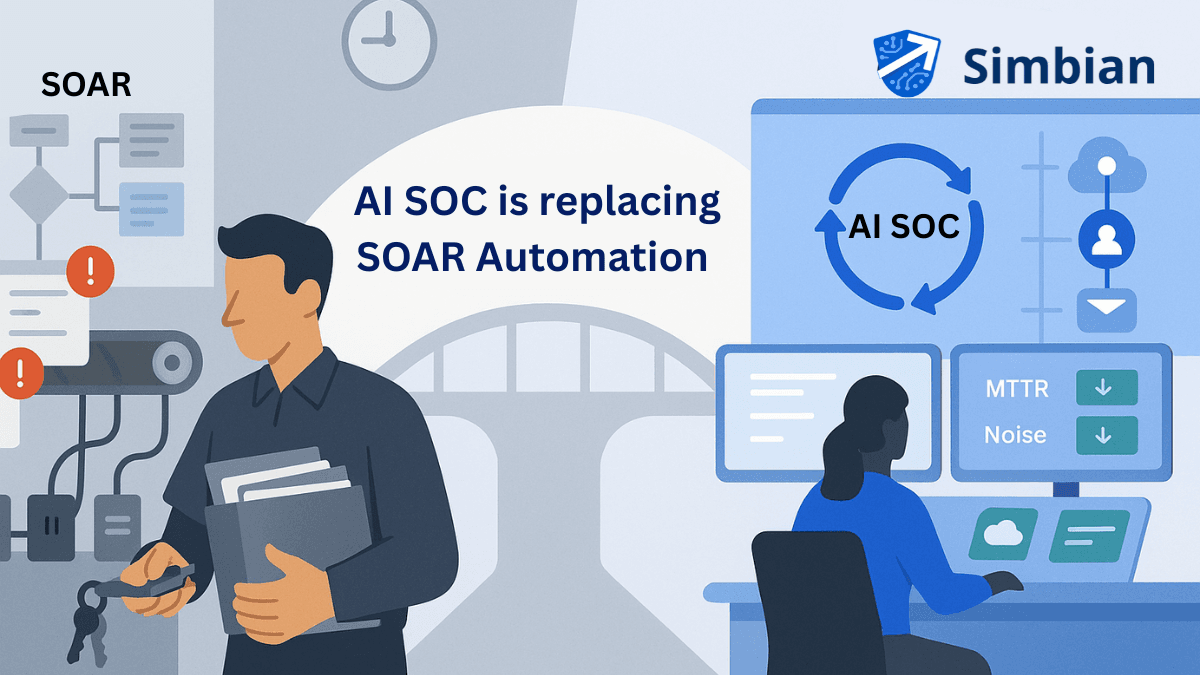
SOAR promised hyperautomation. What it delivered, for most teams, was a full-time playbook engineering job and a ceiling on how much of the security operations center a rules engine could realistically cover. Attackers moved faster. Alert volume climbed. The playbook backlog kept growing.
That's the gap the AI SOC fills. Pioneered by Simbian, this approach to SOC automation rethinks how organizations handle threat detection, incident response, and proactive threat hunting. It's AI in cybersecurity applied to the parts of the workflow SOAR always struggled with: reading context, reasoning over ambiguity, and adapting when playbooks don't match reality. Done right, it cuts false positives, lifts security analyst productivity, and directly improves security analyst retention.
Here's how the AI SOC Analyst model changes the modern security operations center, why Simbian.ai treats it as the natural successor to SOAR, and what a realistic SOC transformation looks like when you swap brittle playbooks for reasoning-based AI security tools.
SOAR components: automation, orchestration, response. SOAR platforms integrate with SIEM, firewalls, endpoint protection, and ticketing systems. They automate incident workflows, orchestrate cross-tool actions, and respond consistently based on predefined playbooks. When the alert matches the playbook, SOAR is fast, auditable, and cheap to run.
Where SOAR breaks down: SOAR excels at repetitive, well-defined tasks. It struggles the moment an alert doesn't fit the pattern. Static rules and hand-authored playbooks can't keep pace with novel threats, and the maintenance burden compounds every quarter. Most teams we talk to admit their SOAR only touches the top 20% of alert types. The rest still hit the analyst queue and add to analyst burnout.
The result is a familiar pattern: heavy investment up front, a small win on Tier-1 automation, then a slow slide back into manual work as playbook drift outpaces engineering capacity..
An AI SOC replaces the playbook-first model with a reasoning-first model. Instead of pattern-matching alerts against static rules, an AI SOC Analyst investigates each alert the way a human would: pull related telemetry, correlate it with threat intelligence, weigh the environment-specific context, and decide.
AI-driven threat detection and analytics: AI SOCs use machine learning and reasoning models to spot anomalies and patterns that static rules miss. That opens the door to predictive threat detection and dynamic threat modeling — including for AI in threat analysis workflows where the attacker is also using automation.
Adaptive response and behavioral analysis: Behavioral analytics teach the system what normal looks like in your environment. Response evolves with it. You get automated alert processing that reflects your architecture, not a generic playbook, and the system keeps improving without a rule-writing sprint.
SOC architecture is going through its biggest shift since SOAR arrived. Teams can hold on to centralized, human-dependent models that won't scale, or move to AI-native architectures that reason at machine speed. The choice isn't human analysts versus AI agents. It's analysts backed by real automation versus analysts drowning in manual queues.
The shift toward AI-enabled security operations isn't a hardware refresh. It's a strategic move for organizations serious about cyber resilience. Attacks are getting more sophisticated, and the talent shortage isn't easing. An AI SOC combines human judgment with machine coverage, which is what "24×7" is supposed to mean but rarely does when the queue is 40% uninvestigated.
The teams that win will treat the AI SOC as more than a threat detection upgrade. They'll use it to reshape how the SOC operates: how alerts get triaged, how threat intelligence flows into decisions, how incident response evidence is captured, and how proactive threat hunting scales past the two or three people currently doing it. That's what SOC transformation actually looks like — not a rebrand of the same workflow, but a different workflow that keeps improving.
Simbian AI SOC is one path there. Whether you evaluate us or someone else, the question isn't whether AI SOCs will become standard. It's how quickly your team adapts, and whether you want to be the SOC still shipping playbook patches next year, or the one running experiments against real attack campaigns.