Loading...

Loading...
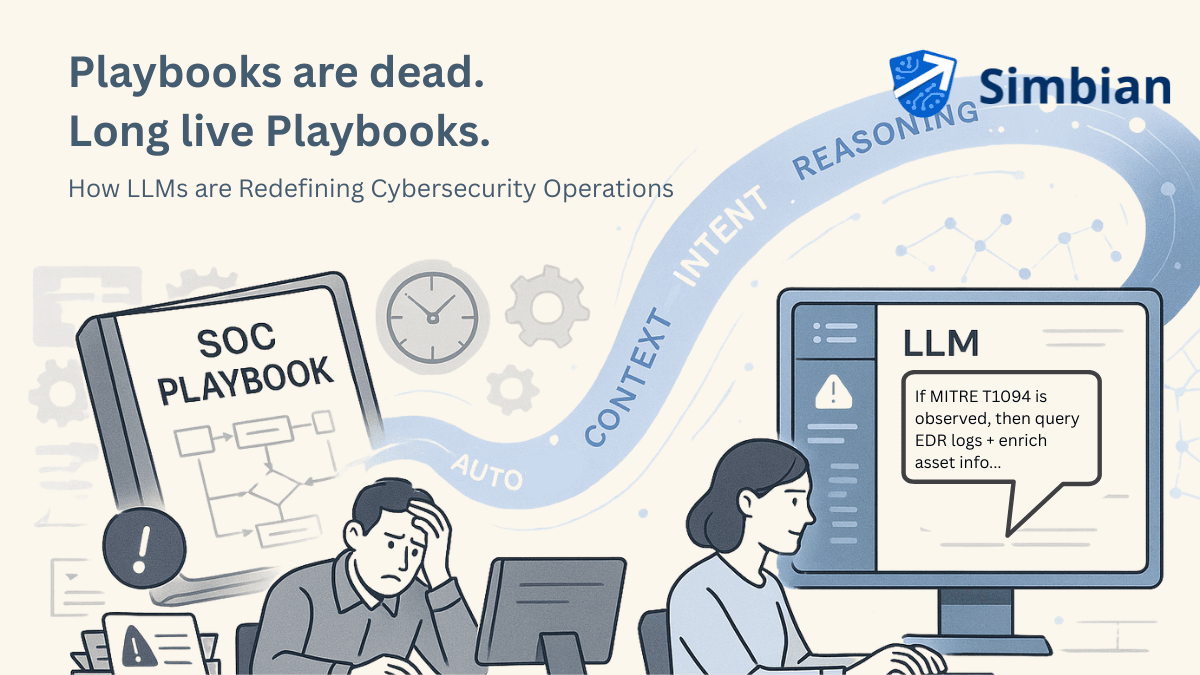
The world of cybersecurity is relentless. Threats continue to evolve, data keeps on growing, detection rules continue to get stale, and finding enough skilled engineers is an impossible task. 15 years ago, we had been promised that technology would help even the odds. SOC Automation, in particular, was supposed to be our silver bullet. SOARs promised the moon but grossly under delivered. They burst onto the scene promising to streamline operations, automate daily tasks, and reduce manual work. SOAR under-delivered with predefined playbooks that were too narrow, very hard to maintain and even harder to scale. . Building and maintaining these required expensive human engineering resources. They could handle the basic, standard daily tasks but fell flat against real-world use cases and sophisticated attacks. That is where humans are still required to live. The investigation logs can be collected but the queries were the same.
The big disruption that was promised was not delivered. Many of the most common "playbook" tasks, like blocking a phishing address or resetting a password, are things the tools themselves can already do.
There is a new kid on the block that is dominating the conversation, Large Language Models (LLMs). We're talking about seriously powerful AI, designed to understand and process human language on a massive scale. While AI and machine learning have been part of cybersecurity for decades. Spam filters worked wonders. AI based attack detections on endpoints worked very well. What are the LLMs doing now? They're not just automating tasks; they're fundamentally changing what is possible.
AI Agents, particularly AI SOC Agent sifts through mountains of logs in L1 SOC, help run structured and unstructured hunting campaigns, help with vulnerability scans, or even fill out parts of those endless security questionnaires. Humans guide AI to dive into the really complex investigative and strategic work. That alone boosts efficiency and can even slash costs, potentially saving millions on data breach expenses and drastically cutting down the time it takes to find and contain breaches. But the true "redefinition" comes from LLMs' uncanny ability to go beyond simple automation. These models are brilliant at processing vast amounts of complex data, identifying patterns, and adapting over time in ways older systems simply can't.
Smarter Threat Detection: LLMs can analyze data from countless sources—logs, network traffic, user behavior, cloud API calls—to pinpoint anomalies and recognize attack patterns, even those elusive zero-day threats that humans and signature-based systems would miss entirely.
Enhanced Threat Intelligence: They can rapidly digest threat reports, open-source intelligence, and even dark web chatter to identify emerging risks and offer predictive insights, helping teams understand and better prepare for attacks before they even hit.
Improved Vulnerability Management: LLMs can actually "read" code and configurations, moving past basic static analysis to understand the context and intent behind it. This helps cut down on those frustrating false positives that plague older tools and helps developers catch errors much earlier. They can also help prioritize vulnerabilities based on what truly matters to the business.
Redefining SOAR: In our interactions with our customers, we have been comparing LLM’s autonomous actions with traditional SOAR tools. LLMs have been faster, more accurate, and produced incident reports. The big difference? Unlike the rigid, playbook-dependent systems, LLMs can improvise and generate contextually appropriate responses to investigations in real-time.
We're already seeing this in action at Simbian. LLMs are helping with triage, investigation, autonomous response in the SOC, automating vulnerability discovery, in the vulnerability management and streamlining security questionnaires, powering faster incident response (like isolating affected systems), enabling AI-powered remediation with custom instructions, and even assisting with patch management and penetration testing.
Generative AI, specifically, is supercharging threat intelligence and automating complex processes. There's even work underway to use AI for dynamic deception tactics to mislead attackers.
The biggest reality check? The attackers are using AI too. Attackers are leveraging AI to generate code to exploit zero-day vulnerabilities. Social engineers are crafting incredibly convincing phishing emails with tools like ChatGPT. Attackers are using machine learning for sophisticated password cracking and CAPTCHA bypassing. We're staring down the barrel of autonomous AI agents developed by malicious actors that could identify vulnerabilities, plan attacks, and evade defenses all on their own. So, the need is urgent. This time fire can be fought fire!
Finally, there's the human element. While AI can eliminate human errors in similar tasks, our training efforts are yielding amazing results in the rapid adoption of AI SOC. Both seasoned pros and new recruits appreciate the value AI brings. Average becomes better. Good becomes great. Great can do much more and also train AI.
So, will LLMs completely replace security analysts? NO!
Instead, the vision is autonomous and collaborative. The SOCs of today are a cyborg blend of humans and AI SOC agents. Humans will focus on the high-level stuff—leadership, strategy, creativity, and critical decision-making. AI agents, seamlessly integrated into our workflows and communication tools, will act as tireless teammates, executing tasks with speed and precision, analyzing data, and providing insights that supercharge human capabilities, hence autonomous. AI will also act as an accelerator, writing queries, sifting through large number of logs and data, summarizing etc., hence being collaborative. Bringing LLMs into cybersecurity is far more than just a tech upgrade; it's a fundamental transformation in how teams operate. It demands continuous training, robust error handling, and a real focus on making it intuitive for humans and AI to work together.
While challenges like biases, adversarial attacks, and the ethical use of AI need careful navigation and regulatory guidance, the potential for LLMs to redefine cybersecurity operations is crystal clear. Simbian is embracing this technology purposefully, thoughtfully, tackling its limitations head-on, and fostering a truly collaborative environment. We at Simbian are building more intelligent, adaptable, and resilient defenses against the ever-increasing sophistication of cyber threats. Reach out to us to see the AI agents in action.
Simbian’s AI SOC Agent is built on a purpose-built Context Lake TM. Context Lake along with the army of AI agents that solve multiple use cases like Threat Hunting (AI Threat Hunt Agent), Vulnerability and Exposure management (AI VRM and CTEM Agents) and Governance and Risk compliance. We envision an army of agents that can help support all functions with a modern cybersecurity practice.