Loading...

Loading...

The short answer: AI is changing cybersecurity careers by automating the work that used to define entry-level roles — alert triage, log review, ticket drafting — while creating higher-paid roles that direct, secure, and govern the automation. Entry-level analyst job postings have dropped roughly 53% since 2022. The 4.8M global cybersecurity workforce gap has not closed. The ladder is taller, narrower, and paid better at the top.
Entry-level security analyst postings have dropped about 53% since 2022, even as the global cybersecurity workforce shortfall sits near 4.8 million people (ISC2, 2025). Both numbers are correct at the same time — and together they explain how AI is changing cybersecurity careers in practice, not in theory. The bottom rungs are gone. The ladder is taller, narrower, and higher-paid.
AI took the repetitive investigation work that used to define the SOC analyst career path — the same work that anchored the bottom of every AI cybersecurity careers ladder. Modern AI agents triage alerts, enrich indicators, draft tickets, and write the first 80% of an incident report. Gartner now estimates that around 50% of Tier-1 SOC responsibilities will be AI-handled by 2028, and Microsoft Security Research reports its own agents already automate roughly 75% of phishing and malware investigations.
In Simbian's production deployment at a Financial Services Company, the Simbian AI SOC Agent completes about 80% of every investigation before a human opens the ticket. The team stopped hiring Tier 1 analysts entirely. That is what the AI impact on cybersecurity jobs — and on AI cybersecurity jobs hiring plans — looks like at the operational level. Not a memo, an org chart.
AI did not replace anything that requires organizational context, decision authority, or the relationship work senior analysts do with the rest of the business. Attackers move laterally in roughly four minutes during the fastest incidents (ReliaQuest, 2026). The job is no longer "watch the queue." It is deciding what counts as a real threat in your environment, tuning the agents that act on that judgment, and owning the calls that carry business, legal, and reputational weight. That is the human-in-control model — and it is now a job description, not a slogan.
No — but it is replacing specific tasks fast enough that the answer feels like yes if you are sitting in the wrong seat. ISC2's 2025 study shows 59% of security teams reporting critical or significant skills gaps, with AI and ML named the single most in-demand skill. Roughly 64% of 2026 security job listings now require AI, ML, or automation skills, and Dexity reported the AI-required share of postings more than doubling in a single month earlier this year. Companies do not need more analysts. They need different ones.
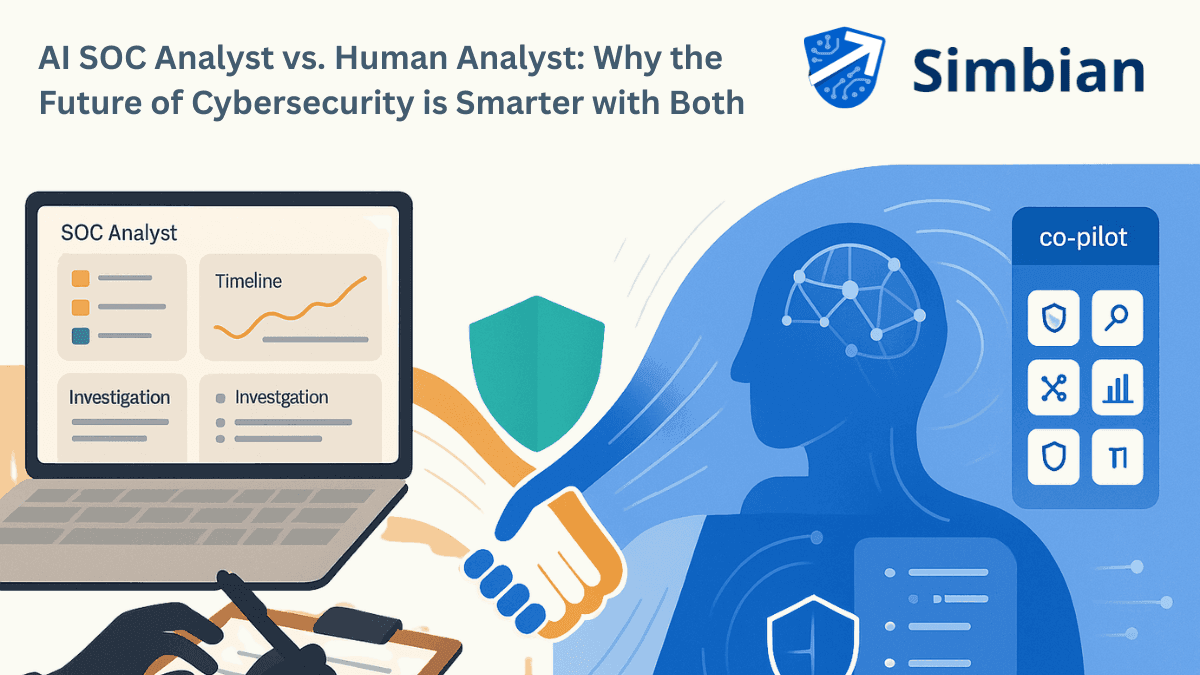
The five-seat SOC org — SOC Manager, SOAR engineer, L3, L2, L1 — collapses into three AI SecOps roles that direct the automation instead of competing with it. The scope widens past the SOC: Threat Hunt, Pentest, and NetSecOps all run on the same model. Each role is built around a job the AI cannot do on its own — govern the program, build the skills, or run the live cases.
Stop deepening skills an agent already does better than you on day one: writing rigid playbooks, manual Tier 1 triage, repetitive log pivoting, basic IOC lookups. Those are table stakes the agent does in seconds.
Invest where the leverage is. Learn to read and critique AI output for security context. Build detection engineering muscle even if you sit in the SOC. Pick up cloud and identity depth. Get enough Python and pipeline work to bend tools to your environment. The 2026 hiring data on AI security careers is unambiguous, and the trajectory is steeper than most career advice has caught up to.
Reskilling is real, and it is not always realistic at the same pace as the change. If your role is collapsing into automation, the move is to climb laterally — into the AI Skill Manager or AI SecOps Analyst seat — using the operational knowledge you already have as the moat. Neither role requires coding; both reward the operational judgment you already carry. Your edge over a fresh grad is not tooling. It is knowing which alerts in your environment have always mattered, and why.
Will AI replace cybersecurity jobs? No, but it is replacing specific tasks — alert triage, ticket drafting, first-pass investigation. Roles built around those tasks are shrinking. Roles built around judgment, AI oversight, detection engineering, and governance are growing. Full read on AI vs SOC analysts.
Which cybersecurity roles are growing fastest because of AI? The five-seat SOC org (SOC Manager, SOAR engineer, L3, L2, L1) is collapsing into three AI SecOps roles: AI SecOps Manager (governs every SecOps program — SOC, Threat Hunt, Pentest, NetSecOps), AI Skill Manager (encodes org knowledge into skills the agents run — from old L3 + SOAR engineer), and AI SecOps Analyst (supervises the agents and owns escalations — from old L1 + L2). Demand for senior analysts in these directing roles is projected to grow about 40% over the next three years.
Is cybersecurity still a good career to enter in 2026? Yes — but the entry point has shifted. Plan to enter through cloud, detection engineering, or AI security rather than Tier 1 SOC, and learn to operate and audit AI tools, not just answer their tickets.
What AI skills should cybersecurity professionals learn first? Prompt and output evaluation for security contexts, basic model and pipeline security, and how to tune and audit agentic systems. Pair these with detection-as-code and cloud identity fundamentals.
How is the SOC analyst role specifically changing? The traditional Tier 1 role is being absorbed by AI agents. L1 and L2 merge into the AI SecOps Analyst seat — supervising the agents, approving HITL actions, and owning escalations across SOC, Threat Hunt, Pentest, and NetSecOps. Senior L3 analysts and SOAR engineers move into the AI Skill Manager seat that encodes the org's knowledge into the skills the agents run. Both are higher-leverage, higher-paid roles that direct the AI rather than compete with it — and neither requires coding.
The ladder is taller now. The people climbing it are the ones who stopped trying to out-triage the machine and started directing it. If you want to see what that looks like inside a production SOC — which Tier 1 work disappears first, and what the analysts actually do instead — Book a Demo of the AI SOC Agent, or read AI SOC: Fact vs Fiction for the unhyped version of what AI is actually doing in security operations today.