Loading...

Loading...
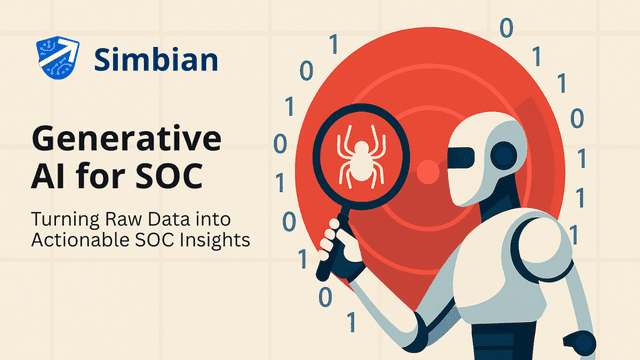
Generative AI in the SOC isn't a chatbot on the side of your SIEM. Used well, it's a context-aware analyst that reads petabytes of logs, emails, and threat feeds, then hands your team a short list of things that actually matter. It predicts novel attack patterns, drafts investigation playbooks against live data, and prioritises risk by behaviour instead of by static rule. Unlike keyword-matching tools, large language models read for meaning, which is why they surface signal your regex queries miss.
Pair a generative model with a purpose-built AI Agent and you get an AI SOC Analyst that never sleeps, never queues, and never forgets what happened last week. The analyst role shifts with it. Tier 1 stops copy-pasting IOCs and starts investigating the alerts the AI escalated. Tier 2 and Tier 3 stop firefighting and start tuning the AI, writing detections, and running threat-hunt hypotheses the models generated overnight. SOC managers stop chasing MTTR spreadsheets and start making capacity decisions with the model as a lever.
The efficiency shows up in the boring places first: case management, evidence collection, and cross-tool correlation. Those are the hours nobody talks about at conferences and everybody loses to on a Tuesday.
Legacy SIEMs flag what they've already been told to look for. Generative AI reasons about what it's seeing. By reading historical breach reports, ATT&CK write-ups, and global feeds, it flags patterns your rule set won't:
certutil fetching payloads, bitsadmin doing anything at all).The shift is from "detect the thing we've named" to "detect the thing that doesn't fit." That's where analyst hours have always gone; now the model does the first pass.
SOC teams lose hours to reading. Generative AI compresses the reading loop:
Give it the same ISAC bulletin your analysts skim in the morning and it returns a ranked list of what you should hunt for by end of day. In production that loop runs end to end: every alert investigated and responded to in under four minutes from detection on average, with 95% of those responses approved by your own analysts.
Not every team has a threat-hunter with ten years of ATT&CK muscle memory. Generative AI narrows the gap:
The point isn't to replace the senior. It's to stop wasting the senior's time on Tier 1 work while the Tier 1 gets a real education from a system that remembers every case it's ever seen.
Skip the "one big pilot" trap. Ship one use case, measure it against the current baseline, and move to the next. That's how AI SOC deployments compound.
Generative AI isn't replacing analysts. It's making them roughly 10x more effective on the work they were already doing. While the model crunches data, humans:
Agents act. Humans steer. The teams getting this right treat the AI as a very fast, very literal junior analyst who needs supervision, not a magic box.
Generative AI is reshaping threat intelligence, but adoption without strategy just adds another dashboard. Simbian's approach:
The bottom line:
SOC teams running generative AI resolve breaches 65% faster and cut operating cost by $1.2M/year on average. In an era where attackers are already using AI to write phishing, generate malware, and probe your perimeter, defending without it is bringing a knife to a drone fight.
Explore Generative AI Solutions to automate detection, free your analysts to hunt, and stay ahead of the AI-powered attacks already in your inbox.