Loading...

Loading...
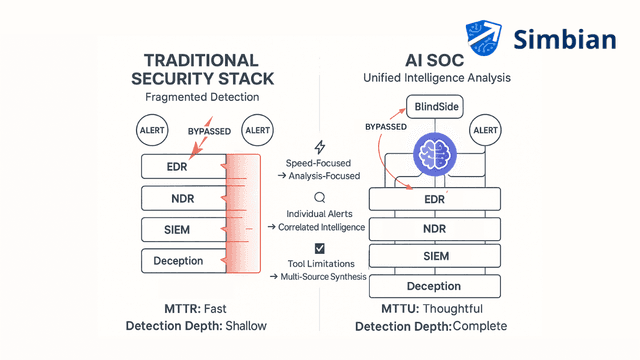
Sophisticated threat actors keep slipping past the most advanced Endpoint Detection and Response (EDR) tools, and the industry is finally admitting it. Cymulate's disclosure of the BlindSide technique showed attackers can systematically unhook EDR sensors, manipulate kernel-level callbacks, and run inside endpoint blind spots by abusing hardware breakpoints to create processes nobody is watching. The lesson isn't that EDR is broken. The lesson is that "detect faster" stopped being a strategy the moment attackers learned to detect the detector first.
Modern evasion is methodical. It targets the specific places EDR looks and the specific moments it looks there.
disabler.exe strip EDR hooks from user-mode libraries and disable kernel-mode callbacks, creating unmonitored system processes that vanish from telemetry. The endpoint is still online; it just stopped narrating what happens on it.The through-line is uncomfortable. Current detection strategies optimize for millisecond response times over analytical depth, and that trade-off is exactly the gap sophisticated operators exploit.
Modern SOCs run stacks of specialized tools. Each is very good at one job and mostly useless at the others.
The failure isn't tool capability. It's that sophisticated attacks live in the seams between tools operating independently, and no single product is architected to see the seam.
The industry keeps selling real-time response. The important security decisions still benefit from deliberate, comprehensive analysis. AI SOC agents that mirror how an expert human analyst reasons close the gap in a specific way — by treating each tool's output as a fragment of one story instead of a standalone verdict.
Consider a BlindSide-style compromise that successfully mutes EDR monitoring. Endpoint telemetry goes quiet. AI SOC works the remaining signals: odd authentication patterns on the compromised account, NDR flagging traffic to fresh infrastructure, and a login attempt against a deception honeypot. Any one of those alerts, on its own, is a shrug. Correlated, they reconstruct the full compromise timeline before the attacker reaches the objective.
Simbian's AI SOC Agent is self-improving, not self-driving. Analysts keep containment authority and escalation calls; the agent handles the correlation and hypothesis work that no human team can do in parallel at 2 a.m.
When EDR visibility drops, the tell is almost never on the endpoint. It's in the shape of everything around it. AI SOC platforms lean on that principle:
None of this replaces EDR, NDR, or the SIEM. It extracts more value from signals those tools already generate by wiring them into one investigation.
The industry needs metrics that reward analytical quality, not just speed.
Faster alerts are not the future. Smarter analysis of the signals you already have is. Organizations that adapt to deliberate, correlated reasoning close the gap that evasion techniques rely on. Those that don't stay exposed to threats specifically designed to exploit fragmented detection.