Loading...

Loading...
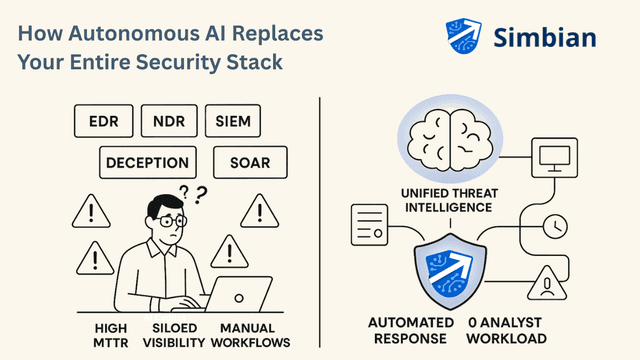
The modern enterprise security stack is collapsing under its weight. Organizations juggle an average of 83 different security tools from 29 vendors, while threats move at machine speed, and analysts struggle with alert fatigue. The solution isn't adding another dashboard or hiring more specialists—it's radically rethinking security architecture through autonomous AI agents that replace, not supplement, your bloated toolchain.
Enterprise security teams face an impossible equation: managing security stacks has been a struggle for organizations, which juggle an average of 83 different security tools from 29 different vendors, according to the study. Each additional tool promises enhanced protection but delivers operational chaos instead.
Consider the hidden mathematics of vendor sprawl:
$5.17 million average breach cost despite massive tool investments
47 different security solutions deployed by average companies
40+ hours weekly lost to context-switching between platforms
66% of teams cannot keep pace with alert volume
These aren't scaling problems—they're fundamental architectural failures. Traditional security stacks treat symptoms while autonomous AI agents eliminate root causes.
Legacy security architecture assumes humans can orchestrate dozens of specialized tools into coherent defense. This assumption crumbles when attackers operate at millisecond speed while defenders need minutes to correlate data across fragmented platforms.
The Tool Trap: Each security vendor optimizes their narrow domain—endpoint, network, cloud, identity—creating intelligence silos that attackers exploit. While your EDR excels at endpoint detection and your SIEM processes logs, neither understands the business context linking them together.
The Integration Illusion: Security orchestration platforms promise to connect disparate tools, but orchestration isn't intelligent. SOAR platforms automate existing workflows without understanding whether those workflows make strategic sense.
The Analyst Bottleneck: Every alert requires human context-gathering across multiple consoles. Analysts spend 80% of their time copying data between tools instead of investigating threats.
Autonomous AI agents flip the security equation by consolidating capabilities into intelligent systems that understand business context, not just technical indicators. Instead of orchestrating 47 tools, deploy one agent that comprehends your entire environment.
Context Lake Architecture: Simbian's autonomous agents leverage Context Lake™ technology to maintain organizational memory across all security functions. Rather than siloed tools that forget yesterday's threats, agents accumulate institutional knowledge that improves decision-making over time.
TrustedLLM Foundation: Unlike consumer AI assistants, TrustedLLM eliminates hallucinations through security-first design. Agents make life-or-death decisions based on verified intelligence, not internet speculation.
Universal Tool Integration: Autonomous agents don't replace your existing security investments—they orchestrate them intelligently. With 70+ native integrations, agents leverage existing EDR, SIEM, and cloud security platforms while adding autonomous decision-making capabilities.
AI Agents are a One Stop Shop
Cost Elimination: Organizations using AI and automation report $1.88 million lower breach costs compared to manual approaches. Autonomous agents eliminate vendor management overhead while delivering superior protection.
Operational Simplification: Replace dozens of security specialists with autonomous agents that never sleep, never burn out, and never miss context. Teams shift from tool operation to strategic threat modeling.
Scalability Without Complexity: Adding new assets or attack surfaces doesn't require additional tools. Autonomous agents scale intelligence automatically, understanding new environments without manual configuration.
Autonomous AI doesn't eliminate security professionals—it liberates them from repetitive tool management. While agents handle routine investigation and response, analysts focus on:
Strategic threat modeling based on agent-discovered patterns
Purple team exercises that test autonomous response capabilities
Policy refinement that improves agent decision-making
Business risk assessment using agent-gathered intelligence
"We've invested millions in existing tools." Autonomous agents maximize existing investments by using them more intelligently. Your EDR becomes more effective when guided by agents that understand the business context.
"Multiple vendors provide redundancy." Tool redundancy creates complexity, not resilience. Autonomous agents provide true redundancy through distributed intelligence that spans your entire environment.
"Our analysts know these tools." Free analysts from tool expertise to focus on threat expertise. Agents handle technical complexity while humans guide strategic decisions.
Start with high-volume pain points where autonomous agents prove immediate value:
Alert Triage Automation: Deploy agents to handle the 10,000+ daily alerts that overwhelm human analysts
Incident Investigation: Replace manual evidence gathering with autonomous correlation across all security tools
Threat Response: Eliminate human delays in containment through autonomous remediation capabilities
Continuous Monitoring: Extend coverage beyond business hours with agents that never need sleep
The next generation of cybersecurity isn't about better tools—it's about autonomous intelligence that makes tools irrelevant. Organizations will compete on the quality of their AI agents, not the quantity of their security platforms.
Stop managing security tools and start deploying security intelligence. The great unbundling has begun, and autonomous AI agents are leading the transformation from reactive toolchains to proactive defense ecosystems.