Loading...
New
See what manual alert triage really costs your security team.
New
See what manual alert triage really costs your security team.

See what manual alert triage really costs your security team.
See what manual alert triage really costs your security team.
Loading...
AI SIEM uses machine learning and AI Agents to triage and investigate SIEM alerts. It ships two ways: built into the SIEM and working on logs ingested into it, or as a layer that queries the SIEM you already run and writes verdicts back. Either way, SIEM rules cover 22% of MITRE ATT&CK techniques on average (CardinalOps, 2025).
The average enterprise SIEM ingests enough telemetry to potentially cover 90% of MITRE ATT&CK techniques and has detection rules for 22%, according to CardinalOps' 2025 report. Rip the SIEM out and you pay to move every log and rebuild every rule, then inherit the same gap on a new console.
The alternative keeps the SIEM and puts a reasoning layer on top to do the work your team never gets to. We build that layer at Simbian, so read the architecture below as a vendor's view.
AI SIEM is either AI built into a SIEM product or an AI layer on top of the SIEM you already own. The two make opposite demands on your data. Vendors sell both as AI SIEM, next-gen SIEM, AI-native SIEM, or agentic SIEM, so a shortlist of AI SIEM tools can mix them without anyone noticing.
The built-in kind starts with ingestion. Collect and normalize the logs in the vendor's store, then apply machine learning and an assistant on top. SentinelOne Singularity AI SIEM, CrowdStrike Falcon Next-Gen SIEM, and Palo Alto Cortex XSIAM sit on this side, and Microsoft pairs Sentinel with Security Copilot. Google SecOps runs a Gemini-powered Triage and Investigation Agent that classifies alerts, and Splunk ships a Triage Agent in Enterprise Security Premier. CrowdStrike argues for centralizing in its 2026 launch: "When vendors bolt agents onto fragmented data stacks, every connectivity gap becomes an investigation gap."
That argument holds once all your data lives in one vendor's store. Getting it there is the first bill. If you run Sentinel with CrowdStrike, ask each vendor's AI what it can see and do in the other's console.
The layer kind, often called an agentic SOC layer, leaves the data where it sits. It reads the SIEM through its API, writes queries in that SIEM's own language, reaches data the SIEM never ingested, and records its verdict on the SIEM's incident.
| Dimension | Built-in AI SIEM | AI SOC layer on your existing SIEM |
|---|---|---|
| Where your logs live | In that vendor's store, ingested first | Where they already are, queried in place |
| Query language | The vendor's own | Each SIEM's own: SPL, KQL, YARA-L, AQL, XQL, ES|QL |
| What it sees | Mainly what was routed into that SIEM, plus whatever its federated search reaches | The SIEM plus EDR, identity, cloud, and ITSM data it never held |
| Where it acts | Through the vendor's own SOAR and integrations | In the tools you already own, behind approval gates |
| Vendors and access | One vendor, one contract | One more vendor, with read access to your SIEM |
| When you change or add a SIEM | The AI changes with it | The layer stays and remaps the schema |
| Best fit | You are consolidating on that vendor anyway | Two SIEMs, a migration underway, or years of detection content to keep |
SIEM replacement does not fix it. A new SIEM inherits the same gap, because the average SIEM already holds enough telemetry to potentially cover 90% of MITRE ATT&CK techniques and has detection rules for 22% (CardinalOps, 2025). The shortfall is missing and broken detections.
The figures come from the CardinalOps 2025 State of SIEM Detection Risk report, which draws on production Splunk, Microsoft Sentinel, CrowdStrike LogScale, and Google SecOps environments. The numbers here are from its 2025 sample; the five-year aggregate on its cover reads 21% coverage and 13% of rules broken. Cribl announced it was acquiring CardinalOps in July 2026 and is building what it calls an open alternative to the SIEM; these figures predate the deal.
In the 2025 sample, the average SIEM had detection rules for four of the 10 techniques adversaries use most. It carried 163 rules, and about one in ten was broken, which leaves roughly 16 that will never fire. The report blames misconfigured data sources, missing fields, and parsing errors.
Those organizations averaged 23,746 log sources across 259 log types. That's more telemetry than their detection teams had the hours to turn into rules. Anton Chuvakin of Google Cloud's Office of the CISO, quoted in the report, puts the bottleneck where it belongs. "A great team with an average SIEM will run circles around the average team with a great SIEM."
A migration adds breakage of its own. You re-point collectors, translate rules into a new query language, and keep the old SIEM alive for retention while you do it. Those 16 broken rules make the trip too.
A built-in AI SIEM sees the slice of an attack you paid to route into it, and its AI is built mainly to answer one question about that slice: did we detect it? Defense needs three more answers, and the SIEM holds only some of the evidence for them.
Start with what the SIEM sees. Ingest pricing forces choices, and Microsoft's own Sentinel pricing guidance steers high-volume network, firewall, and proxy logs to a cheaper data lake tier built for retention and investigation, not real-time alerting. Even a SIEM holding every log rarely knows which server pays the bills, who owns the svc-backup account, or that the user behind an odd login resigned on Friday.
Then there's what it does. A SIEM stores and searches. Isolating a laptop, disabling an account, or filing the patch ticket happens in your EDR, identity provider, and ITSM, often through SOAR playbooks someone has to keep alive.
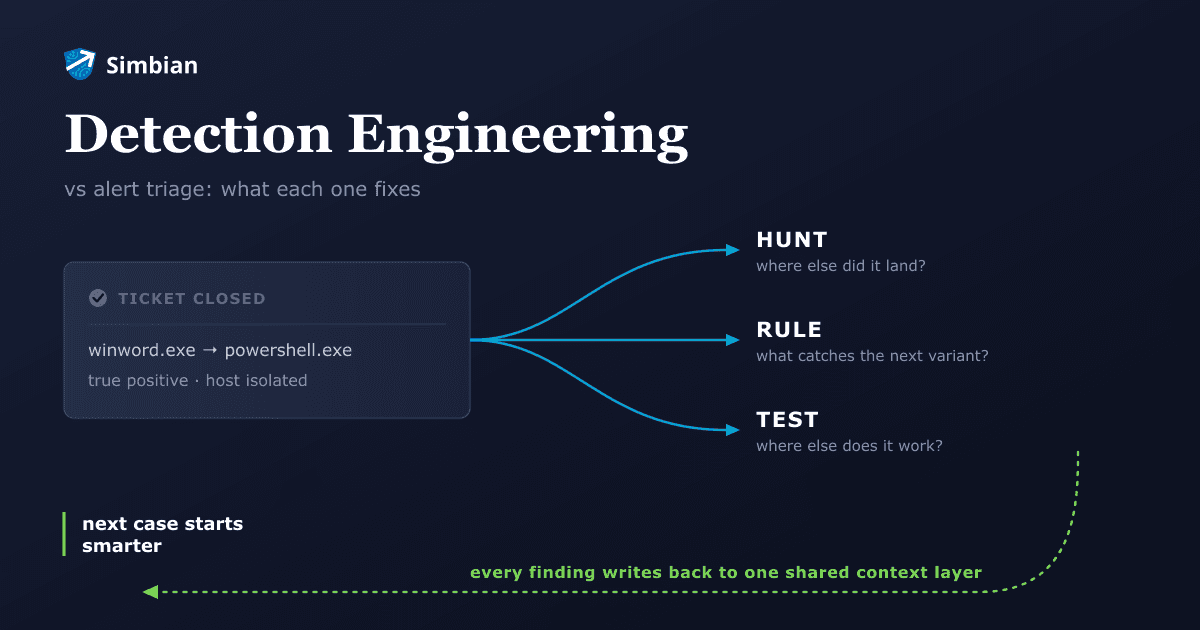
Covering one technique means asking four questions about it, across time:
Take Kerberoasting (MITRE ATT&CK T1558.003). The present is one account suddenly requesting Kerberos service tickets for many service accounts with RC4 encryption (Event ID 4769), which your SOC investigates to a verdict. The past is threat hunting through older data for the same pattern from other accounts. The future is a pentest that proves which service-account tickets actually crack offline, then a detection rule for the gap. It's written in your SIEM's language, and a person approves it before it ships.
Simbian assigns an Agent to each question on one platform: the AI SOC Agent for the present, the AI Threat Hunt Agent for the past, and the AI Pentest and AI Detection Engineering Agents for the future. The SOC and Threat Hunt Agents share the Context Lake™, one memory of your assets, identities, processes, and past decisions, and the Pentest and SOC Agents share findings in both directions.
An AI SOC architecture on an existing SIEM goes in six steps, in this order, because each lowers the risk of the next.
Your SIEM holds the retention your auditors expect and the detection content your team spent years tuning. A second copy of your logs adds a second bill and a second store inside audit scope. Some augmentation offers work exactly that way, piping a copy of your telemetry into another vendor's data lake.
Ask every vendor where the data lands before you sign. Simbian reads your SIEM at query time, keeps what it learns in a Context Lake scoped to your tenant, and never trains on your data. Its SaaS runs in the US, EU, Japan, or India, with model calls kept in the same region. It also runs in your own cloud, on-premises, or air-gapped with your own model.
The layer should search your SIEM through its API in the language it already speaks. That means SPL for Splunk, KQL for Microsoft Sentinel, UDM search and YARA-L 2.0 for Google SecOps, AQL for QRadar, XQL for Cortex XSIAM, and ES|QL for Elastic. Start it with read-only credentials. A good Agent spends its first hours mapping your schema. It fires many small queries that list tables and sample rows, then writes the map down so later queries start from your field names.
Every query an AI SIEM layer runs, ours included, competes with your scheduled detections, and on Sentinel's Basic and Auxiliary tiers it is billed by the data scanned. Agree on a query budget up front.
Connect the EDR process tree, the identity provider's sign-in history, cloud audit logs, the ticket that approved the change, and the runbook, without routing any of it into the SIEM. Simbian reads from more than 100 tools, acts in more than 25, and normalizes what it reads into one schema, so two SIEMs and an EDR look like one estate.
The verdict, the evidence, the reasoning, and the ATT&CK mapping belong on the SIEM's native object. That's a Sentinel incident, a Splunk Enterprise Security finding (a notable event before ES 8), or a Google SecOps case. Writing back keeps the audit trail where your auditors already look and keeps analysts in one console. Write-back support varies a lot by vendor and by SIEM; our SIEM integration comparison of five AI SOC Agents checks exactly that.
Begin read-only. Move to recommendations, then to actions that wait for a named person's approval, and lift those gates one action type at a time as the approvals hold up. Containment on a domain controller should never share a threshold with closing a duplicate phishing alert.
Treat the rollout the way you'd treat a new analyst. Confirm you're looking at the same data and reaching the same conclusions before you scale.
Picture the 3 a.m. upgrade. One field gets renamed, a few dozen detections stop matching, and nothing throws an error.
You find out at the audit.
An AI SIEM layer that queries the SIEM all day can catch the silent break before the audit does. Simbian looks for detection rules that have gone noisy, broken, or missing, and drafts the fix in your SIEM's own query language for a person to approve, with rollback. It notices when a source goes quiet, even if the error behind it was filtered as non-actionable, and proposes an updated schema map when a vendor update changes a field.
SIEM AI Agents write mostly correct SPL, KQL, and XQL once they map your schema and remember which queries failed. On a production shadow tenant streaming live Cortex XSIAM alerts in 2026, Simbian went from 0% to 70% XQL query success. It had never seen the language. It took two iterations and zero engineers.
A general-purpose model has never seen your field names. Ask a chatbot for a Splunk search and it will borrow syntax from another language and invent a field. Production SIEMs add their own traps. Here is how a reasoning Agent handles each:
What the Agent learns comes back as a proposed change to its skills and memory, shown as a diff for a person to approve.
Replace the SIEM when the SIEM itself is failing. Choose SIEM augmentation, an AI layer over the SIEM, when the SIEM works and the work on top of it doesn't get done. Sometimes you need both. Then the layer is how you run a SIEM migration without a big-bang cutover.
| Your situation | Lean toward |
|---|---|
| Renewal is near and the SIEM can't retain or search what you need at a price you can carry | SIEM replacement, with the layer carrying investigations through the cutover |
| Years of tuned detection content in SPL or KQL | Keep the SIEM and add the layer |
| Two SIEMs, or a SIEM migration already underway | One AI layer across both |
| Ingest cost is the main complaint | Tier the data first, then add a layer that queries in place |
| Your EDR, SIEM, and identity all come from one vendor and will stay there | That vendor's built-in AI is a reasonable start |
| Alert triage backs up overnight and on weekends | Built-in AI or a layer, if it investigates every alert to a verdict and can act in your EDR and identity tools |
There's a real case for replacement. If your SIEM can't keep 12 months of the logs your regulators ask for, an AI layer won't save it. The weak case is "our SIEM is noisy and our coverage is thin." The 22% average spans every platform CardinalOps sampled.
Test an AI SIEM layer on your own alert queue, read-only first, and measure five things a vendor demo can't show you.
Grade the trend from its first day on live alerts. As a reference point, Simbian in production (October 2026) investigates and responds to every threat, on average under 4 minutes from detection to response, and 95% of the responses it proposes are approved by the customer's own analysts.
Their call, not ours. The other 5% come back with context that improves the next response.
Q: Does an AI SOC platform replace or complement my existing SIEM? It complements it. The SIEM stays your system of record for retention, compliance, and the detection content your team built. The AI SOC investigates and responds on top of it, querying the SIEM in place, acting through your EDR and identity tools behind approval gates, and writing its verdicts back to the SIEM's incidents.
Q: What is the difference between AI SIEM and a traditional SIEM? A traditional SIEM stores and searches logs and fires rule-based detections that analysts triage by hand. An AI SIEM adds machine learning and AI Agents that triage and investigate alerts, either inside the SIEM or as a layer that queries it in place. The logs underneath stay the same, so detection gaps carry over until someone writes the missing rules.
Q: Is AI SIEM the same as next-gen SIEM? Not quite. Next-gen SIEM is a vendor category label, used by CrowdStrike Falcon Next-Gen SIEM among others, for a cloud-native SIEM that ingests endpoint, identity, and log data into one store and adds built-in AI. AI SIEM is broader, covering that built-in kind and an AI layer that queries the SIEM you already run, in its own language, without moving your logs.
Q: Is the SIEM dead? No. Practitioners complain about its cost, yet 43% of respondents to the SANS 2025 SOC Survey name SIEM as the top technical skill they seek when hiring. The work on top of it is moving to AI layers that query the SIEM where it is.
Q: What is agentic SIEM? Agentic SIEM describes a SIEM workflow where an AI Agent chooses its next investigative step, queries connected tools, and assembles context before reaching a verdict. Trend Micro uses Agentic SIEM as a product name. The same Agent behavior can also run as a layer on an existing SIEM.
Q: Can one AI layer work across two SIEMs during a SIEM migration? Yes, if it queries each SIEM in its own language and normalizes the results into one schema. Investigations then keep running on both SIEMs while you move sources over, so no single cutover date carries all the risk. Check that write-back works on both before you rely on it.
Q: How long does it take to put an AI layer on an existing SIEM? For Simbian, about a week of technical deployment once your vendor-risk review clears. Day one connects your tools. Days two and three learn your environment from tickets and runbooks. Day four runs on live alerts with every action awaiting approval, and day five goes live. Nothing is ripped out or re-piped.
Q: What should an AI SIEM layer never do without approval? Any response action you have not explicitly cleared. Start with every action gated, then clear one action type at a time, such as closing duplicate phishing alerts. Actions that touch employees, domain controllers, or production systems should keep a named human approver, and every action should leave an audit record on the SIEM incident.
Start with the rules that will never fire. The average SIEM carries about 16 of them. Find yours before you price a migration. If you want to watch a layer query your SIEM in its own language, book a demo and bring a week of alerts.