Loading...

Loading...
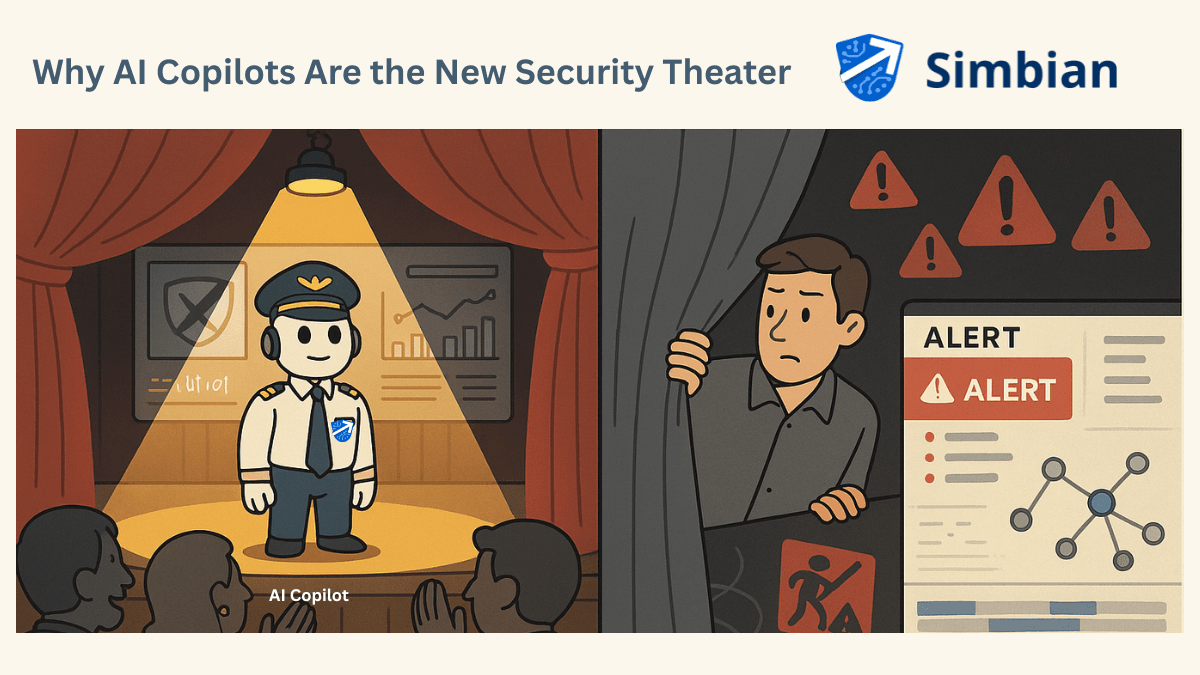
Most AI copilots sold as SOC tools are chat windows with a security skin. They summarize what your analyst already sees, translate KQL, and wait for the next prompt. That is not defense. That is a faster way to lose. The market has been calling every LLM assistant an "AI SOC," and it is time to separate the two: assistants that shorten a click, and an autonomous SOC that closes an alert without one.
Modern attacks move at machine speed. Ransomware can begin encrypting systems in about 15 seconds, and the fastest commodity malware executes in under 20 milliseconds once loaded. Meanwhile, teams running Microsoft Security Copilot and similar assistants still measure response in minutes, not milliseconds, because a human has to prompt, read, decide, and act.
This is not a UX gripe. It is a mismatch between how attackers operate and how assistants are built. Every second an analyst spends composing the "right" prompt is a second the intruder spends moving laterally. Assistants stack a new latency on top of the queue you already have, then charge for the privilege.
The deeper problem is queue physics. If your SOC receives tens of thousands of alerts a week and a copilot helps an analyst work each one a bit faster, the backlog still wins. Ai alerts pile up because triage is single-threaded and human-bounded. Faster prompts do not add threads.
Copilots run on a familiar premise: humans in the loop improve outcomes. In theory, sure. In production, the loop is the bottleneck. Analysts introduce delay exactly when speed matters, and the psychological comfort of an "assistant" quietly erodes vigilance. You start to trust the summary because it reads well, not because you verified it.
Assistants also sit idle by design. A copilot needs a prompt to do anything. An autonomous SOC does not. By the time a tier-1 analyst frames the question, reads the answer, and picks an action, the attacker has already progressed through several stages of the kill chain. That is the trap: the tool feels productive because the analyst is busy, while the incident continues.
Vendor documentation for popular copilots is unusually honest about limits. Responses can "lack accuracy and comprehensiveness," sensitive data can leak into prompts, and any generated code needs "rigorous testing." These are not edge cases. They are the design envelope of a general-purpose assistant retrofitted for security.
The clearest tell: Microsoft patched a zero-click Copilot vulnerability that could be triggered by a single email, letting an attacker manipulate the AI against its own user without a click.. A tool meant to reduce risk expanded the attack surface. Every new integration point for an LLM is a new place for prompt injection, data exfiltration, and identity confusion to land.
An autonomous SOC operates on a different premise. Instead of waiting for a prompt, AI SOC Agent monitors, investigates, and responds continuously. It does not need permission to pull a log, correlate an identity signal, or ask an EDR for process lineage. It is built to detect, decide, and defend without a human framing the question first.
The performance gap is measurable, not rhetorical. In production deployments, agentic SOC coverage reaches every alert, 24/7, with a response in under four minutes on average and 95% of those responses approved by the customer's own analysts. The agent is grounded in Context Lake, which learns organizational patterns (which service accounts are noisy, which subnets are jump hosts, which alerts have been closed as benign 500 times) and applies that institutional memory to every new signal.
This is self-improving, not self-driving. Humans still hold containment authority, escalation calls, and the sign-off on destructive actions. What changes is the ratio: analysts spend their time on judgment, not on a queue that never should have needed a human in the first place.
Under the hood, ai alert triage happens in three moves that a copilot cannot replicate on its own.
The result is soc automation you can actually leave running overnight, because the mechanism (evidence → reasoning → action → record) is inspectable at every step.
If the job is helping an analyst write a query faster or summarize a case they already opened, a copilot is fine. It is a productivity aid. If the job is closing the gap between when an alert fires and when a decision is made, only an autonomous soc changes the shape of the problem. Ai for cybersecurity has to be judged on the outcome — mean time to decision, coverage of the alert backlog, analyst hours reclaimed — not on demo polish.
The choice is not "AI vs no AI." It is soc ai as a chat window versus an ai soc agent that carries the workload. Copilots make the current SOC feel modern. An agentic soc actually rebuilds how the SOC operates: continuous triage, continuous investigation, continuous response, with humans steering the exceptions.
In a world where milliseconds separate containment from a bad Monday, "helpful assistant" is not the same product as "autonomous defender." Practitioners who have lived a real incident already know the difference. The market is catching up.