Loading...
Live Webinar
How to Beat ARTEX to Your Own Vulnerabilities, 9 Dec at 9:30 AM PT.
Live Webinar
How to Beat ARTEX to Your Own Vulnerabilities, 9 Dec at 9:30 AM PT.

How to Beat ARTEX to Your Own Vulnerabilities, 9 Dec at 9:30 AM PT.
How to Beat ARTEX to Your Own Vulnerabilities, 9 Dec at 9:30 AM PT.
Loading...

Threat hunting vs threat intelligence comes down to direction. Threat intelligence looks outward, analyzing what adversaries do elsewhere from threat feeds, OSINT, and vendor reports. Threat hunting looks inward, testing hypotheses against your own SIEM, EDR, and network telemetry for activity no alert caught. In the SANS 2026 CTI Survey, 66% of respondents used intelligence for threat hunting.
In February 2024, CISA, the NSA, and the FBI warned that Volt Typhoon had kept footholds in the IT networks of some US critical infrastructure organizations for at least five years. Their joint advisory had almost nothing to block. "Conventional IOCs associated with the malicious activity are generally lacking," it said. It described behavior instead. The group reached a domain controller over RDP with valid domain admin credentials, made a shadow copy with vssadmin, and used WMIC to run ntdsutil, which pulled NTDS.dit, the Active Directory database, out of it.
No feed can sweep for that.
Someone has to read the advisory, turn it into a question about their own domain controllers, decide whether a hit is an incident, and decide whether the next one should page anyone. Those are four jobs: intelligence, hunting, incident response, and detection engineering.
Threat intelligence tells you what adversaries are doing to other organizations. Threat hunting asks whether any of it is happening to yours. Intelligence work follows intelligence requirements that say what the business needs to know. A hunt assumes an intruder may already be inside and tests a hypothesis against your own telemetry, looking for activity no alert has flagged.
The table sets out the difference between threat hunting and threat intelligence, with incident response added because it gets confused with both.
| Threat intelligence | Threat hunting | Incident response | |
|---|---|---|---|
| Direction | Outward: adversaries, campaigns, and techniques elsewhere | Inward: your own environment | Inward: one confirmed or suspected incident |
| Goal | Inform decisions about which adversaries and techniques matter | Find intrusions no alert caught | Contain, eradicate, and recover |
| Approach | Ongoing collection and analysis | Proactive and hypothesis-led | Reactive, once an incident is declared or suspected |
| Starts from | Intelligence requirements set by leadership and the SOC | A hypothesis, not an alert | An alert, a report, or a hunt finding strong enough to open an incident |
| Data and tools | Threat feeds, OSINT, ISAC sharing, vendor reports, and a threat intelligence platform (TIP) | SIEM, EDR, and network telemetry, queried directly | The same telemetry, plus disk images, memory captures, and host triage |
| Core skills | Adversary analysis, sourcing, and writing for decision-makers | Knowing what normal looks like on your network, querying, and attacker techniques | Scoping, containment, forensics, and coordination under time pressure |
| Passes to | Hypotheses for hunters, indicators for time-limited sweeps | Confirmed intrusions to IR, repeatable behaviors to detection engineering, missing logs to whoever owns them | Lessons and new hypotheses back to hunting and detection |
Threat intelligence supplies the hypothesis, and threat hunting tests it. A report on what an adversary does becomes a hunt when someone turns it into a question their own telemetry can answer. What the hunt learns, such as which accounts behave oddly or which admin tools are normal on which hosts, goes back to intelligence and shapes the next hypothesis.
The Volt Typhoon advisory shows how narrow that question has to be. A claim that the group copied NTDS.dit isn't testable. This is: has any domain controller logged ESENT events 216, 325, 326, or 327, the IDs CISA says "may indicate actors copying NTDS.dit"? Those events sit in each domain controller's Application log, which CISA notes holds them longer than the Security logs do.
The window can't be last week, since CISA told defenders to "assume significant dwell time."
A smaller share of respondents now use intelligence this way. Threat hunting was the top use of intelligence in the SANS 2025 survey, at 77%. In the SANS 2026 CTI Survey, it fell to third, behind security operations (71%) and incident response (69%). The authors offer one possible explanation: as detection engineering matures, "intelligence derived from hunting can be codified into rules and playbooks, reducing the need for sustained, resource-intensive hunting at the same level." If they're right, more intelligence now goes straight into rules. Hunting keeps whatever no rule can express yet, and an NTDS.dit theft by a valid admin account is that kind of thing.
An indicator sweep, searching your logs for known-bad IP addresses and file hashes, is hunting at its most basic. Run it on a schedule anyway, and expect it to age fast. Deny an adversary one IP address, David Bianco wrote in his Pyramid of Pain, and "they can usually recover without even breaking stride." Mature hunting works at the top of his pyramid, on tactics, techniques, and procedures (TTPs), which adversaries can't swap out as cheaply (why hunt TTPs instead of IOCs). That's where living-off-the-land intrusions sit, and CISA's joint guidance on living-off-the-land techniques notes "a general lack of conventional indicators of compromise" there.
Threat hunting is proactive: it starts from a hypothesis, before any alert, and looks for activity nothing has caught. Incident response is reactive. It begins once an incident is confirmed or suspected, then contains, eradicates, and recovers. The hand-off comes when a hunt finds evidence strong enough to open an incident, and its queries, entities, and timeline go with it.
NIST's SP 800-61 Revision 3 (April 2025) draws the same line. Incident response covers Detect, Respond, and Recover. Threat hunting sits under Identify (ID.RA-03), among the preparation activities NIST calls "not part of the incident response itself."
In the Volt Typhoon case the line is easy to find. A domain controller showing NTDS.dit pulled from a shadow copy isn't a finding to write up next week. Taken with the SYSTEM hive, as CISA describes, that file gives up the password hashes for every account in the domain, and in one confirmed compromise, an industry partner saw the group "dumping credentials at regular intervals."
Open the incident.
From then on, searching other hosts for the same activity is scoping. Incident response owns it, even if the same hunter is still typing the queries.
Hand over the queries themselves. CrowdStrike's 2026 Global Threat Report puts average eCrime breakout time, from initial access to lateral movement, at 29 minutes in 2025, and the fastest breakout it observed at 27 seconds. At that speed, responders can't afford to re-run every query you already ran.
In the investigations behind M-Trends 2026, organizations first spotted the malicious activity themselves, such as through their own security alerts or staff reports, 52% of the time, up from 43% the year before. Those intrusions had a median dwell time of nine days, against 25 when an outside party such as law enforcement or a security firm raised the alarm. A hunt is one more way to land in the nine-day group.
Threat detection is automated and reactive. It waits for a match, comparing events against rules, signatures, or baselines written in advance. Threat hunting is proactive. It starts from a hypothesis about activity no alert has flagged, rules out the benign explanations, and reports what it couldn't check.
The same bar applies when software runs the hunt. An automated hunt that skips the last two steps is just a scheduled query.
A rule that alerts when a domain controller's Security log is cleared fires the day it happens. A hunt asks a question with a longer memory: has any domain controller copied NTDS.dit since an intruder could have arrived?
A detection rule decides in advance which version of a behavior is malicious. A behavior-based hunt, whether a person or an AI Agent runs it, decides during the investigation. It can weigh context the SIEM doesn't hold, such as who owns the account or whether a change window was open when the command ran.
Malware-free intrusions are where that matters. In 2025, 82% of the detections CrowdStrike recorded were malware-free, according to its 2026 Global Threat Report. Adversaries used valid credentials, trusted identity flows, and approved SaaS integrations, and blended in with normal use. Mandiant's M-Trends 2026 puts the problem plainly: "detection hinges on the analyst's ability to distinguish benign administrative activity from an attacker's malicious actions."
A rule can make that call only if the deciding fact is in the data it reads.
In the 2025 sample behind CardinalOps' State of SIEM Detection Risk report, detections covered 22% of MITRE ATT&CK (v16) techniques and 10% of rules were broken, yet the same organizations ingested enough data to potentially cover 90%. Treat that 90% as a ceiling. It counts whether log sources arrive, not whether the data is good enough to hunt with, and CardinalOps, now part of Cribl, sells detection-engineering software, as Simbian does.
Simbian's AI Threat Hunt Agent makes that call during the investigation. A hunt can start from your hunter's hypothesis, from a threat report, or from one written automatically when a SOC investigation needs a deeper look. The Agent then runs what Simbian calls an elimination game. Before it calls something a threat, it tests the benign explanations and shows you the ones it rejected.
By default it weighs them against the Context Lake™ (entity knowledge, past investigations, behavioral baselines, and the context your team supplies). Sometimes the context is the problem, so it can also run log-first and ignore it, to catch patterns that org context would wrongly explain away. Every hunt ends in one of four verdicts (Confirmed Threat, Suspicious Activity, Detection Opportunity, or Benign), with a MITRE ATT&CK kill-chain map and a downloadable log of every query it ran.
When a log source is down, the Agent has the same problem your hunters do. It switches to an equivalent source if one exists. If none does, it lists the gap with a severity and flags whether it affected the verdict. Your hunters can review any verdict. You decide how far the Agent goes before it asks.
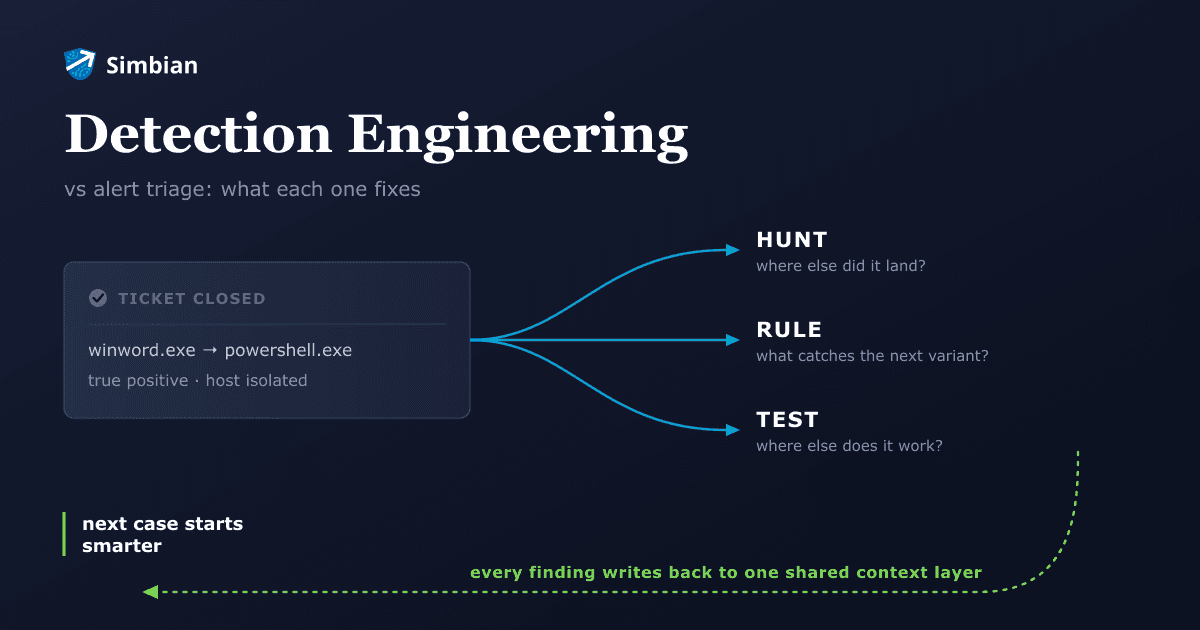
A hunt finding should become a detection rule only when it passes four checks, which Simbian calls the hunt-to-rule test. Is the telemetry collected everywhere the behavior can happen? Can the logic exclude the benign twin? Is the alert volume workable? Is it a behavior, not an indicator? Each "no" sends the finding somewhere other than a paging rule.
Bianco's Hunting Maturity Model says that at its top level "any successful hunting process will be operationalized and turned into automated detection." Splunk's PEAK framework ranks a hunt's outputs from reports up to signatures and rules, and its test for the top two levels is one question: would you be confident enough to put the result in front of a SOC analyst as an alert? If not, PEAK points to a report or a dashboard. "Confident enough" is a judgment call. The hunt-to-rule test swaps it for four yes-or-no checks, each with a destination when the answer is no.
A hunt that finds nothing still leaves a record of what was searched and what couldn't be. PEAK's authors count it as a success "even if you didn't find what you were looking for, as long as you are satisfied that you would have found it, had it been present."
Run the Volt Typhoon findings through the test and they split three ways. A cleared Security log (event 1102) passes almost unaided, since CISA says "all Event ID 1102 entries should be investigated as logs are generally not cleared." The ntdsutil copy doesn't pass on its own, because administrators use ntdsutil to create install-from-media (IFM) copies for building new domain controllers.
The RDP session events CISA lists (21 to 25) are every admin team's daily traffic, so they stay a recurring hunt.
A rule on telemetry you don't collect catches nothing, yet it still shows up as coverage on a dashboard. If the hunt found the behavior only on hosts that happen to log it, fix the logging first. The ESENT events live in each domain controller's Application log, so a SIEM that collects only domain controllers' Security logs will never see them.
In the SANS 2026 Threat Hunting Survey, hunters said as much: 50% named data quality or quantity as their biggest barrier, ahead of skilled staff at 45%. It's the first time data has led.
A benign twin is the legitimate activity that looks identical to the malicious behavior at the field level. Many SOCs close it as a benign true positive. Using ntdsutil to build install media for a new domain controller is one. So are an admin pushing patches with a remote-execution tool and a service account signing in at 2 a.m. for a batch job.
If the only way to tell them apart is something the SIEM doesn't know, like the change calendar or the account owner, bring that context in as a lookup. Otherwise the finding isn't ready to page anyone.
Keep the finding as a recurring hunt (the open SigmaHQ rule repository has a separate threat-hunting rule type for this case), or feed it into risk-based alerting as one signal among several.
Backtest a candidate detection rule from a hunt finding against your own history before it ships. It should fire on what the hunt found and stay quiet enough on routine activity for your SOC to keep up. A rule that pages on every admin login teaches the SOC to ignore it.
Too noisy? Narrow the scope, or leave it in the hunt queue until you can.
If the hunt turned up an indicator, such as a domain or a file hash, hand it to intelligence, which can enrich it and set an expiry for a sweep. If it's a behavior, check whether an existing rule already partly covers it, and tune that before writing a new one.
A rule costs upkeep for as long as it lives, so save rules for behaviors that come back. Respond to behavior fast enough, Bianco argued, and you force adversaries "to do the most time-consuming thing possible: learn new behaviors."
A hunt finding that fails the hunt-to-rule test still has somewhere to go. The check it failed decides the destination, which can be a logging fix, a SIEM lookup or recurring hunt, tuning, or a time-limited sweep for intelligence-sourced indicators.
| Hunt-to-rule check failed | Where the finding goes |
|---|---|
| Telemetry isn't collected everywhere | A logging or configuration fix, then a re-hunt |
| Logic can't exclude the benign twin | A SIEM lookup, a recurring hunt, a risk-based signal, or an investigate-only rule |
| Alert volume isn't workable | Tuning and a narrower scope, or back to the hunt queue |
| It's an indicator, not a behavior | A time-limited sweep for intelligence-sourced indicators |
A person does, every time: your SOC lead, your detection engineer, or your MDR analyst if you use one. Simbian's AI Detection Engineering Agent picks up the hunt's Detection Opportunity, a kill-chain-shaped pattern that never fired an alert, and drafts a candidate rule or edits an existing rule that partly covers the behavior. Nothing deploys until that person approves it.
The Detection Opportunity also appears in the Agent's Gaps view, which starts where the hunt-to-rule test starts, with telemetry gaps, then configuration gaps, then missing detections. The approver sees the rule's reasoning and a backtest against your own data. If a tuned rule later starts missing things, the version history from V0 shows who changed it and why, what tuning was suggested and deployed, and who approved it. Any earlier version can be restored.
The February 2024 Volt Typhoon advisory had almost nothing to block, and it still produced a hypothesis, an incident, a rule, and a standing hunt. Take the last advisory your team read and walk it the same path. The hand-off where it stalls is the one to fix first. To see the AI Threat Hunt Agent take a hypothesis to a verdict, and the AI Detection Engineering Agent draft a candidate rule for your team to approve, Book a Demo.
Q: Should every successful threat hunt become a detection rule? No. A finding should become a rule only when it passes Simbian's hunt-to-rule test: the telemetry is collected everywhere the behavior can occur, the logic can exclude the benign twin (with a lookup if it needs context the SIEM doesn't hold), the backtested alert volume is workable, and the finding is a behavior rather than an indicator. Findings that fail go to logging fixes, recurring hunts, risk-based signals, or intelligence sweeps.
Q: How does threat intelligence support proactive threat hunting? It supplies the hypotheses. A report on an adversary's techniques becomes a hunt when someone turns it into a question their own telemetry can answer, such as whether any domain controller logged the ESENT events CISA tied to NTDS.dit copying by Volt Typhoon. Intelligence on TTPs makes better hunts than indicator lists, which adversaries change cheaply. In the SANS 2026 CTI Survey, 66% of respondents used intelligence for threat hunting.
Q: Is an IOC sweep a threat hunt? Only at the most basic level. Bianco's Hunting Maturity Model counts searching historical data for indicators from threat reports as minimal hunting (HMM1). Indicators fed straight into automated alerting sit at HMM0, the level before any hunting. More mature hunts start from a hypothesis about behavior where no indicator exists yet, as CISA describes for living-off-the-land intrusions.
Q: Can one analyst do both threat hunting and threat intelligence? Yes, and on a small team one person may have to. Both need a working knowledge of attacker techniques. The work pulls in different directions, though. Intelligence is collection, analysis, and reporting for other people, on a cycle set by intelligence requirements. Hunting is querying your own telemetry and knowing what normal looks like on your network. Block out separate time for each, or the reporting cycle will eat the hunting.
Q: What are the three levels of cyber threat intelligence? Strategic, operational, and tactical. Strategic intelligence gives leadership trends and risk. Operational covers specific campaigns and impending attacks, and it's rare. Tactical describes adversary techniques that SOC and hunting teams can act on. The 2015 model from MWR InfoSecurity, published with the UK's CPNI and CERT-UK, adds a fourth level, technical, for indicators such as IP addresses and hashes. Hypothesis-led hunts lean on tactical intelligence.
Q: Can threat intelligence replace threat hunting? No. Threat hunting vs threat intelligence isn't a choice, because each does a job the other can't. Intelligence supplies indicators and hypotheses to test, and only a hunt against your own telemetry shows whether that activity is in your environment. A feed also can't report behavior nobody has seen and written up yet. A hypothesis-led hunt can look for it anyway.