Loading...
New
See what manual alert triage really costs your security team.
New
See what manual alert triage really costs your security team.

See what manual alert triage really costs your security team.
See what manual alert triage really costs your security team.
Loading...

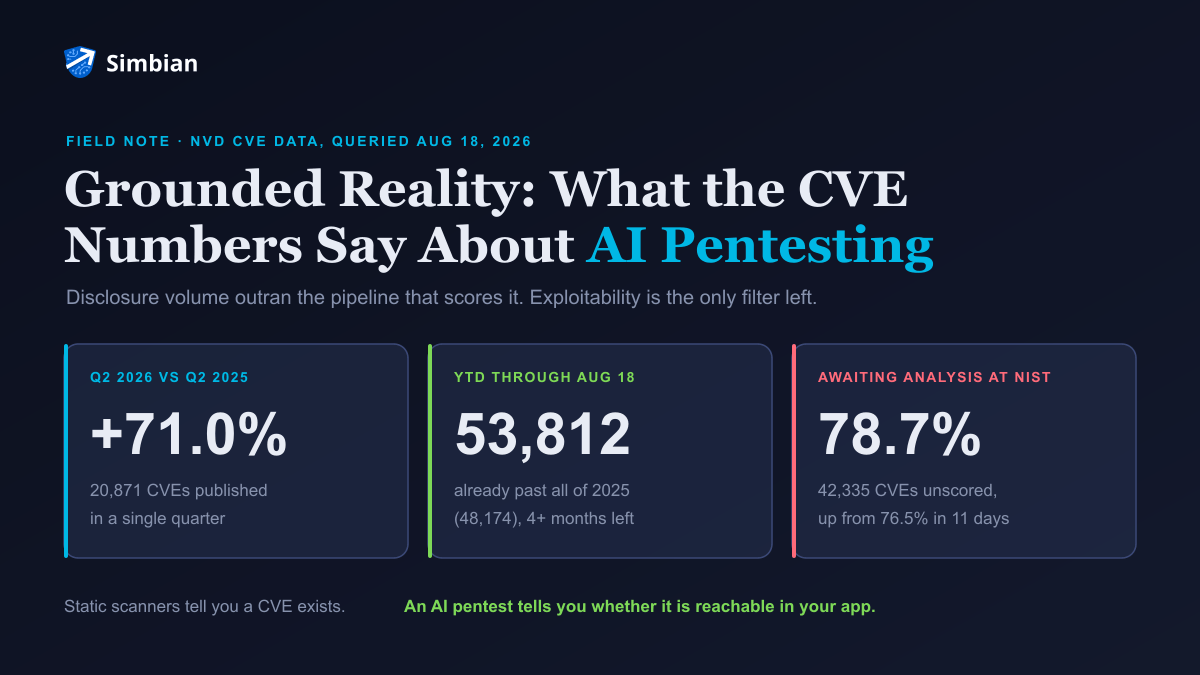
A Simbian field note on the NVD CVE data, verified against the NVD CVE database.
We queried the NVD CVE database directly on August 18, 2026. Q2 2026 published 20,871 CVEs, 71.0% more than Q2 2025. 2026 year to date has already passed all of 2025, and 78.7% of those CVEs are still unscored at NIST. Disclosure volume has outrun the pipeline that scores it, which leaves AI pentesting — testing whether a flagged CVE is actually reachable in your own application — as the only filter that still narrows the list.
We see so much happening in the security industry, and it is our responsibility to bring clarity to enterprises and help them navigate the storm. We have also seen plenty of marketing fluff about how AI is hacking everything, but we want to give a grounded reality check on what is actually going on: are the vulnerabilities we have spent our careers managing still relevant in the age of AI?
Enterprises are still reluctant to use AI pentesting for finding bugs, worried in the back of their minds about what happens if it goes rogue. We understand that worry, but if enterprises do not do this proactively, adversaries will. In fact, adversaries will likely prioritize targeting the enterprises that have not pointed AI hackers at their own attack surfaces first.
Hype aside, let us look at the actual vulnerabilities that an AI or a human hacker would consider exploiting. For this analysis, we queried the NVD CVE database directly. Unsurprisingly, there is a serious spike in CVEs being published, and it accelerated again in just the last week. Here are the numbers.
| Metric | Volume / Value | Comparison / Insights |
|---|---|---|
| CVEs this quarter (Q2 2026: Apr–Jun) | 20,871 | Q2 2026 total published volume |
| CVEs last year, same quarter (Q2 2025: Apr–Jun) | 12,205 | +71.0% YoY expansion vs. Q2 2025 |
| CVEs YTD (Jan 1–Aug 18, 2026) | 53,812 | Already exceeds all of 2025 (48,174), with 4+ months left |
| CVEs last week (Aug 11–17, 2026) | 3,603 | 7-day ingestion volume, nearly double the prior week |
| Last week vs. Q2 weekly average | 224.4% | +124.4% above the Q2 average of 1,605.5 CVEs/week |
| Awaiting analysis (YTD, at NIST) | 42,335 | 78.7% of YTD CVEs still pending, up from 76.5% eleven days earlier |
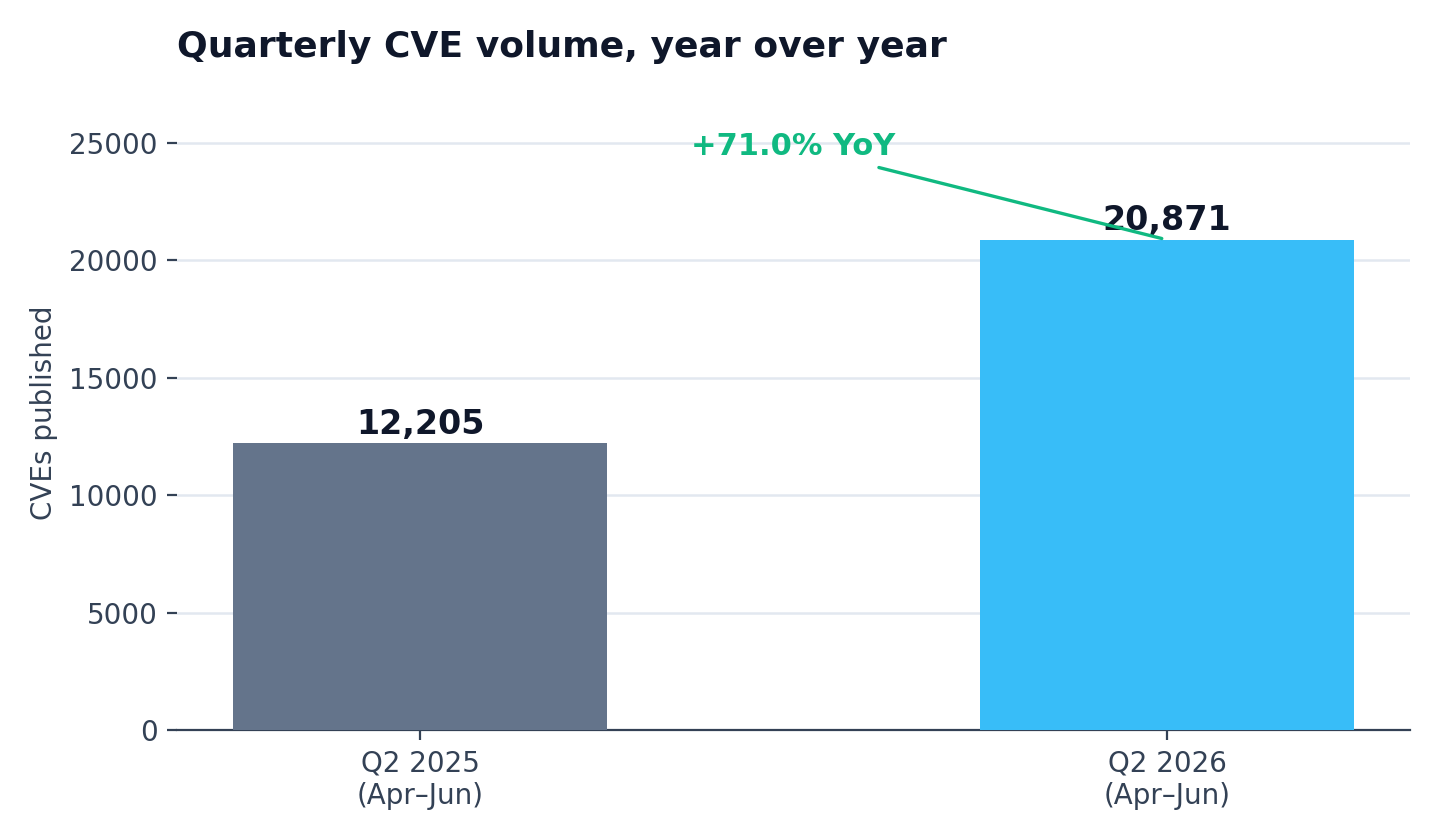
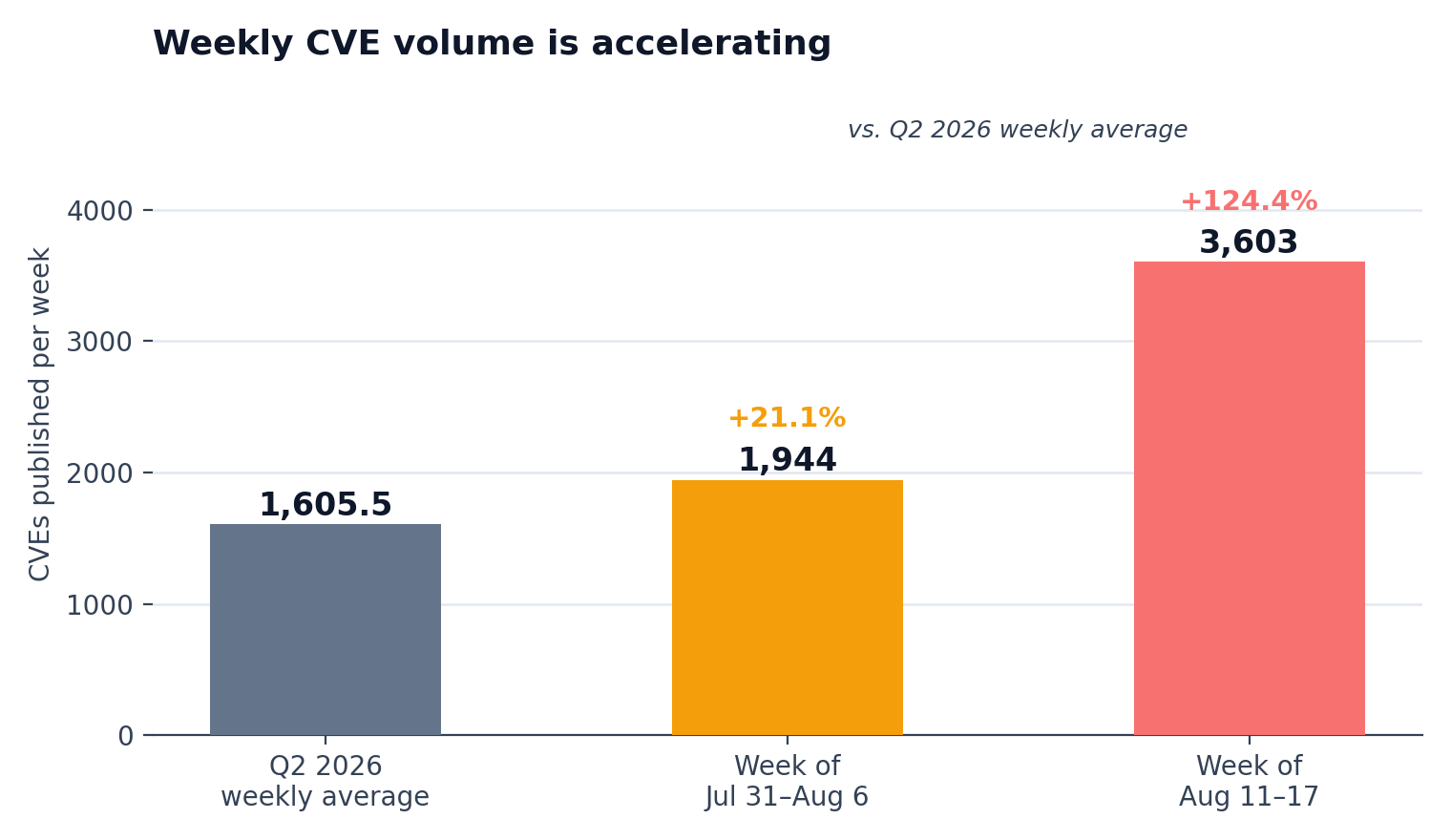
Q2 2026 ran 71% hotter than Q2 2025. The week of Aug 11–17 then ran 124% above even that elevated Q2 baseline, more than double, up from a 21% overage just the week before.
At 53,812 CVEs logged in 230 calendar days, the average daily ingestion rate for 2026 sits at approximately 234 vulnerabilities per day, itself up from the ~223/day pace measured eleven days earlier. With more than four months still left in the year, 2026 has already published 5,638 more CVEs than all of 2025 combined.
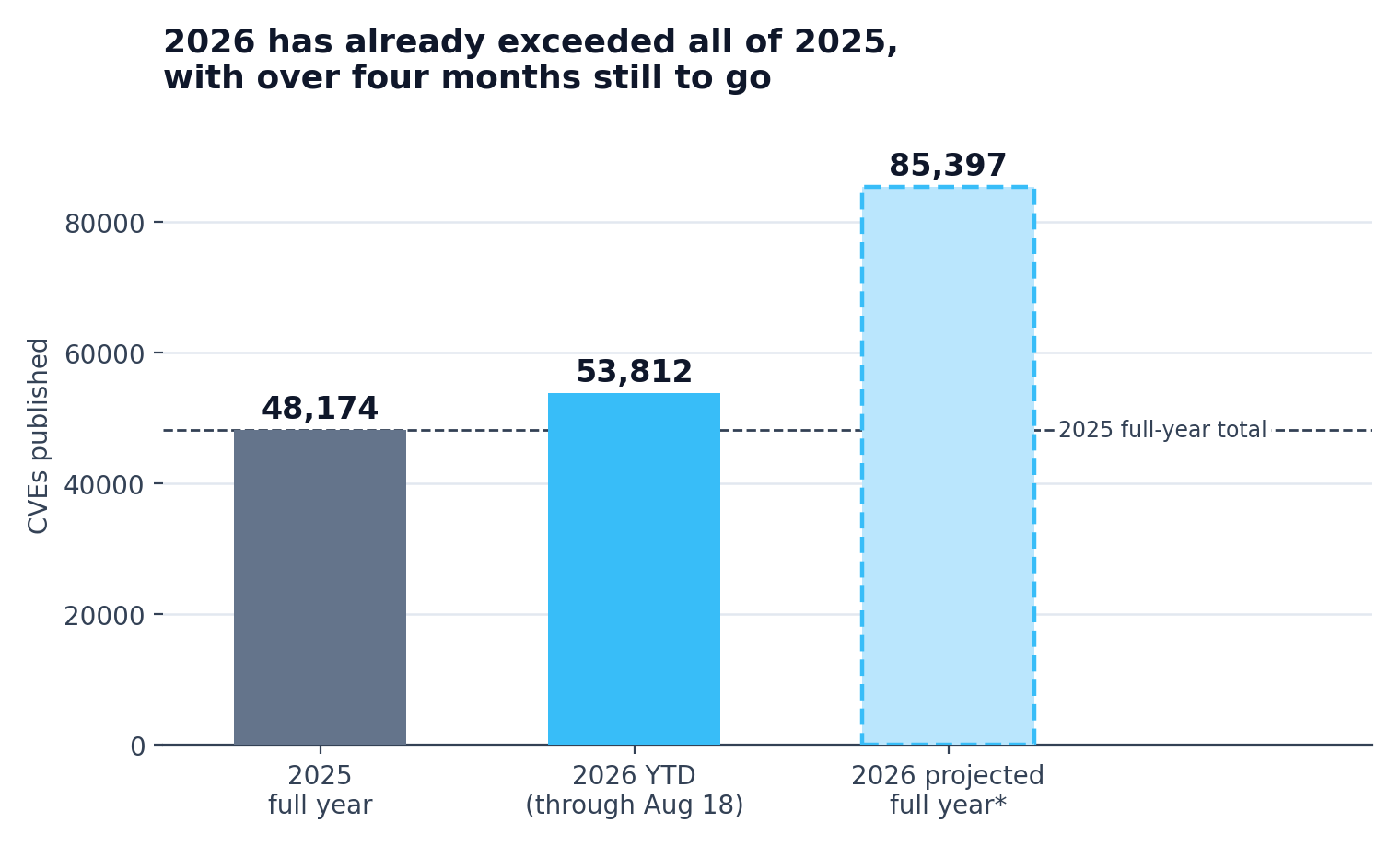
The projected full-year figure (85,397) is a simple linear extrapolation of the current daily rate, not a forecast model. It lands inside the "70,000 to 100,000 is entirely possible" range independent forecasters have floated for 2026; see Sources.
Of the 53,812 total CVEs published year to date in 2026, 42,335 (78.7%) are currently sitting in Awaiting Analysis status at NIST. That share was 76.5% just eleven days earlier: the backlog is not only large, it is growing faster than NVD can enrich it.
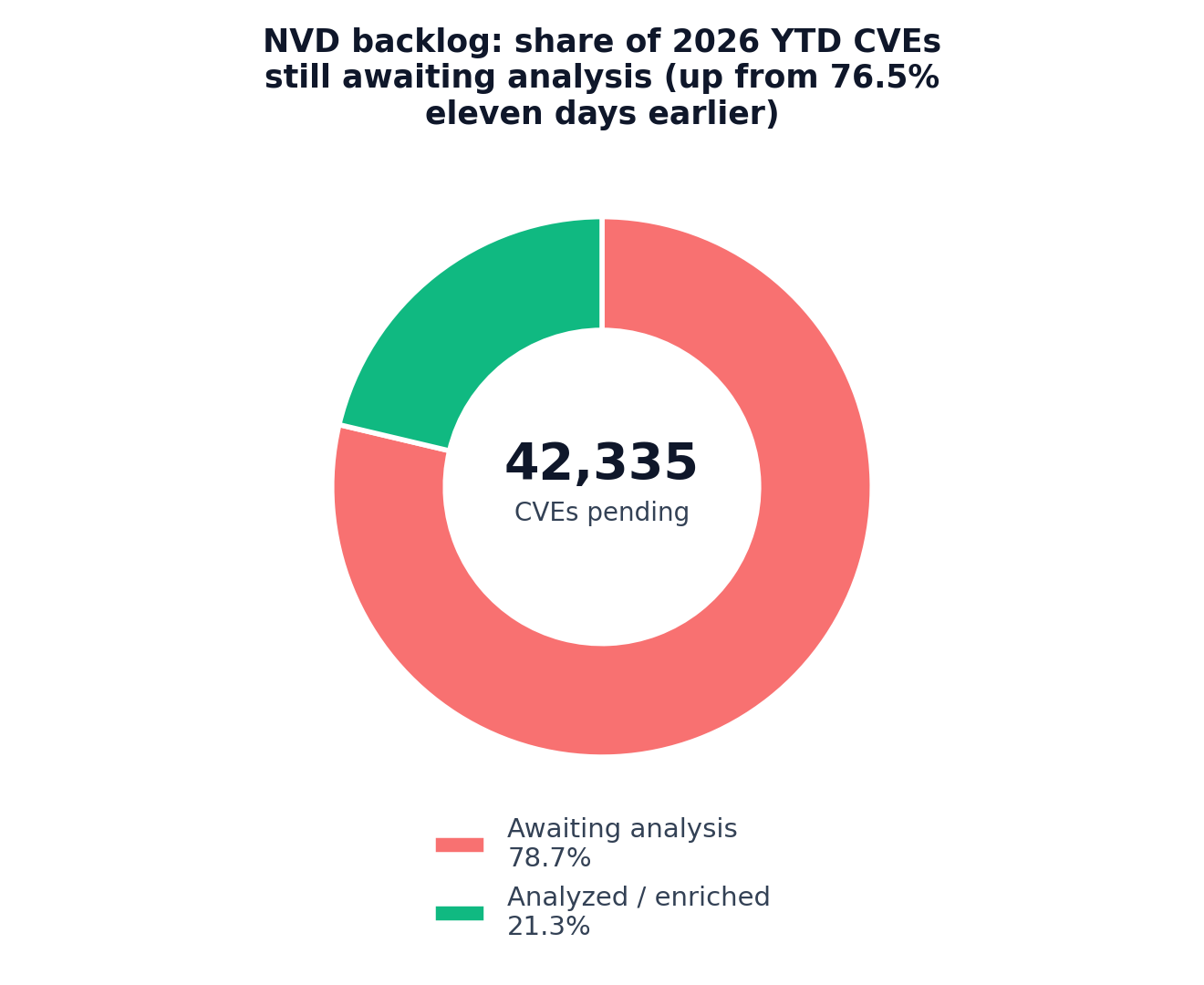
That is not a footnote. It confirms that enterprises cannot wait on NVD CVSS scoring alone and need to lean on AI-powered penetration testing in the meantime.
NVD has become harder to keep pace with as AI accelerates both vulnerability discovery and submission volume, and a growing share of new submissions are themselves AI assisted. NIST is trying to address this: on August 12, 2026, it published a Request for Information in the Federal Register seeking industry input on modernizing the NVD for an AI shaped threat landscape, with comments due October 13, 2026. That is a genuinely promising step, but it will not change anything for security teams this quarter. Organizations still need to uncover and validate bugs on their own, rather than waiting on NVD registrations to catch up.
To see how this plays out in practice, let us look at what actually happens the moment you run npm install express.
A standard scaffolded app pulls in 67 packages into node_modules. You directly chose exactly one of them:
The other 66 are transitive dependencies you never individually picked, reviewed, or approved. They arrived because express's maintainers, and their maintainers, and theirs, decided they needed them.
Run npm audit against a fresh install of that tree today (August 2026) and you will see 0 known vulnerabilities. That is real, and it is good news. It is also not the whole picture: npm audit only checks whether your currently installed versions fall inside a currently open advisory. It says nothing about what this dependency tree has already been through, or what it is likely to go through next.
And it has been through real, disclosed vulnerabilities. Here is what a closer look at just 3 of the 67 packages turns up:
__proto__ query parameter. Disclosed and patched in late 2022.response.redirect() (CVE-2024-43796).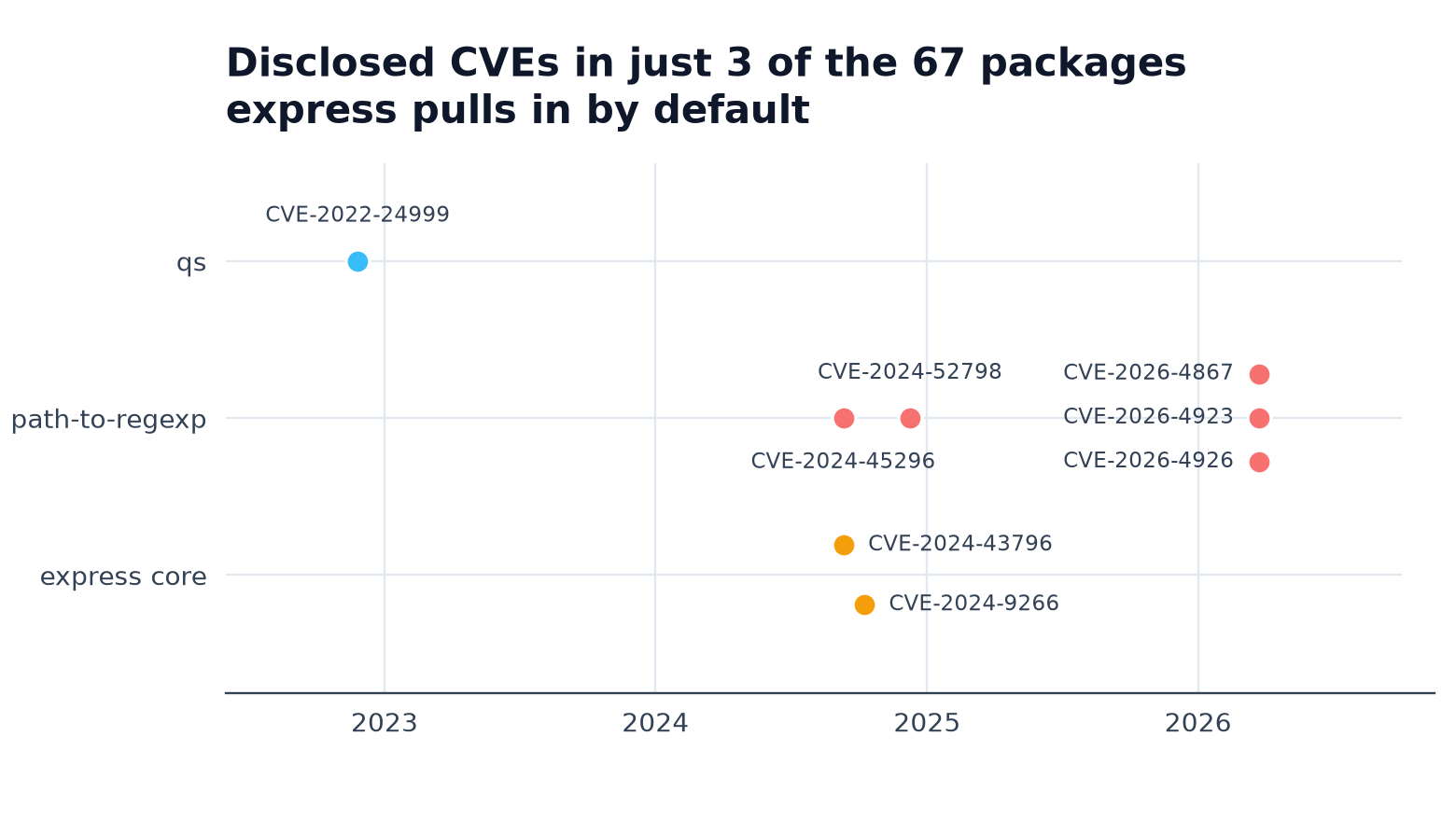
That is three of the sixty-seven packages, and it already adds up to eight distinct, verified CVEs spanning 2022 through 2026, clustered heavily in 2024 and again in 2026. We have not exhaustively scanned all 67 packages for this revision; a complete historical count would need a per-package query against OSV across the full tree. The three packages above were individually verified against public advisory sources for this revision. The remaining 64 packages in the tree have not been checked.
That is the real takeaway from npm install express. Not that today's install is unsafe: today's audit is clean, and there is no reason to doubt it. It is that you cannot opt out of inheriting 66 packages you did not choose, that this exact tree has a demonstrated history of real vulnerabilities, and that a clean scan today is a snapshot, not a guarantee about next month or next quarter. The CVE volume data earlier in this piece shows disclosures arriving faster than ever, and there is no reason to expect this dependency tree is exempt from that trend. The question was never whether a vulnerability will eventually show up here. It is how fast you find out, and whether you can tell if it is actually reachable and exploitable in your specific app, before someone else does.
This is just from looking closely at 3 of the 67 packages a default npm install express brings in. The rate at which vulnerabilities are being found and published across the wider ecosystem is a growing concern, as the CVE numbers above show. Point a static scanner at a medium scale application today and you will easily see at least 100 CVEs flagged across its full dependency tree.
AI written exploits have a real edge here. A model can generate many variations of an attack for a single vulnerability, adapting each attempt on the fly based on the live request, the response, and how the specific application is built. Static scanners cannot do this: they either match known patterns or pull public exploit code from repositories like GitHub. GitHub itself is starting to show reliability strain under the sheer volume of AI generated code now flowing through it, so leaning on public exploit repositories is likely to get harder, not easier.
If an enterprise tries to fix all of these blindly while NVD is still working through its backlog, teams will be left hanging in the storm. Relying solely on static scans or manual triage is no longer sustainable. The only realistic way forward is to see whether an AI hacker can actually exploit these vulnerabilities in your environment, and if it can, prioritize fixing them immediately.
This is exactly what we are doing at Simbian. Our AI pentest agent does not blindly trust static CVE lists. Instead, it attempts to exploit every reachable attack surface and vector, so the enterprise gets a report that is genuinely actionable and validated, not just a list of theoretical findings.
Finding bugs is not the whole problem, though. Many tools can find issues, but discovery without protection leaves a gap. At Simbian, we take those findings and provide targeted compensatory controls and SOC detection rules, powered by our ContextLake, which is shared across our entire agent stack. That gives enterprises full 360 degree security, instead of tools that work in silos and detections that operate in isolation.
A few concrete steps to move from CVE volume anxiety to validated, prioritized fixes:
None of this means the CVEs your team already tracks stop mattering. It means the volume has outpaced what static scanning and manual triage can realistically keep up with, and the backlog data shows that gap widening, not closing. The only way to know which of those thousands of flagged issues actually matter in your environment is to test exploitability directly. That is the grounded reality behind the headlines: AI is not changing what a vulnerability is. It is changing how fast you can find out which ones are actually worth your team's time.
If you want to see what that looks like against your own applications, book a demo.
Q: How many CVEs have been published in 2026 so far? 53,812 CVEs were published between January 1 and August 18, 2026, an average of roughly 234 per day. That already exceeds the 48,174 CVEs published in all of 2025, with more than four months left in the year.
Q: Why is the NVD backlog a problem for vulnerability management? Of the 53,812 CVEs published in 2026 year to date, 42,335 (78.7%) are sitting in Awaiting Analysis status at NIST, up from 76.5% eleven days earlier. The backlog is growing faster than NVD can enrich it, so a severity score you can prioritize against may not arrive for the CVE you are looking at today.
Q: How is AI pentesting different from a static vulnerability scanner? A static scanner matches known patterns or pulls public exploit code from repositories like GitHub, and stops at "this CVE is present." AI pentesting attempts the exploit: a model generates many variations of an attack for a single vulnerability and adapts each attempt based on the live request, the response, and how your specific application is built. The output is a validated finding rather than a theoretical one.
Q: Does a clean npm audit mean my dependency tree is safe? No. npm audit only checks whether your currently installed versions fall inside a currently open advisory. A fresh npm install express audits clean in August 2026, yet just 3 of the 67 packages it pulls in have eight disclosed CVEs between 2022 and 2026. A clean scan is a snapshot, not a guarantee about next quarter.
Q: Where should a security team start with AI pentesting? Pick a couple of applications that are critical to the organization, run them through an AI pentest, and check how many of the flagged issues are actually exploitable. Mitigate the ones that turn out to be real, then move AI pentesting into a continuous phase so apps are re-tested on an ongoing basis rather than once a year.
services.nvd.nist.gov, queried live on August 18, 2026 by publication date and vulnStatus.npm install / npm audit run by the Simbian team on August 18, 2026, confirming 67 packages installed and 0 currently open vulnerabilities in that install.


