Loading...
Live Webinar
How to Beat ARTEX to Your Own Vulnerabilities, 9 Dec at 9:30 AM PT.
Live Webinar
How to Beat ARTEX to Your Own Vulnerabilities, 9 Dec at 9:30 AM PT.

How to Beat ARTEX to Your Own Vulnerabilities, 9 Dec at 9:30 AM PT.
How to Beat ARTEX to Your Own Vulnerabilities, 9 Dec at 9:30 AM PT.
Loading...

The best automated penetration testing tools in 2026 are Aikido Pentest, BreachLock Breach360, FireCompass, Hadrian Nova, Horizon3.ai NodeZero, Novee, Pentera, Picus Autonomous Penetration Testing, Simbian's AI Pentest Agent, and Terra Security. Each attempts the exploit and proves it. They differ in reach, and only four (Horizon3.ai, Pentera, Picus, and Simbian) document a check on whether your SOC saw the attack.
Your attacker automated penetration testing before you did. On October 21, 2026, Microsoft Threat Intelligence reported Storm-0940, a China-state-aligned group, using "the agentic AI penetration testing framework ARTEX" to try signing in to more than 2,250 tenants. On November 13, 2026, an FBI FLASH alert (FLASH-20261113-001) listed the 15 ways ARTEX intrusions got in. The list names no zero-day and no CVE.
Most of it reads like a pentest report from 2012: SQL injection, XXE, IDOR, weak admin passwords. The rest is stolen credentials and abused trust relationships. Your tool now has to find and prove the openings it can reach before the attacker's tool does. Then it must tell you whether anyone in your SOC noticed.
Simbian sells one of the ten tools below. The list is alphabetical, not ranked, and every capability comes from the vendor's own pages as of November 18, 2026. Where a vendor's pages are silent, we say "does not document"; the tool may still do it.
To qualify, a tool has to try the exploit itself and sell to enterprises. Other tools qualify too, and a few are named after the ten. Most of the ten recur across 12 published comparisons. BreachLock appears on none of them. It's here because its August launch documents both requirements. Simbian is here because it's ours.
Automated penetration testing software finds a weakness, tries to exploit it, and uses what works to reach a goal such as domain admin or a customer database. Then it reports the proof, so you fix what an attacker can use. That separates it from three neighbors:
The top 10 automated penetration testing tools started on opposite sides of the perimeter. Horizon3.ai and Pentera grew up on internal networks and identity, and Picus and BreachLock cover networks too. Aikido, Hadrian, Novee, and Terra started with applications and the external perimeter. Most have since crossed over.
Aikido sells its pentest as one module of an AppSec suite. Coverage runs from web apps and APIs (REST, GraphQL, gRPC, SOAP) to the internet-facing network, mobile apps, and LLM features such as MCP servers. A broker reaches internal apps. "Separate agents re-exploit each finding to confirm it's real." When an attack could escalate, it pauses and shows you the analysis first; there's also a panic button and an air-gapped on-premises option. Aikido's FAQ says human testers "remain valuable for non-web targets."
Best for: Development teams running a pentest on every deploy.
BreachLock launched Breach360 on August 26, 2026, to test "your web applications and your internal and external networks" from a Linux host, an OVA, or Docker. It "asks for your approval before any lateral movement or privilege escalation." There's a kill switch. Findings carry proof-of-exploitability screenshots and MITRE ATT&CK mapping, and a certified BreachLock pentester can review them. Breach360 shows where your defenses stopped an attack. Its pages don't mention checking for SIEM alerts.
Best for: Network and web testing with human review on the same contract.
FireCompass hands developers the exploit itself. In its words, "Every finding ships proof of exploit, steps to reproduce, and ready-to-run Python." It leads with web and API pentesting, adds "networks, servers, and cloud," and chains app-to-network lateral movement. External tests run as SaaS. Internal ones need an appliance. You get scope enforcement, rate limits, kill switches, and optional human review.
Best for: Proving a fix by rerunning the exploit script.
Hadrian Nova tests only your external attack surface, on purpose. Launched in March 2026, it covers domains, web apps, APIs, cloud assets, login portals, and "third-party and partner portals." Humans review its authenticated, IDOR, and cross-tenant test results. Nothing gets installed. The FBI's first ARTEX recommendation is to inventory every internet-facing app, partner and supplier portals included. That's the ground Nova covers.
Best for: A sprawling external footprint. Pair it with a network tool for the inside.
Horizon3.ai NodeZero "pivots through your network, chaining together weaknesses just as an attacker would and then safely exploits them." It's in 8 of the 12 comparisons we reviewed, second only to Pentera. It runs internal tests from a Docker host or OVA and external ones from Horizon3's cloud. Since July 2026 it spans "web applications, infrastructure, cloud, data, and identity." A separate EDR Healthcheck tests "whether your EDR detects, alerts, and blocks," with timestamps aligned to your SIEM and EDR logs.
Best for: Proving internal and Active Directory attack paths.
Novee pairs "a proprietary offensive AI model" with frontier models and tests "web, mobile, AI apps, APIs, and external attack surfaces." You approve the scope before testing. A proxy outside the model caps the request rate, holds the agent to approved hosts and time windows, and has a kill switch. Each finding comes with "a working exploit and reproducible steps," and it retests on new deployments, though internal network testing isn't in its docs.
Best for: Application and AI-app teams testing from outside as they ship.
Pentera builds the SOC check into the pentest itself, so you can "review triggered and missed alerts during internal attack runs." It executes "complete attack kill-chains across identity, endpoint, network, and cloud" through three modules, Core (internal), Surface (external), and Cloud, and lists web applications and APIs among its targets. Pentera appears in 10 of the 12 comparisons we reviewed, more than any other tool. Safety comes from throttling, impact limits, an emergency stop, and read-only modes. New AI-native web app agents are in beta. General availability is rolling out in Q4 2026.
Best for: Large internal estates where the SOC wants to see what it missed.
Picus Autonomous Penetration Testing "attempts the exploit and pushes for the next foothold" across external assets, internal networks, and identities. Picus launched it on November 12, 2026, rebuilt on five years of its own automated pentesting. Deployment uses the existing Picus agent, with three intensity levels, hard-deny rules, and one click to stop everything. The fully agentic mode is in early access. Detection checking lives in Picus's separate BAS product, which also ships detection rules.
Best for: Picus customers adding agentic exploitation to the automated security validation they already run.
When Simbian's AI Pentest Agent gets in, the attack leaves logs. If no alert fired on them, the AI Detection Engineering Agent records a detection gap and writes the missing rule the same day, which deploys automatically or after a human approves it.
The Agent runs four tests: web app, API, network, and supply chain (the packages and libraries your code pulls in). Each runs on demand, on a schedule, or on every change, in black-box, gray-box, or white-box mode. Cloud Link takes them inside your network. It's a connector with zero inbound ports. Each finding pairs the attack with a control request that proves cause, plus a cURL command that replays it. It tests the APIs a mobile app calls, not the app binary, and doesn't claim cloud IAM review.
Best for: Teams that want each pentest to show the SOC what it missed.
Terra keeps a pentester involved through what it calls "Human-on-the-Loop," meaning "a human pentester making the call at every critical decision point." Coverage spans web apps, APIs, AI systems, and networks. You can run it as multi-tenant SaaS, single-tenant in your own cloud, or on premises and air-gapped. Terra exploits and confirms each finding before it reaches you. It re-tests "within hours of every code change," and certified pentesters sign the reports.
Best for: Teams that need a pentester's signature on the report.
RunSybil tests web apps and APIs with an HTTP request and response per finding, and Ethiack runs event-driven testing with proof-of-exploit. Astra and Escape pair AI pentesting with scanning. Pentest-Tools.com's Sniper module exploits known CVEs, and Strix is an open-source option for pull requests. Burp Suite, Intruder, and Invicti turn up as scanners, and Cymulate frames itself as BAS and exposure validation. NetSPI, which completed its merger with Synack on October 5, 2026, sells human-led testing with AI help.
Of the 10 automated pentesting tools compared here, four document a way to check whether your SOC saw the attack: Horizon3.ai NodeZero, Pentera, Picus, and Simbian's AI Pentest Agent. Each cell comes from the vendor's docs as of November 18, 2026.
| Tool | Reaches, per its own docs | Proof it ships | Checks whether your SOC saw it |
|---|---|---|---|
| Aikido Pentest | Web, API, internet-facing network, internal apps via broker, mobile, LLM features | Re-exploited proof of concept | Not in its public docs |
| BreachLock Breach360 | Web apps, internal and external networks | Screenshots, kill chain, MITRE ATT&CK | Partly: shows blocks, no SIEM alert check documented |
| FireCompass | Web, API, networks, servers, cloud | Exploit, repro steps, runnable Python | Not in its public docs |
| Hadrian Nova | External only, partner portals included | Repro steps, human-reviewed | Not in its public docs |
| Horizon3.ai NodeZero | Internal, external, cloud, identity, web apps | Exploit proof and impact | Yes, via EDR Healthcheck |
| Novee | Web, mobile, AI apps, APIs, external | Working exploit, repro steps | Not in its public docs |
| Pentera | Internal, external, cloud, identity, web apps, APIs | Exploit evidence | Yes, triggered and missed alerts |
| Picus Autonomous Penetration Testing | External, internal, identities | Attack paths with evidence | Yes, via Picus BAS, which ships detection rules |
| Simbian AI Pentest Agent | Web, API, network, supply chain; internal via Cloud Link | Attack next to a control request, cURL | Yes, a missed alert becomes a detection gap; the rule deploys automatically or after human approval |
| Terra Security | Web, API, AI systems, networks | Exploited, confirmed findings | Not in its public docs |
No automated pentesting tool documents all 15 initial-access techniques in the FBI's ARTEX FLASH alert. The nine application and API flaws are home ground for every app-capable tool above. The credential techniques fit the identity testing that Horizon3.ai, Pentera, and Picus document, and FireCompass documents leaked-credential chains. The three trust techniques get the least coverage in vendor docs.
Once the demo ends, put the same five questions to every automated pen testing tool on your shortlist.
Map your estate before the demo. A tool reaches your attacker's surface only where its documented reach matches it. Finding an IDOR in your customer portal takes an app tool; walking Active Directory takes a network one. Most enterprises need both, from two tools or one that documents both, as BreachLock, FireCompass, Horizon3.ai, Pentera, Simbian, and Terra do.
Proof is something a developer can replay: a request and response, a script, a cURL command, or screenshots with the kill chain. The most convincing pair the attack with a control request that proves cause. That's Simbian's format, so weigh our view accordingly. For a fair trial, point the tool at an app your last manual pentest covered and count what it confirmed, missed, and made up.
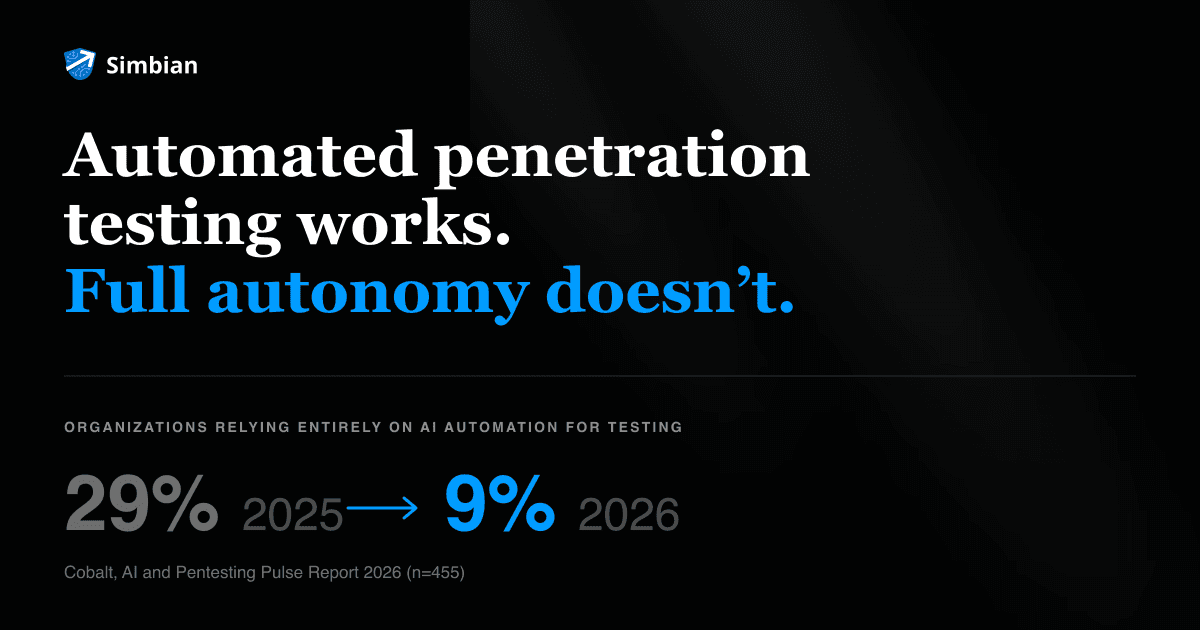
AI agents still overreach. In a 2026 ICLR paper, Lin and colleagues put professional testers and AI agents on a university network of about 8,000 hosts. The authors' own agent beat nine of ten humans, yet the agents had "higher false-positive rates." In Cobalt's 2026 AI and Pentesting Pulse survey (Cobalt sells human-led pentests), 78% of security teams said automated tools had given them false negatives.
Four of the ten tools here document a way to check whether your SIEM or EDR fired along the way: Pentera, Horizon3.ai, Picus, and Simbian, though Horizon3.ai and Picus use a separate product. The check matters because the two sides get different feedback. "An attacker who breaks in gets a clean signal that they succeeded," Alankrit Chona, Simbian's CTO and co-founder, wrote. "A defender who clears an alert gets nothing of the kind." If your tool doesn't check, run it without telling the analysts on shift (tell their lead, so nobody declares an incident) and compare its timeline against your alert queue.
Put scope where the model can't reach it. The apps an agent tests can feed it instructions, and a boundary written only in its prompt can be argued away. On November 4, 2026, India's CERT-In issued an advisory on AI-driven attacks against financial firms. It told them to require written approval, a defined scope, and a time window for all penetration testing, because "the tools themselves do not validate authorization." OWASP's Autonomous Penetration Testing Standard (APTS, an incubator project, version 0.1.0) supplies the vocabulary; its first three domains are scope enforcement, safety controls, and human oversight.
A good tool retests by replaying the exact exploit, because the window of exposure stays open until that replay fails. Verizon's 2026 Data Breach Investigations Report found only 26% of critical vulnerabilities in CISA's Known Exploited Vulnerabilities catalog fully remediated, with a median of 43 days.
Q: How does automated penetration testing software work? It follows the penetration testing methodology a human uses: map the authorized scope, probe for weaknesses, exploit what it can, chain what works, and report the proof. In 2026 an LLM agent usually picks each next step, which is why most vendors now say "autonomous" or "agentic."
Q: Which automated penetration testing tools test Active Directory? Horizon3.ai NodeZero and Pentera document Active Directory and identity attacks on internal networks. Picus documents internal network and identity testing, and BreachLock documents internal network testing with lateral movement and privilege escalation. FireCompass documents app-to-identity lateral movement into Active Directory, and Terra documents Active Directory testing in an internal network preview. Aikido, Hadrian, and Novee do not document internal Active Directory testing.
Q: What is the best automated pentesting tool for APIs? The best automated pentesting tool for APIs logs in as more than one user. Broken object-level authorization (BOLA), first on the OWASP API Security Top 10, only appears when one user can read another user's objects, and broken function-level authorization when a low role reaches an admin function. Aikido, Hadrian, Novee, RunSybil, and Simbian document multi-user or cross-tenant authorization testing; FireCompass and Terra document API testing too, so ask each whether it tests as two users.
Q: How do automated penetration testing tools integrate with existing security systems? Mostly through the SIEM and EDR. Pentera shows which alerts an internal attack run triggered and missed, Horizon3.ai's EDR Healthcheck aligns its timestamps to your SIEM and EDR logs, and Picus ships detection rules through its separate BAS product. Simbian hands each attack that fired no alert to its AI Detection Engineering Agent as a detection gap.
Simbian's AI Pentest Agent turns the pentest finding itself into defenses. It's one of the Agents in Simbian's Self-Improving Defense and shares one Context Lake™ with every other Simbian Agent, so a finding arrives with what the SOC already knows about its host. A WAF virtual patch goes live in minutes. The AI Detection Engineering Agent writes a detection rule the same day, which deploys automatically or after a human approves it. Once the fix ships, a one-click retest proves it.
Your pentesters keep the annual test, and an auditor who wants an independent signature still gets one. The AI Pentest Agent covers the months between, when ARTEX is probing. The FBI, citing Microsoft, says some of its intrusions went from first targeting to privileged access in under three hours.
To score your own shortlist on the five questions above, use the AI Pentest Buyer's Scorecard. To see the Agent run against one of your apps, Book a Demo.