
TL;DR
🧪 Continuous Pentesting: Set a daily schedule, and a new server on your IP ranges gets tested within a day.
🛡️ PHP2Shell: One unauthenticated request can run code on a PHP server. Find which of yours it can reach.
🎙️ Alankrit on Howdy: When should an AI Agent stop a process, and when should your analyst make the call?
🔬 Cyber Defense Benchmark: Gemini 4 Argon ranks #3 of 32 at threat hunting; even the leader misses most attack steps.
🎯 Compare Hub: Rule vendors out fast: each of 14 comparisons says where the other vendor wins.
📘 Simbian Academy: Partner teams learn the discovery questions and objections they’ll meet on a Simbian deal.
📰 Industry Buzz: Five October stories, with what to patch, roll back, or check this week.
Now in the AI Pentest Agent: Network Pentests on Your Schedule
Someone on your team stands up a Jenkins server and doesn’t tell security. A firewall change opens a port. An attacker can find either one long before next year’s pentest does.
The AI Pentest Agent now tests your network. Give it IP addresses or ranges, and it tries to exploit the open services it finds, from the outside. It raises a finding only when an exploit works. Each one comes with the evidence, steps to reproduce it, and numbered fixes. Ports, services, and versions with no working exploit are logged in an inventory.
Then set a schedule, from daily to quarterly. Each run starts from what changed since the last one, so on a daily schedule that new Jenkins server gets tested within a day. Schedules also work on web app, API, and supply-chain (your app’s dependencies) scopes, which covers the months between your compliance pentests.
PHP2Shell: Which of Your PHP Hosts Can It Actually Reach?
One unauthenticated request can run code on a PHP server, and someone tried it before a fix existed. They aimed PHP2Shell at an Amazon honeypot on October 17, four days before disclosure. The two flaws sit in the PHP runtime itself, underneath WordPress, Drupal, and Laravel. No app update fixes them.
Every release before the October 21 fixes is affected, so a version report flags nearly every host. Alankrit Chona’s guide ranks them by three questions. Can the exploit reach this app? Is an unpatched worker still answering requests? Did anything land before you patched?
Alankrit Chona: Why AI Learns to Hack Before It Learns to Defend
Teaching a model to hack is easier than teaching it to defend your systems, because every organization’s systems and priorities are different. Simbian’s Co-founder and CTO makes that case on the Howdy YouTube channel. For your SOC, the hardest part comes after detection. Your analysts burn out investigating every alert fast enough to find the real attack.
He also walks through what AI Agents should be allowed to do alone: when an Agent should reset a password or stop a process, and when your analyst should make the call.
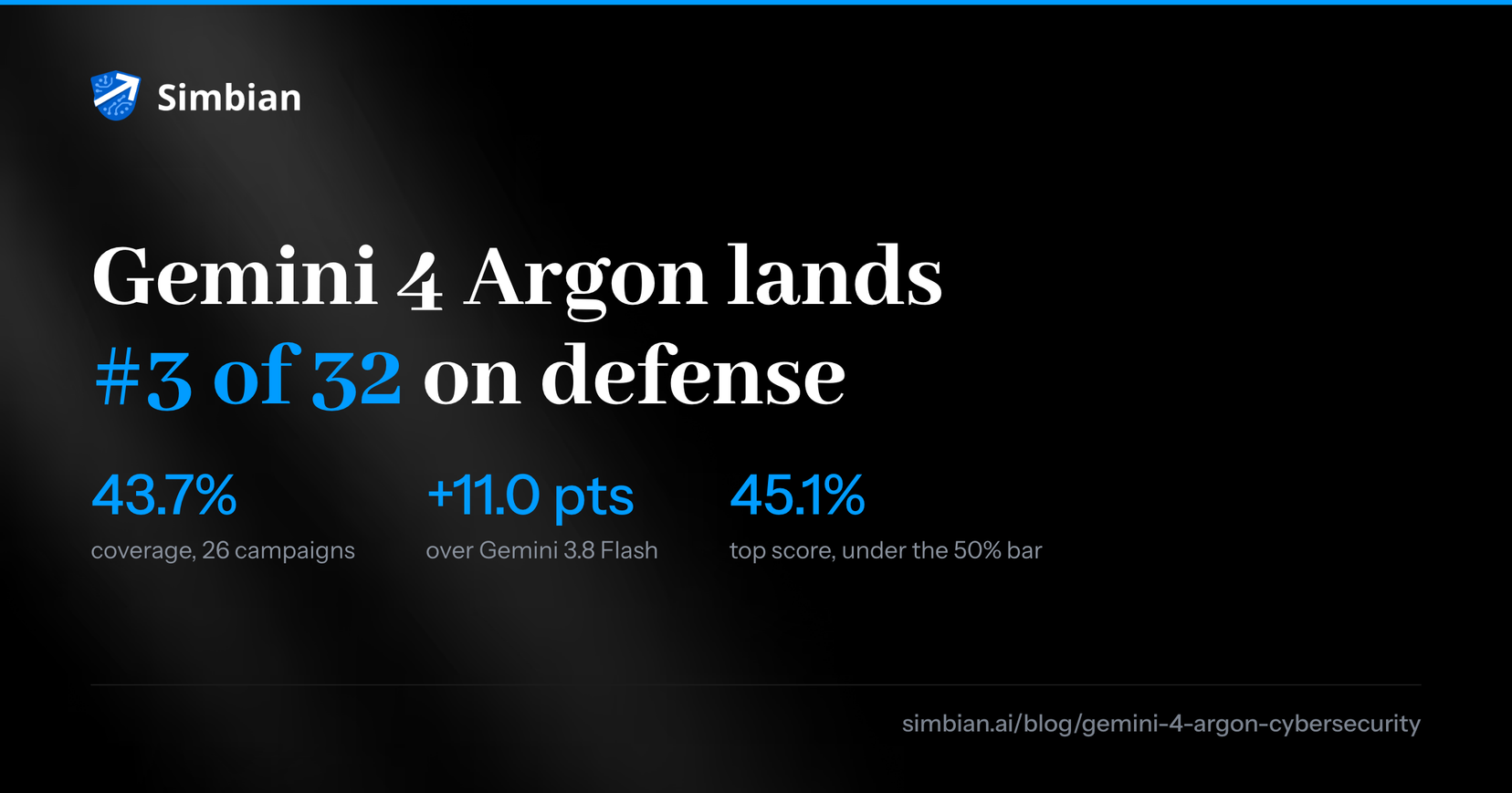
Cyber Defense Benchmark: Google Makes the Top Three
Gemini 4 Argon found 43.7% of the attack steps across our 26 real attack campaigns, ranking #3 of 32. That’s 1.4 points behind Claude Opus 5 and 11.0 points ahead of Gemini 3.8 Flash, the biggest jump between generations we’ve measured. Each hunt costs $2.88, though the model sometimes refuses without warning.
Before you pick a model for your SOC, note that none of the 32 clears the 50% pass bar, the leader included.
Shortlisting? Every Simbian Comparison Is on One Page
Your shortlist might hold an AI SOC startup, the SOAR tool you already run, and the AI your security platform vendor just added. The new compare hub covers all three categories, plus AI pentesters, in 14 side-by-side pages. Four are new this month: Palo Alto Networks, Splunk SOAR, Microsoft Security Copilot, and Myrmex. Each page says where the other vendor wins, so you can rule options out.
For Partners: Simbian Academy Is Open
Partner teams selling Simbian now have a place to get deal-ready. The sales engineer course takes 17 minutes and covers the qualifying signals, discovery questions, and objections they’ll meet on a deal. Every course is self-paced: an Essentials course for each role, then an introduction to the AI SOC Agent or the AI Pentest Agent. Each one ends in a certificate in their name.
Five stories that caught our attention in October.
1. Three Ivanti VPN zero-days, chained to root: A clean integrity check won’t clear an Ivanti Connect Secure appliance. Volexity caught an attacker it tracks as UTA0576 chaining three zero-days to run commands as root without logging in, on an appliance The Hacker News reports was fully patched at 22.8R2.4. Exploitation began October 3. CISA warns the Integrity Checker Tool may miss it "because threat actor commands execute in memory," and one of the three flaws was unpatched when the story ran. Source
2. Attackers ran an AI pentest tool through ConnectWise into Microsoft 365: If ConnectWise connects to your tenant, check its app credentials. Microsoft says a group it tracks as Storm-0940 used the open-source framework Artex to target more than 300 accounts across eight organizations "at a pace of more than 2,900 attempts per minute," and tried to sign in to more than 2,250 tenants. Its route in was compromised ConnectWise app credentials, which the attackers changed to keep access after remediation. Source
3. An AI Agent that hijacks exposed LLM endpoints: Symantec captured Skynet, an offensive AI Agent that runs on LLM endpoints left open to the internet, so their owners pay for its compute. It carries 74 tool definitions, from FOFA scanning to exploits for Laravel, Next.js, Django, and Jupyter, and was built to run for up to 100,000 steps without human approval. Symantec’s honeypot logged more than 127,000 requests from it. Source
4. LiteLLM poisoned on PyPI and Docker: If you installed LiteLLM 1.107.0, roll back to 1.106.2 and rotate your keys. The malicious release was live for roughly three hours on October 21. That was enough for an estimated 49,000 downloads. Attackers got in with GitHub OAuth tokens taken from an internal LiteLLM deployment left exposed to the internet. The payload steals cloud secrets, AI API keys, and SSH keys, and Wiz saw stolen credentials in use about 4.5 hours later. Source
5. Patch Tuesday passes 1,400 fixes: Patch CVE-2026-96951 first. It’s a Mark-of-the-Web bypass in Windows Shell (CVSS 8.8), already exploited and on CISA’s Known Exploited Vulnerabilities list. Microsoft counts 1,413 CVEs in its October release, 1,102 of them in Windows. "This month alone, Microsoft patched more vulnerabilities than it did in all of 2025," SecurityWeek notes. Source



Simbian AI, 809 Cuesta Dr Suite B # 104, Mountain View, CA, 94040, United States, +1 650-695-0740