Loading...
New
See what manual alert triage really costs your security team.
New
See what manual alert triage really costs your security team.

See what manual alert triage really costs your security team.
See what manual alert triage really costs your security team.
Loading...
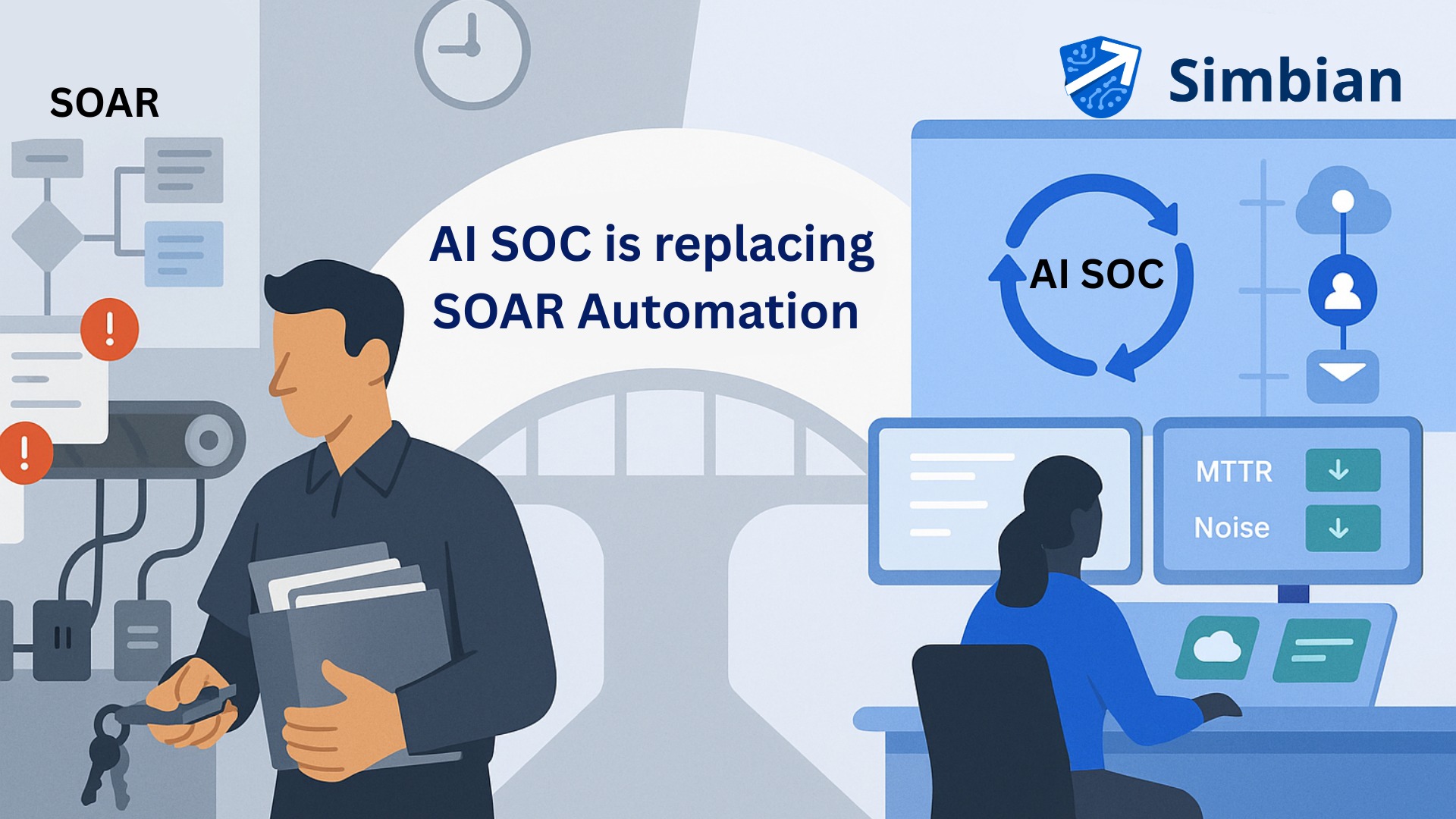
SOAR automates what you predefine. AI SOC reasons through what you didn't. They both try to solve the same problem of automating security operations, but take fundamentally different approaches to do so. Confusing the two is how security teams end up with 100+ playbooks, yet still can’t get to 40% of their alerts.
A CISO approves a budget line for " AI-powered SOC automation." The vendor demos a SOAR platform with a GPT-based assistant that summarizes alerts or suggests playbook steps. The team buys it. Six months later, they still have 100+ playbooks to maintain, analysts are still spending 70 minutes per alert, and 40% of alerts still go uninvestigated.
What happened? They added an electric motor to a gas car. The fundamental architecture underneath didn't change.
This is one of the most consequential misunderstandings in security operations today: the belief that AI features on a SOAR platform produce an AI SOC.
SOAR (Security Orchestration, Automation, and Response) is a platform that automates predefined incident response workflows through playbooks — IF/THEN logic chains that trigger specific actions when specific conditions are met.
AI SOC, by contrast, is a reasoning-based architecture. Instead of executing pre-written logic, it evaluates context, correlates signals across data sources, applies business-aware judgment, and determines the appropriate response, with or without a playbook to reference.
The distinction between SOAR and AI SOC is not a feature debate. It's an architectural one.
SOAR platforms are fundamentally structured as decision trees: IF [trigger condition] THEN [execute action A]. This works for high-volume, low-complexity tasks such as password resets, known-hash blocking, and duplicate deduplication. The problem is that modern threat scenarios don't follow a script. What happens when:
In this and other cases, SOAR automation stalls, misfires, and/or escalates to a human, because it can only react to what was anticipated when it was written. Security teams compensate by writing more playbooks. That is how organizations end up managing 100+ playbooks.
A true AI SOC doesn't ask "Does this match a rule?" It asks: "What is actually happening here, and what is the right response given everything I know?"
This reasoning capability allows AI SOC to:
The underlying engines are not rule processors. They are large language models trained on security operations data, augmented with enterprise-specific context, and constrained by organizational guardrails. The result is an investigation quality that adapts rather than breaks.
Many vendors have responded by adding LLM capabilities to SOAR platforms, such as chat interfaces, alert summaries, and suggested playbook steps. This is progress, but it does not close the architectural gap. A single LLM integrated into a SOAR platform inherits that platform's fundamental constraint. It can suggest better answers, but it's still operating inside a workflow designed for deterministic, rule-based execution.
An effective AI SOC Agent use a multi-model architecture — multiple specialized AI "workers" that cross-check each other's outputs before a decision is made. Think of it as a peer review process built into the system itself:
This architecture directly addresses the hallucination problem. You don't evaluate AI effectiveness by fearing potential errors; you evaluate it by whether the system's architecture systematically reduces them.
Single-LLM SOAR add-ons cannot do this. At enterprise scale, this distinction matters enormously.
This is the question every security team asks once they understand the architecture gap. The answer is: no, not immediately.
Let existing playbooks run to renewal. Don't disrupt what's working. As workflows come up for review during tool renewals or process audits, migrate them to AI reasoning rather than rewriting them.
Start parallel operations for a single alert category. Run both SOAR and AI SOC on the same alert type (e.g., phishing) for 2–4 weeks. Compare analyst approval rate, time from detection to response, false positives, and analyst time. Data beats debate.
Sunset playbooks as AI SOC proves coverage. Track which playbooks AI SOC has effectively replaced. Remove them from active maintenance one by one. Your playbook count will trend toward zero over 6–12 months.
Dimension | SOAR | AI SOC |
Core logic | IF/THEN playbooks | Reasoning engines |
Handles novel threats | No — stalls or misfires | Yes — adapts without new playbooks |
Playbook requirement | 100+ and growing | Zero |
Business context | None (rules only) | Built-in enterprise context |
Integration requirement | Custom connectors per tool | Works with existing stack |
Deployment to production | 3–6 months | 1 week |
Hallucination control | N/A | Multi-model peer review |
Autonomous alert resolution | ~25% | 90% |
Alert coverage | ~60% / work hours | 100% / 24×7 |
One of the most persistent objections to AI SOC is: "AI doesn't understand our business context the way our analysts do."
This was a legitimate concern in 2022. It isn't in 2026. Modern AI SOC platforms build Enterprise Context — a continuously updated knowledge base derived from four sources:
The result: an AI SOC that understands why the CFO's login from an unfamiliar country at 2 AM is different from a contractor's login under the same conditions. It knows which assets are crown jewels and which "suspicious" activities are actually authorized. Critically, AI SOC learns this organizational context faster than a new human hire — and without the risk of knowledge loss when experienced analysts leave. This is the gap no SOAR playbook can bridge, because playbooks are instructions. They don't learn. They don't carry institutional memory forward.
Access our AI SOC Buyer's Scorecard to know the best way to evaluate AI SOC vendors.