Loading...
New
See what manual alert triage really costs your security team.
New
See what manual alert triage really costs your security team.

See what manual alert triage really costs your security team.
See what manual alert triage really costs your security team.
Loading...
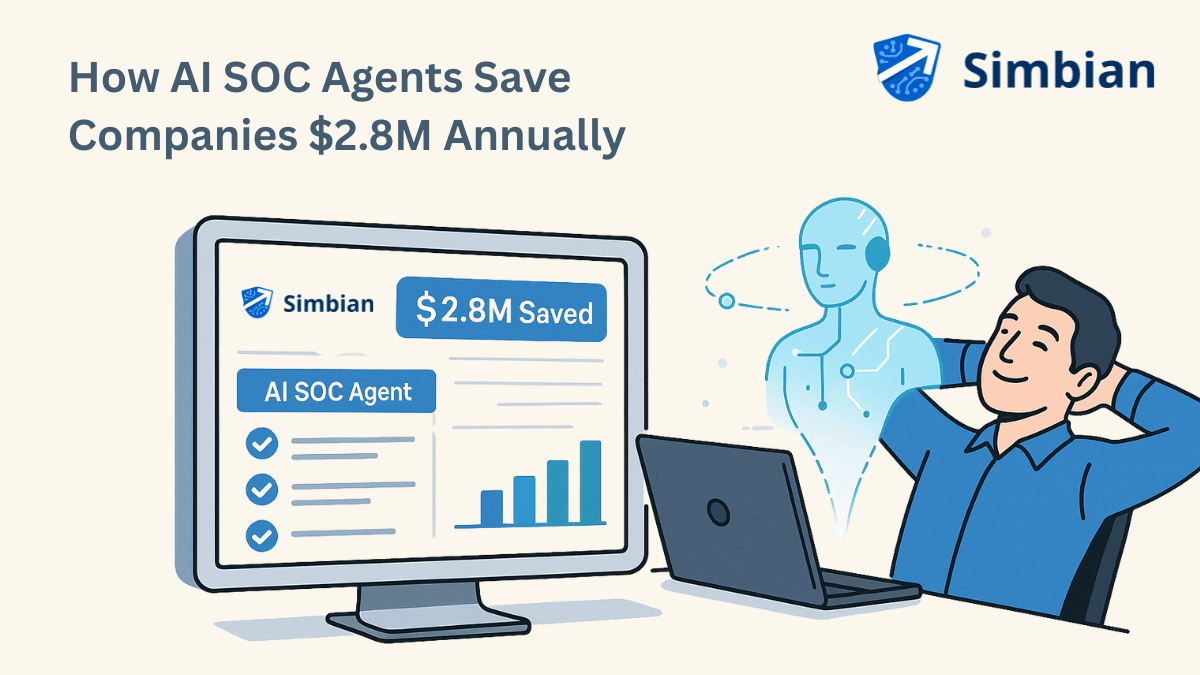
An AI SOC pays for itself when it removes the hires, playbooks, and outside services you would otherwise buy to keep pace with alert volume. Modelled for an 8-analyst SOC working 4,000 alerts a month, Simbian saves $2.65M over three years at list price and pays back in eight months, with breach-cost savings left out of the number entirely.
Most AI SOC ROI claims are a single large figure with nothing underneath it. The figures below come from the same model that powers our cybersecurity ROI calculator, at a reference profile you can change, so every number here can be reproduced and every assumption behind it can be checked.
Eight analysts at a loaded cost of $165,000 a year is $1.32M before anything else is counted. Add 1,000 escalations a month to a four-person incident response team, a $150,000 SOAR licence with 60 playbooks to maintain, 22 hunts a month, and 10 web applications tested once a year by an outside firm, and the first year costs $1.54M.
The number that moves the case is growth. At 20% more alerts a year, the same queue needs 11 additional hires by year three, and the third year costs $2.52M. Nobody budgets for that line, so it arrives as a backlog instead: 600 alerts a day and a team that only gets to a quarter of them.
The model keeps your team in place and counts what you no longer have to buy. Over three years at list price:
Together that is $2.65M over three years against a total cost of $6.02M without Simbian. Payback lands in month eight, after the first annual payment, never in month one.
Breach costs are excluded. The model can include an expected breach-loss reduction, and in the deal-desk version it adds roughly a third to the headline. It is off in every public figure because a probabilistic avoided-loss number inside a cash number is the thing a CFO discounts hardest. Everything above is an operating cost you already pay today.
Headcount reduction is also not in the model. Your analysts keep containment authority and approve every proposed response. 95% of the responses Simbian proposes are approved by the customer's own analysts. Their call, not ours.
Four calculations, all of which the calculator shows:
Capacity. Each analyst has 1,400 productive hours a year at 80% target utilisation. Alerts multiplied by minutes per alert gives the analysts the queue needs today, and the hires it needs as volume grows.
Improvement curve. Simbian starts by investigating 70% of alerts to a verdict and reaches 85% as it learns your environment. Analyst context notes shorten that curve: at ten notes a week the model reaches 90% of the ceiling in about three and a half months instead of seven.
Residual work. Verdicts arrive with evidence, so review time per alert halves, and 10% of investigated alerts still get a human QA pass.
Payback. Hires land in the month the queue needs them and Simbian bills annually in advance. Payback is the first month cumulative net value turns positive.
The reference profile is a starting point. Change the analyst count, alert volume, loaded cost, hunts, and outside pentest fees to your own, and the three-year figure, payback month, and hours returned move with them. When you want the defaults replaced with readings from your own stack, Book a Demo and we build the case with you.
Q: What is the ROI of an AI SOC? Modelled for an 8-analyst SOC working 4,000 alerts a month, Simbian saves $2.65M over three years at list price against $6.02M of hiring, playbooks, hunts, and outside tests, and pays back in eight months. Breach-cost savings are excluded from that figure.
Q: Does an AI SOC reduce headcount? No. The model keeps your current team and counts the hires you would otherwise need to keep pace with 20% annual alert growth: 11 by year three without Simbian, two with it. Analysts keep containment authority and approve every proposed response.
Q: How do I calculate ROI for my own SOC? Use the cybersecurity ROI calculator linked above. It asks eleven questions, analysts, loaded cost, alerts, minutes per alert, escalations, hunts, hunter hours, applications, outside tests and their fee, and shows every default it uses for the rest.