Loading...
New
See what manual alert triage really costs your security team.
New
See what manual alert triage really costs your security team.

See what manual alert triage really costs your security team.
See what manual alert triage really costs your security team.
Loading...
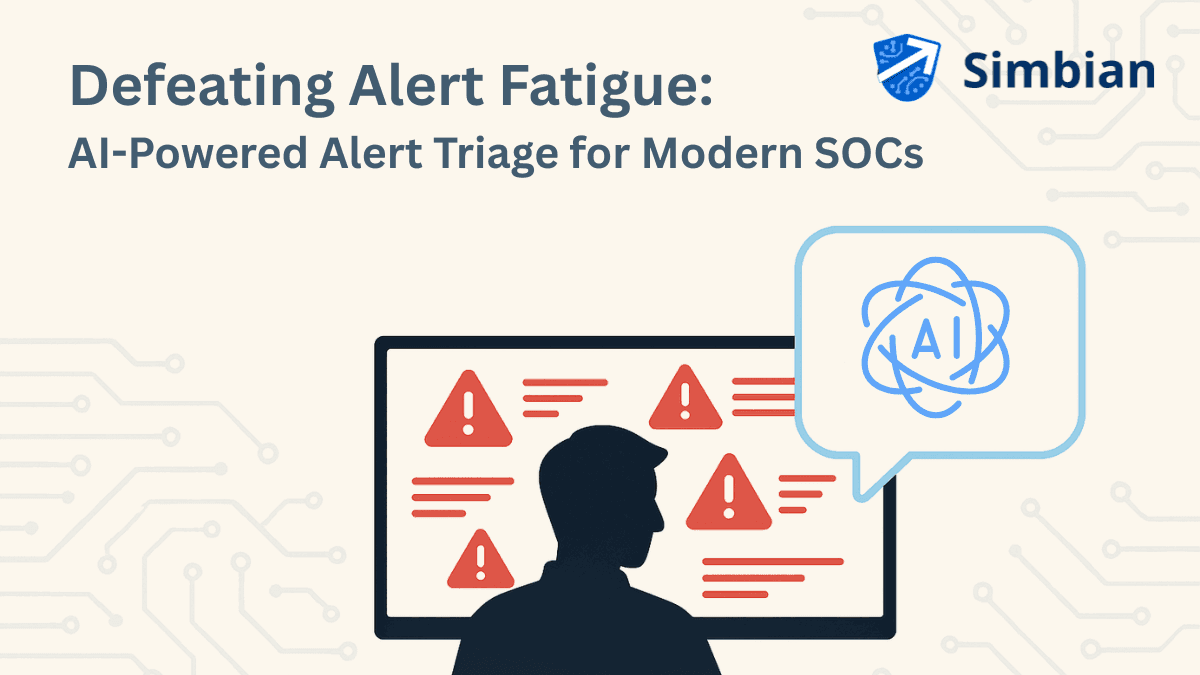
Alert fatigue is not a productivity problem. It is a detection problem dressed up as one. When an analyst clicks through a thousand notifications a day, the ninety-ninth medium-severity ticket doesn't get less attention than the first. It gets none. That is the failure mode modern SOCs quietly ship every shift, and it is what AI-powered alert triage has to fix before anything else in the security operations stack matters.
Most SOCs today generate more signal than any human roster can absorb. Industry surveys peg the average enterprise queue at notifications a day, and roughly 40% of security alerts go uninvestigated on average (market stat — not Simbian-sourced). The analysts staring at those queues aren't lazy. They are rationing attention, and the rationing itself becomes the vulnerability.
The human cost lands hardest on the people you can least afford to lose. Senior analysts who joined to hunt threats now spend their shifts closing tickets that should never have reached them. Burnout follows, then attrition, then a hiring cycle that resets institutional knowledge to zero. The "boy who cried wolf" analogy is comforting because it puts the blame on the alerts. The real story is that the queue trained your team to distrust their own tools.
Alert triage is the first decision every SOC makes on every signal: does this matter, does it matter now, and who owns the next step? Traditional workflows lean on a linear sequence — initial assessment, context gathering, validation, prioritization, response — and each hop costs time an analyst doesn't have. Skip a hop and you miss context. Slow down and the queue eats you.
Effective triage forces analysts to answer three questions in under a minute: what is the asset, what is the blast radius, and what does the rest of the environment say about this signal right now? Without a consistent answer, SOCs either over-react to noise or under-react to genuine threats. Neither outcome shows up in a quarterly report until it shows up in an incident review.
An AI SOC investigates every alert the moment it lands, not the moment an analyst gets to it. That is the whole shift. Machine learning correlates the signal against historical incidents, user behavior, and threat intelligence in seconds, and the reasoning is written down so a human can audit it. The point isn't to hide analysts from the queue. The point is to hand them a queue where every ticket already carries its verdict and its evidence.
This is where agentic AI earns its keep in the SOC. An agentic AI system doesn't just score an alert; it pulls the surrounding logs, checks the user's recent activity, confirms whether the endpoint is patched, and stitches the answer into one investigation record. Simbian's AI SOC Agent runs this loop on every alert — no playbook maintenance, no tuning shelf-life — and hands the analyst a verdict with the trace of how it got there. The result is soc ai that behaves like a senior analyst on a good day, at machine speed, without the burnout curve.
Rolling this out without breaking the SOC takes discipline. Start with clean data sources and a documented baseline: current alert volume, false positive rate, mean time to conclusion. If you cannot measure the "before" honestly, you will not be able to defend the "after" to a CFO.
Then phase the automation. Pilot on a single alert category — cloud identity, EDR, phishing triage — with human review on every closed ticket for the first two weeks. Watch the disagreement rate. If the agent and the analyst agree on 90%+ of dispositions, expand scope. If they don't, the fix is upstream in the data, not in the model.
Smart prioritization uses more than severity. Asset value, kill-chain stage, exposure to the internet, and correlated activity on adjacent identities all factor into the score. The goal is not to eliminate human judgment. It is to make sure human judgment is spent on the 5% of alerts where judgment actually changes the outcome.
Mean Time to Detect (MTTD) and Mean Time to Respond (MTTR) still matter, but they miss the middle. Mean Time to Conclusion (MTTC) captures the full arc from ingestion to disposition and is the metric that tells you whether triage is working end-to-end. Pair MTTC with analyst-hours-per-closed-alert and false-negative rate on red-team exercises. Three numbers, one story.
The next wave of alert triage looks less like a smarter dashboard and more like an investigator that never sleeps. Behavioral analytics will flag identity anomalies before the SIEM does. Natural language interfaces will let a tier-two analyst ask "show me every alert on this user in the last 90 days that touched a domain admin" and get a real answer in seconds. Detection engineering will lean on the same agentic AI to write and validate rules against the last cycle's misses.
Simbian's approach here is self-improving, not self-driving. Humans keep containment authority and escalation calls. Agents act; humans steer. Every closed alert is a labeled example the next cycle learns from, which is why coverage compounds instead of drifting.
The organizations that fix triage first fix everything else downstream. Detection engineering gets sharper because the feedback loop is faster. Threat hunting gets more time because the queue is clean. Response gets more decisive because the evidence is already in the ticket. Alert fatigue doesn't get "managed." It gets removed as a design constraint. That is the honest promise of ai soc done right — and the reason the next incident review looks different from the last.
Q: What is AI alert triage? AI alert triage is the use of agentic AI and machine learning to evaluate every security alert the moment it lands — enriching it with context, scoring it against historical incidents and threat intelligence, and handing analysts a verdict with the reasoning trace. It replaces manual, queue-based prioritization with machine-speed investigation on 100% of alerts.
Q: How does AI reduce alert fatigue in a SOC? By investigating every alert autonomously — no queue, no playbooks — an AI SOC removes the ration-attention failure mode. Analysts see only the alerts where their judgment changes the outcome, which typically cuts noise volume dramatically and returns senior analysts to threat hunting and detection engineering work.